The Heraldry Society, shield

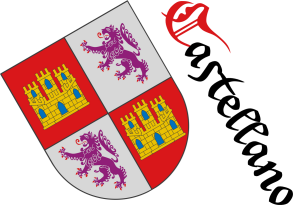
Quarterly Azure and Gules; overall a leopard face, crowned Or, langued Gules, within a tressure flory Or.
Escudo cuartelado de azur y gules; brochante sobre el todo, una cabeza de leopardo coronada de oro, lampasada de gules, dentro de un trechor flordelisado de oro.
Interpretation I have made: as a pointed shield; with its quarters enamelled in plain Azure and Gules; its tressure flory and its leopard face outlined in Sable, shaded and illuminated in Or with the tongue in Gules; and the whole with a beaten metal finish.
In its own publication [The Heraldry Society; 2013; página 6] the blazon is written as «Quarterly Azure and Gules a Lion's Face crowned with an Ancient Crown Or within a Tressure flory on the outer edge of the same» where:
- they specify the crown as «Ancient Crown»,
- they use the term «flory» ~ «fleury»,
- they assume the tongue is Gules,
- in some interpretations they assume the eyes are Sable, one would say enkindled Sable, initially I also illuminated the eyes in Sable, but currently I paint them in Or as I believe they should be, and
- finally for the «trechor» ~ «tressure» they clarify it is on the outer edge «on the outer edge» and that its tincture is «of the same» ~ «de lo mismo» as the leopard face, that is the metal Or.
Blazon keywords: Quarterly, Azure, Gules, Overall, Head, Leopard, Crowned, Or, Langued, Within, Tressure and Flory.
Style keywords: Pointed, Illuminated, Outlined in sable, Shaded and Metal beaten.
Classification: Interpreted, Socioeconomic and Coat of arms.
Bearer: The Heraldry Society.

The Heraldry Society, my arms

Quarterly: 1 Sable, an «o» Or; 2 and 3 Or, two Wolves passant, in pale Sable; 4 Sable, an «XI» Or. Crest: Upon a helm, with a wreath Or and Sable, a cross of Burgundy Gules, charged with three open books Argent, 1 and 2, leathered Sable, inner Gules, garnished Or, charged with twelve numbers «100 100 111 110 011 000 011 001 001 001 011 11» Azure, two in each page. Mantling: Sable doubled Or. Motto: «In principio erat Verbum» Argent over a scroll Azure, fimbriated Or.
Escudo cuartelado: 1o de sable, una «o» de oro; 2o y 3o de oro, dos lobos pasantes, en palo de sable; 4o de sable, un «XI» romano de oro. Timbrado de un yelmo, adornado de dos lambrequines de sable doblados oro, un burelete de oro y sable, cimado de una cruz de Borgoña de gules, cargada de tres libros abiertos de plata, 1 y 2, de tapas de sable, guardas de gules, filos de oro, cargados de doce números «100 100 111 110 011 000 011 001 001 001 011 11» de azur, dos en cada hoja. Lema: «In principio erat Verbum» de plata sobre una filacteria de azur, perfilada de oro.
Image of one of the web pages of the members belonging to The Heraldry Society where their coats of arms are shown, in this case mine with its blazon written in English, which can be consulted at TheHeraldrySociety.com/membersarms/antoniosalmeron.htm
New website design


Categories: Technology, Socioeconomic, Created, Personal, Semi-circular, Illuminated, Outlined in the field tincture, Freehand, Quarterly, Or, Sable, One, Letter, Two, Wolf, Passant, In pale, Number, Gules, Argent, Azure, Crest and mantling, Helm, Mantling, Wreath, Crest, On, Charged, Disordered, Cross, Cross of Burgundy, Cross couped, Book, Open, Motto, Scroll and Fimbriated.
Root: The Heraldry Society.

Navarre

Escudo de gules, un carbunclo cerrado, pomelado de oro; cargado en el centro de una esmeralda en forma de losange de sinople.
Original coat of arms of Navarre interpreted with: a semicircular (round) base; the field in flat Gules; the pommetty carbuncle illuminated in Or and outlined in Sable; the emerald illuminated in Vert and also outlined in Sable; and the whole finished with a raised-stroke effect.
In the armorial [Urfé; Siglo XV; indexed on folio 151, but actually written on 142] the arms of Navarre are blazoned in French as «de gueles à l'escarboucle d'or pommelée alumée de sinoble en la moyenne en guise d'esmeraude», it only gives the blazon, since this armorial is not illustrated.
An image of the original French blazon text can be seen in the article Blazon of Navarre in the Urfé armorial.
The interpretation of the arms of Navarre shown here is based on the one illustrated in the armorial [Bosque, J. del; 1540; folio 1 of the 1613 numbering], which is its main plate, with the arms of the king of Navarre surrounded by the coats of arms of the lineages and manors of his «ricoshombres», twelve lineages in total.
In [Menéndez Pidal de Navascués, F.; 1963] one can consult his view on what is, probably, the real origin of the arms of Navarre, which he bases on:
- The existence of a defensive element of the shield called the boss, placed at its center. This element already existed in classical Rome, on the shields of the legionaries and, in addition, it could serve to keep small valuables inside.
- The later reinforcement of this boss with 8 spokes, that is, 4 diameters set vertically, horizontally, bendwise and bendwise sinister, giving rise to a radiated boss to strengthen the shield.
- This radiated boss on rich shields could be very elaborate and even be adorned with gems, thus becoming an ornamental element.
- The evolution of the radiated boss from a defensive and ornamental element to the so-called carbuncle, but now as a heraldic element with a radial structure. Originally the carbuncle was a mystical stone, comparable to the ruby, that emitted an intense light capable of illuminating the knight in the darkness of night. Heraldically the name carbuncle is used to denote a scheme of radial rays and not the marvellous stone that emitted them and from which it borrows its name.
- This eight-rayed carbuncle, joined at the ends forming a closure, like an orle, and decorated with pommels, on a field Gules, and with an emerald overall at its center is what constitutes the arms of Navarre.
Regarding the importance of the radiated boss and the carbuncle, not only in the arms of Navarre but in heraldry in general, [Menéndez Pidal de Navascués, F.; 1963] goes a step further when he writes «although it has never been pointed out, it seems evident to us the influence of this piece on the classic partitions of the shield, contained in the four diametral lines that compose it». He makes us see that «cortado, partido, tronchado y tajado» and, therefore also, «cuartelado, en sotuer y jironado», do not have their origin in the different ways of striking a shield with a sword, as illustrated, for example, in [Avilés, J.; 1725a; plate 18, illustrations 23, 24, 25 and 25], but in different ways of selecting, as delimiters, the four diameters of the carbuncle.
Blazon keywords: Without divisions, Gules, One, Carbuncle, Pommelled, Or, Charged, In the fess point, Emerald, Vert and Lozenge.
Style keywords: Freehand, Illuminated and Outlined in sable.
Classification: Interpreted, Civic and Coat of arms.
Bearer: Navarre.
Navarra, closed carbuncle

Escudo de gules, un carbunclo cerrado, pomelado de oro; cargado en el centro de una esmeralda en forma de losange de sinople.
Coat of arms interpreted with: a semicircular (round) base; the field in flat Gules; the pommetty carbuncle and the emerald illuminated in Or and Vert, shaded and outlined in Sable; and the whole finished in lightly-hammered metal.
In addition to historical documents such as the armorials [Urfé; 15th century] which blazons it and [Bosque, J. del; 1540] which illustrates it, there is, in the last half century, an abundant bibliography on the arms of Navarre, for example: [Menéndez Pidal de Navascués, F.; 1963], [Menéndez Pidal de Navascués, F.; 1974], [Martinena Ruiz, J. J.; 1982], [Menéndez Pidal de Navascués, F.; 1999], [Menéndez Pidal de Navascués, F.; Martínez de Aguirre, J.; 2000], [Martinena Ruiz, J. J.; Menéndez Pidal de Navascués, F.; 2001] and [Martínez de Aguirre, J.; 2007].
This pommetty shield can also be seen, for example, on the outer façade of the convent of Santo Domingo in Estella, on capitals preserved in the Cathedral of Tudela and on capitals of the church of Santa María la Real of Laguardia, the latter dating from the 14th century.
Blazon keywords: Without divisions, Gules, One, Carbuncle, Pommelled, Or, Charged, In the fess point, Emerald, Vert and Lozenge.
Style keywords: Soft metal, Illuminated, Outlined in sable and Shaded.
Classification: Interpreted, Civic and Coat of arms.
Bearer: Navarre.
Blasón de Navarra en el armorial Urfé

Escudo de gules, un carbunclo cerrado, pomelado de oro; cargado en el centro de una esmeralda en forma de losange de sinople.
The armorial [Urfé; 15th century] contains only blazons written in French and is not decorated with shields.
The image shows my interpretation of the arms and, beneath it, the blazon of the king of Navarre as follows «Le Roy de Navarre... de gueles à l'escarboucle d'or pommelée alumée de sinoble en la moyenne en guise d'esmeraude» which could be translated as «The King of Navarre... Gules, a carbuncle Or pommetty, illuminated Vert in the middle in the manner of an emerald».
Note that the blazon does not suggest the presence of an emerald, but that the place corresponding to the central boss of the shield, from which the rays of the carbuncle emerge, is enamelled Vert.
In the article Universitas Studiorum Navarrensis about the arms of the University of Navarre I interpret the arms of Navarre borne in profile by the Archangel Saint Michael, which, by my way of painting it, lies halfway between the carbuncle and the chains, with round chain links and long carbuncle rays, where at the centre there is no emerald, but a Vert enamel in the manner of an emerald.
Blazon keywords: Without divisions, Gules, One, Carbuncle, Pommelled, Or, Charged, In the fess point, Emerald, Vert and Lozenge.
Style keywords: Soft metal, Illuminated, Outlined in sable and Shaded.
Classification: Interpreted, Civic and Coat of arms.
Bearer: Navarre.
Navarra, chains Or

Gules, a chain orlewise, crosswise, and saltirewise Or, charged in the fess point with an emerald Vert.
Escudo gules, una cadena puesta en orla, en cruz y en sotuer de oro, cargada en el centro de una esmeralda de sinople.
Coat of arms interpreted with: a semicircular (round) base; the field in flat Gules; the chains and the emerald illuminated in Or and Vert and outlined in Sable; and the whole executed with a raised-stroke finish.
This coat of arms, except for the emerald, corresponds to the blazon written in [Avilés, J.; 1780a; page 412 and figure 260] which says «Gules, a chain placed in orle, cross, and saltire Or, which some blazon differently», leaving me, as a reader, curious to know what that other way he refers to might be.
Then, [Avilés, J.; 1780a; pages 412–413] writes his version of the origin of the arms, saying that «...it was borne by Sancho VIII, called the Strong, and twenty-first King of Navarre, in the year 1212, for the battle of Las Navas de Tolosa in Sierra Morena ...given to him by the King of Castile, Don Alfonso IX, whose aid he had joined...», which we would say Alfonso VIII of Castile, «the one of Las Navas».
Blazon keywords: Without divisions, Gules, One, Chain, Orlewise, Crosswise, Saltirewise, Or, Charged, In the fess point, Emerald and Vert.
Style keywords: Freehand, Illuminated and Outlined in sable.
Classification: Interpreted, Civic and Coat of arms.
Bearer: Navarre.
Navarra, emerald overall

Gules, a chain orlewise, crosswise, and saltirewise Or, charged in the fess point with an emerald Vert.
Escudo gules, una cadena puesta en orla, en cruz y en sotuer de oro, cargada en el centro de una esmeralda de sinople.
Current coat of arms of Navarre interpreted with: the point of the shield in the shape of a semicircular (round) arch; its field enamelled in flat Gules; the chains, formed by round and elongated links, illuminated in Or and shaded by the light emitted by the emerald; the emerald illuminated in Vert; and the whole outlined in Sable and finished with a hammered-metal effect.
Unlike other ways of blazoning it, I like the emerald to be overall. I truly believe it is better that the emerald of Vert colour lies over the Or metal, whether of the chain or of the carbuncle, and not over the Gules field, since it avoids placing colour upon colour or metal upon metal.
It can be consulted in [Vega, P. J. de; 1702; folio XV of the manuscript].
Blazon keywords: Without divisions, Gules, One, Chain, Orlewise, Crosswise, Saltirewise, Or, Charged, In the fess point, Emerald and Vert.
Style keywords: Metal beaten, Illuminated, Outlined in sable and Shaded.
Classification: Interpreted, Civic and Coat of arms.
Bearer: Navarre.
Noblemen of Navarre

The King of Navarre, at the time of his new and solemn coronation, is raised and lifted up as King by the hands of twelve barons of the greatest and oldest houses of the said Kingdom, and these are the twelve Noblemen who are named on the other side, with their blazons and coats of arms.
Interpretation and composition of 13 coats of arms that I have created with a parchment-like finish.
A free interpretation, for example, without the central crown over the arms of Navarre, with a different title, written «Navarra» and not «Nabarra», etc., based on the principal plate of [Bosque, J. del; 1540; folio 1 of the numbering of 1613] and with texts taken from the transcription by [Martinena Ruiz, J. J.; 1982; pages 122 and 123].
«Ricohombre», written together, currently means «title that formerly belonged to the highest nobility of Spain», [Real Academia Española; 2001].
Its plural «ricoshombres» is the most commonly used form, but «ricohombres» is also correct and used; and in [Bosque, J. del; 1540] it is written separately, and «honbre» with an «n» before the «b», that is, «ricos honbres».
Blazon keywords: Without divisions, Party per bend, Azure, Gules, Or, Argent, Sable, Vert, Eagle, Chequey, Cross flory, Cross couped, Fess, Chief, Lion, Pale, Poplar leaf, Clay pot and Rampant.
Style keywords: Semi-circular and Old parchment.
Classification: Interpreted and Kingdom of Navarre.
Bearer: Noblemen of Navarre.
Continue with: Almorrabides of Navarre.
-
Language
-
Categories of heraldry
-
Divisions of the field
- Without divisions
- Party per pale
- Party per fess
- Party per bend
- Party per bend sinister
- Tierce
- Tierce sinister
- Tierced per pale
- Tierced per fess
- Tierced per bend
- Tierced pallwise inverted
- Quarterly
- Quarterly per saltire
- Gyronny
- Party per fess, the chief per pale
- Party per pale, the sinister per fess
- Party per fess, the base per pale
- Party per pale, the dexter per fess
- Chapé
- Chaussé
- Embrassé
- Contre-embrassé
- Chapé ployé
- Party per chevron
- Enté
- Enté en point
- Flanched
-
Metals
-
Colours
-
Furs
-
Other tinctures
-
Ordinaries and sub-ordinaries
-
Diminutives of the ordinaries
-
Geometric charges
-
Composite ordinaries
-
Inanimate charges from Nature
Atom, Cloud, Crescent, Decrescent, Diamond, Emerald, Estoile, Goutte, Increscent, Lightning flash, Moon, Mount, Mullet, Mullet of four points, Orbital, Plough of Ursa Major, Rainbow, Ray of the sun, River, Sea, Snowflake, Sun, Sun in splendour, Sun of May, Terrestrial globe, Trimount, Water and Wave.
-
Vegetal charges from Nature
Acorn, Apple, Apple tree, Ash, Bluebonnet, Bunch, Camellia, Chrysanthemum, Cinquefoil, Cornflower, Dogwood flower, Double rose, Easter lily, Eguzki-lore, Elm, Fleur de lis, Flower, Gourd, Grape, Holm oak, Hop cone, Indian paintbrush, Kapok tree, Laurel, Lily, Linden, Lotus flower, Madonna lily, Madrone tree, Mexican cedar tree, Mulberry tree, Oak, Olive tree, Palm tree, Plantain plant, Pomegranate, Poplar leaf, Prickly pear cactus, Rose, Scots pine, Shamrock, Sunflower, Thistle, Tree, Tulip, Vine and Wheat.
-
Animal charges from Nature
Badger, Bald eagle, Barbel, Barn owl, Bear, Beaver, Bee, Beetle, Bighorn sheep, Binson, Black grouse, Blackbird, Boar, Brach hound, Bull, Cat, Cow, Doe, Dog, Dolphin, Dove, Eagle, Elephant, Falcon, Female figure, Fish, Flame, Fly, Fox, Frog, Gazelle, Goat, Goldfinch, Goose, Heron, Horse, Hummingbird, Jaguar, Lark, Leopard, Lion, Lion passant, Lion rampant guardant, Lioness, Lynx, Male figure, Martlet, Merino ram, Monkey, Mountain bluebird, Owl, Panther, Parrot, Peacock, Pelican, Pelican in her piety, Pronghorn, Puffin, Quetzal, Raven, Roe deer, Rooster, Salamander, Savage, Seagull, Serpent, She-wolf, Stag, Starling, Swan, Talbot, Turtle, Tyger, Vulture, Warren hound and Wolf.
-
Parts of natural charges
Arm, Beak, Branch, Caboshed, Chest, Claw, Covert, Dorsal fin, Eagle claw, Ear of wheat, Ermine spot, Escallop, Feather, Foot (palmiped), Footprint, Foreleg, Forepaw, Hand, Head, Heart, Hoof, Leaf, Neck, Ostrich feather, Palm frond, Paw, Roe deer' attire, Shoulder, Sprig, Stag's attire, Stag's massacre, Stem, Swallow-tail, Tail, Tail addorsed, Tail fin, Talon, Tibia, Tooth, Trunk, Trunk (elephant), Two hands clasped, Two wings in vol, Udder, Wing and Wrist.
-
Artificial charges
Ace of spades, Adze, Anchor, Anvil, Arch, Archer, Arm vambraced, Armillary sphere, Arrow, Axe, Baton of Herald, Bell, Bell tower, Beret, Bonfire, Book, Bookmark, Bow, Branding iron, Bridge, Broken, Buckle, Cannon, Cannon dismounted, Cannon port, Canopy roof, Caravel, Carbuncle, Castle, Cauldron, Celtic Trinity knot, Celtic trefoil knot, Censer, Chain, Chess rooks, Chi-Rho symbol, Church, Clarion, Clay pot, Closed book, Club, Column, Comb, Comedy mask, Compass rose, Conductor's baton, Cord, Covered cup, Crossbow, Crossed staff, Crozier, Crucible, Cuffed, Cup, Cutlass, Cyclamor, Dagger, Displayed scroll, Double vajra, Drum, Ecclesiastical cap, Fanon, Federschwert, Flagpole, Fleam, Four crescents joined millsailwise, Full plate armor, Galician granary, Garb, Gauntlet, Geometric solid, Grenade, Halberd, Hammer, Harp, Host, Hourglass, Incense burner, Key, Key ward, Knight, Knot, Lantern, Letter, Line, Loincloth, Maunch, Menorah, Metal mortar, Millrind, Millstone, Millwheel, Minaret, Monstrance, Mortar, Mullet of six points pierced, Nail, Non-classic artifact, Norman ship, Number, Oar, Oil lamp, Open book, Page, Paintbrush, Pair of pliers, Pair of scales, Pestle, Piano, Pilgrim's staff, Plough share, Polish winged hussar, Port, Portcullis, Potent, Quill, Ribbon, Rolled scroll, Rosette of acanthus leaves, Sabre, Sackbut, Sail, Scepter, Scroll, Scythe, Sheaf of tobacco, Ship, Skirt, Spear, Spear's head, Stairway, Star of David, Step, Sword, Symbol, Tetrahedron, Torch, Tower, Tragedy mask, Trident, Trumpet, Turret, Two-handed sword, Two-man cross-cut saw, Wagon-wheel, Wall between two towers, Wall couped, Water-bouget, Wheel, Winnowing fan and With a turret.
-
Immaterial charges
Angel, Archangel, Basilisk, Dragon, Dragon's head, Garuda, Golden fleece, Griffin, Heart enflamed, Justice, Mermaid, Our Lady of Mercy, Ouroboros, Paschal lamb, Pegasus, Phoenix, Sacred Heart of Jesus, Saint George, Sea-griffin, Sea-lion, Trinity, Triton, Unicorn, Winged hand and Wyvern.
-
External elements
-
Heraldic creations
-
References
-
Formats
-
Keywords on this page
Open, Chequey, Almorrabides of Navarre, Old parchment, Pointed, Azure, Overall, Wreath, Head, Chain, Carbuncle, Charged, Crest, Crowned, Created, Cross, Cross of Burgundy, Cross couped, Quarterly, Outlined in sable, In the fess point, Coat of arms, Emerald, Personal, Gules, Illuminated, Interpreted, Lozenge, Semi-circular, Metal beaten, Soft metal, Navarre, Or, Pale, Argent, Without divisions, Civic, Pommelled, Crosswise, Orlewise, Saltirewise, Kingdom of Navarre, Sable, Vert, Socioeconomic, Shaded, The Heraldry Society, Freehand and One.