Sable


A liden supporting the arms of the Strategy Department of Consultoria.IO with motto

Azure, on waves of the sea in base Argent, a ship oars in action Or, pennant flying, and in full sail Argent; on a chief Argent, a closed book Gules, edges and clasps Or. Supporter behind the shield: A linden eradicated Sable, leaved Vert, fructed Or. Motto: «Ubi concordia ibi victoria» Sable over a scroll Or.
Escudo de azur, en punta un mar ondado de plata sumado de un barco con remos de oro, con vela y gallardete de plata; en un jefe de plata, un libro cerrado y brochado de oro, tapas de gules. Sostenido por un tilo arrancado de sable, hojado de sinople, frutado de oro acolado detrás del escudo. Lema: «Ubi concordia ibi victoria» de sable sobre una filacteria de oro.
Coat of arms devised by me, illuminated with lights and shadows, with a pointed outer contour and with a texturized finish.
The coat of arms of the Strategy Department of Consultoria.IO designed by Ignacio Perez de Bartolome and me and emblazoned by me. Consultoria.IO is a consulting firm specialized in scale-up e-commerce stores.
Design rationale
Teamwork navigating towards a common goal (lymphad with sail and oars), keeping trade secrets (book with clasps), and solidity in support and growth (linden). The motto «Ubi concordia ibi victoria» means «Where there is unity, there is victory». It conveys the idea that success arises from harmony and collaboration between the team and its clients, working together toward shared goals.
Blazon keywords: Azure, Argent, Or, Gules, Sable, Vert, One, Wavy, Sea, In base, On, Ship, Oar, Sail, Chief, Closed book, Book, Clasped, Supporter (thing), Supporter, Behind the shield, Linden, Tree, Eradicated, Leaved, Fructed, Motto and Scroll.
Style keywords: Illuminated, Pointed and Plain tincture.
Classification: Socioeconomic, Created, Boa, Coat of arms, Pennon and Flag.
Bearer: Strategy Department of Consultoria.IO.

Academia de Letras e Artes da Guiné-Bissau

Argent, a tower with a turret Gules, port and windows Argent, masoned Sable.
Escudo de plata, una torre donjonada de gules, aclarada de plata, mazonada de sable.
Arms emblazoned by me, highlighted with lights and shadows, with a semi-circular external shape and with a leather finishing.
Coat of arms of the Academia de Letras e Artes da Guiné-Bissau, ALAB, designed by Joseph Crews and emblazoned by me.
Blazon keywords: Argent, Gules, Sable, One, Tower, Turret, Port and windows and Masoned.
Style keywords: Illuminated, Semi-circular and Leather.
Classification: Socioeconomic, Interpreted, Boa and Coat of arms.
Bearer: Academia de Letras e Artes da Guiné-Bissau.
Ackerson - Akers, lineage

Ackerson and Akers lineages.
Sable, a Bend between three Acorns Or.
Illuminated and freehand finishing.
The coat of arms of Ackerson and Akers lineages emblazoned by me and extracted from [Burke, B.; 1989].
Unless the blazon specifies another layout, when a bend is between three charges, this charges are ordered, two in the chief and one in the base, as the three acorns do in this case.
[Rietstap, J. B.; 1861] escribe el blasón de «Ackers ou Akers» como «de sable, à une bande d'or, acc. de trois glands du mesme».
Blazon keywords: Sable, Bend, Between, Three, Acorn, Or and Ordered.
Style keywords: Freehand, Outlined in sable and Illuminated.
Classification: Interpreted.

Ackhurst, lineage

Ackhurst lineage.
Argent, on a Bend Sable three Acorns Or.
Illuminated and freehand finishing.
The coat of arms of Ackhurst lineage emblazoned by me and extracted from [Burke, B.; 1989].
Unless the blazon specifies another direction, the charges in a bend follow the direction of their bend, as the acorns do in this case.
Blazon keywords: Argent, Bend, Sable, Three, Acorn, Or and Bendwise.
Style keywords: Freehand, Outlined in sable and Illuminated.
Classification: Interpreted.
Adams, A.; 1941

Arthur Adams, PhD, F. S. A., «Cheshire Visitation Pedigrees, 1663», 141 pages, edited by J. Whitehead and Son Limited, series Publications of the Harleian Society, volume 93, London, 1941.
This book includes some illustrations, but in black and white. The coat of arms that illustrates this bibliographic reference is a color interpretation of one of those recorded in this book, based on the recreations by Martin S. J. Goldstraw. It specifically corresponds to the coat of arms of Allen de Brindley, with the difference that here its crest is not included.
Bibliographical reference of century XX.
The author is Adams, Arthur.
The following articles cite this bibliographic reference:
Alarcon of Cantabria, lineage

Gules, a cross flory voided Or; within a bordure Gules with eight saltires couped Or.
Escudo de gules, una cruz hueca flordelisada de oro; bordura de gules, ocho sotueres de oro.
Coat of arms painted by me, highlighted with lights and shadows, outlined in Sable, with a semi-circular external shape and with a freehand finishing.
Ancient arms of Alarcon of Cantabria emblazoned by me.
Blazon keywords: Argent, Sable, Or, Gules, Three, Cross, Flory, Voided, Bordure, Saltire and Couped.
Style keywords: Outlined in sable, Illuminated, Semi-circular and Freehand.
Classification: Personal, Interpreted, Boa and Coat of arms.
Bearer: Alarcon of Cantabria, lineage.
Alborán, Sea of

Party per fess: 1 Sable, three mullets of eight points Argent, 1 and 2; 2 Azure, three anchors Or, 2 and 1.
Escudo cortado: 1o de sable, tres estrellas de plata de ocho puntas, 1 y 2; 2o de azur, tres anclas de oro, 2 y 1.
Coat of arms designed by me, illuminated with lights and shadows, outlined in Sable, with a semi-circular outer contour and with a watercolor finish.
Blazon keywords: Sable, Argent, Azure, Or, Three, Party per fess, Mullet, Disordered, Anchor and Ordered.
Style keywords: Outlined in sable, Illuminated, Semi-circular and Watercolor.
Classification: Imaginary, Created, Boa and Coat of arms.
Imaginary bearer: Alborán, Sea of.
Alea Capital

Party per pale Sable and Or, two griffins' heads eraticted, and addorsed counterchanged.
Escudo partido de sable y oro, dos cabezas de grifo arrancadas y adosadas del uno en el otro.
Coat of arms emblazoned by me with a semi-circular shape, illuminated, and with a freehand finishing.
Blazon keywords: Party per pale, Sable, Or, Two, Head, Griffin, Erased, Addorsed and Counterchanged (side-by-side).
Style keywords: Outlined in sable, Semi-circular, Illuminated and Freehand.
Classification: Socioeconomic, Created and Coat of arms.
Bearer: Alea Capital.
Alfonso VIII of Castile, royal crown

King of Castile from 1158 to 1214.
Gules, a castle triple towered Or, port and windows Azure, masoned Sable. Crest: An open royal crown Or.
Escudo de gules, un castillo de oro, aclarado de azur, mazonado de sable. Timbrado de una corona real abierta.
Arms of the king, as interpreted by me, as follows: the shield's shape is pointed and rounded; the field is enameled Gules; the castle is outlined in Sable; and the whole composition features a watercolor finish.
In [Valero de Bernabé, L.; 2009a; page 1] the author specifies the main characteristics of the «Castilian royal castle», which can be summarized as: «with three towers, the middle one taller, and the two flanking it identical», «each tower crowned with three battlements», «one to three doors and one or two pointed windows on each tower», and «masoned and battlemented», as also noted by the same author in [Valero de Bernabé, L.; 2009b; page 33].
Blazon keywords: Without divisions, Gules, Or, Azure, Sable, One, Castle, Port and windows, Masoned, Crest, Open royal crown and Crown.
Style keywords: Ogee, Plain tincture, Outlined in sable and Watercolor.
Classification: Interpreted, Personal, Coat of arms and Kingdom of Castile.
Bearer: Alfonso VIII of Castile.
Alfonso X of Castile; 1265

Alfonso X of Castile, The Wise, «The Seven-Part Code», its estimated completion year is 1265.
This is the copy I can consult, as it is available in the Hispanic Digital Library, it is a manuscript measuring 42 by 30 centimeters that once belonged to Álvaro de Zúñiga y Guzmán, first Duke of Arévalo, which later came into the possession of the Catholic Monarchs, initially Queen Isabella I of Castile, and after her death, King Ferdinand reclaimed it for the price of 5,251 maravedis. The original is housed in the National Library, in display case 4/6.
This copy, in addition to its numerous capital letters, has 8 illustrated pages, which according to its subsequent hand-numbering in pencil are:
- Page 6, among its illustrations can be seen 2 coats of arms of the Zúñiga family «Argent, a bend Sable, over all, a chain in orle Or», in this case formed by 16 links, 8 round and 8 more elongated placed in profile.
- Pages 106 and 191, on the latter can be seen a curious bishop-lizard climbing.
- Pages 294 and 331, on the 2nd at the bottom, a maiden is seen walking a monkey to relieve itself and to her right a fight of men with beast bodies.
- Page 379 and on its previous unnumbered page, and finally, on page 415 which begins with a tournament where the 2nd knight bears the ancient arms of France «Azure, semy of fleurs de lis Or».
The coat of arms that illustrates this bibliographic reference is that of Álvaro de Zúñiga y Guzmán. For the creation of his chain, I followed the illustration of his 2 coats of arms on the already mentioned page 6 of this manuscript.

It is one of my favorite manuscripts and, perhaps, the one with which I have created the most things.
Bibliographical reference of century XIII.
Classification: Castilian language, Manuscript and In color.
The author is Alfonso X of Castile.
The following article cites this bibliographic reference:
External links:
- National Library of Spain.
- Indirect access to the Library of Congress of the United States of America.
- Direct access to the Library of Congress of the United States of America.
Internal resources: AlfonsoXDeCastilla1265.7Partidas.10642.pdf.
Alfonso X the Wise

Quarterly: 1 and 4 Gules, a castle triple-towered Or, port and windows Azure, and masoned Sable; 2 and 3 Argent, a lion rampant Purpure, armed and langued Gules.
Coat of arms depicted by me, illuminated with lights and shadows, contoured in Sable, with an ogee external shape and with a freehand finishing.
Coat of arms of the King Alfonso X of Castile, 1221–1284, 1st son of the King Ferdinand III of Castile, 1199-1252, and the Queen Beatrice of Swabia, 1205–1235. The order of the quarters is first the castle of his grandmother, Queen Berenguela of Castile, and second the lion of his grandfather, King Alfonso IX of León; however, the other day I discovered that on the map by [Martineau du Plessis, D.; 1700; volume II, illustration 30, page 126], in the shield framed between parallels 37 and 36 and meridians 21 and 22, the lion occupies the 1st quarter and the castle the 2nd quarter; that is, their order appears reversed.
Blazon keywords: Gules, Or, Azure, Sable, Argent, Purpure, One, Quarterly, Castle, Triple-towered, Port and windows, Masoned, Lion, Rampant, Armed and Langued.
Style keywords: Outlined in sable, Illuminated, Ogee and Freehand.
Classification: Personal, Kingdom of Castile and Leon, Interpreted, Boa and Coat of arms.
Bearer: Alfonso X of Castile.
Allen de Brindley

County of Cheshire, visitation of 1663.
Party per bend sinister: 1 Or, three martlets Sable; 2 Sable, three martlets Or.
Escudo tajado: 1o de oro, tres marletas de sable; 2o de sable, tres marletas de oro.
Coat of arms interpreted with: a rounded base; the field illuminated in Or and Sable; the martlets outlined of the field and illuminated in Sable and Or; and the whole with a leather finish.
A coat of arms recorded in [Adams, A.; 1941] which Cheshire Heraldry blazons as follows: «Per bend sinister Or and Sable, six martlets counterchanged», note that no specific arrangement is specified for the martlets.
There is also an entry for «Allen de Brindley» in [Armytage, G. J.; Rylands, J. P.; 1909], but it only records the family tree without specifying the coat of arms.
Blazon keywords: Party per bend sinister, Or, Sable and Martlet.
Style keywords: Rounded, Illuminated, Outlined in the field tincture and Leather.
Classification: Interpreted, Personal and Cheshire County.
Bearer: Allen de Brindley.
Alphonse X of Castile, open royal crown

Escudo cuartelado: 1o y 4o de gules, un castillo de oro, aclarado de azur, mazonado de sable; 2o y 3o de plata, un león rampante de púrpura, armado y lampasado de gules. Timbrado de una corona real abierta.
Quarterly: 1 and 4 Gules, a castle triple towered Or, port and windows Azure, masoned Sable; 2 and 3 Argent, a lion rampant Purpure, armed and langued Gules. Crest: An open royal crown Or.
I emblazoned the coat of arms of the King with an external shape ending in an ogee arch, the field, castles, lions, and crown are outlined; and all have a crystal clear finishing.
Blazon keywords: Quarterly, Gules, Or, Azure, Sable, One, Castle, Port and windows, Masoned, Argent, Purpure, Lion, Rampant, Armed, Langued, Crest, Open royal crown and Crown.
Style keywords: Ogee, Plain tincture, Outlined in sable and Marmoreal.
Classification: Interpreted, Personal, Coat of arms and Kingdom of Castile and Leon.
Bearer: Alphonse X of Castile.
Anderson of Erbury

Argent, a chevron between three crosses flory Sable.
Escudo de plata, un cabrio acompañado de tres cruces flordelisadas todo de sable.
Illuminated with lights and shadows and with a freehand finish.
The coat of arms of Anderson of Erbury emblazoned by me in 4 ways: 1) tricking using abbreviations, 2) hatching using lines, 3) plain tinctures, and 4) lights and shados. It is a preliminary artwork for the arms of Nick Allen Rica II.

Blazon keywords: Without divisions, Argent, One, Chevron, Between, Three, Cross flory, Cross couped and Sable.
Style keywords: Freehand, Outlined in sable, Illuminated, Pointed, Tricking, Hatching and Plain tincture.
Classification: Interpreted, Kingdom of Scotland and Schema.
Bearer: Anderson of Erbury.
Andrea Tamburelli Lanzara di Pietragavina with a crown of an Italian Count
![Party per pale: 1 per fess indented perlong Or and Azure overall on a fess Azure a mullet Or, and on a chief cousu Or an eagle displayed, a crown Or above [for Tamburelli]; 2 Azure, a lion rampant Or supporting a lance palewise Argent, in chief three mullets Or [for Lanzara]. Crest: a crown of an Italian Count.](../escudo_heraldico/_detalle.htm?img=TamburelliLanzaraA.32.CountCrown.LightBlue.jpg&cla=Diestro "Andrea Tamburelli Lanzara di Pietragavina with a crown of an Italian Count")
Party per pale: 1 per fess indented perlong Or and Azure overall on a fess Azure a mullet Or, and on a chief cousu Or an eagle displayed, a crown Or above [for Tamburelli]; 2 Azure, a lion rampant Or supporting a lance palewise Argent, in chief three mullets Or [for Lanzara]. Crest: a crown of an Italian Count.
Arms interpreted by me, illuminated with lights and shadows, outlined in Sable, with an ogee outer contour and with a texturized finishing.
Coat of arms of Count Andrea Tamburelli Lanzara di Pietragavina, registered under number R0018 by the Chief Herald of Arms of Malta and emblazoned by me.
Blazon keywords: Or, Azure, Sable, Argent, One, Three, Party per pale, Party per fess, Indented, Overall (line of division), Fess, Charged, Mullet, Chief, Eagle, Displayed, Crown, Above, Lion, Rampant, Grasping, Spear, Point upwards, Crest and Crown of Count.
Style keywords: Outlined in sable, Illuminated, Ogee and Cousu.
Classification: Personal, Lineage, Interpreted, Boa and Coat of arms.
Bearer: Tamburelli Lanzara di Pietragavina, Andrea.
Andrew Ronald McMillan Bell of Auchinreoch, hand-drawn

Gules, a cross Argent charged with four ermine spots conjoined in cross Sable, in the dexter of the chief a lion’s head erased Or. Crest: Upon a helm befitting his degree issuant from a crown of Baron above the shield, with a chapeau Gules turned up ermine, a demi-lion, double queued Or, grasping a pennon Gules, bearing a canton Azure, charged with a saltire Argent. Mantling: Gules doubled Argent. War cry above the crest: «ΑΛΑΛΑ · ΑΛΑΛΑ». Motto: «Mieux vaut s’user que rouiller». Supporters: Two knights in three-quarter armour affronty proper, each holding with his outer hand a spear Argent bearing a banner, the dexter Sable, a panther rampant guardant Argent, incensed Or, collared, pendent therefrom a bell Azure, the sinister a banner barry of six Or and Azure, a canton Ermine, terraced Vert semé of Maltese Rock Centaury (Cheirolophus crassifolius) proper.
G0116: the coat of arms of Andrew Ronald McMillan Bell of Auchinreoch, of the United Kingdom, as granted by the Chief Herald of Arms of Malta and emblazoned by me for this grant. The photograph shows my hand-drawn delineation of the Maltese Rock Centaury. Two versions of the flower are visible, drawn in ink on two sheets of translucent tracing paper: behind, my first attempt, and in front, the second and final version, the one I kept. Below, a row of digitized centaury flowers, painted from that final drawing, is placed as decoration. Finally, the image shows the coat of arms, with the compartment filled with the same flowers.
Blazon keywords: Gules, Argent, Sable, Or, Azure, Vert, One, Four, Two, Six, Cross, Charged, Ermine spot, Conjoined, In cross, Dexter, Chief, Lion, Head, Erased, Crest, Upon (wreath), Helm, Issuant, Crown of Baron, Crown, Above the shield, Chapeau, Lined, Ermine, Demi, Double queued, Grasping, Canton, Saltire, War cry, Above the crest, Motto, Supporter (human form), Supporter, Knight, Affronty, Proper, Spear, Panther, Rampant, Guardant, Enflamed, Collared, Suspended, Bell, Barry, Compartment and Semé.
Style keywords: Outlined in sable, Illuminated and Pointed.
Classification: Personal, Interpreted, Boa, Hand-drawn, Collage, Photographic, Pennon, Flag and Banner of arms.
Bearer: McMillan Bell of Auchinreoch, Andrew Ronald.
Antonio Salmeron, The Armorial Register

Registered by The International Register of Arms, 1st of April of 2020, Registration number 0542, Volume 3.
[Armorial Register, T.; 2020; page 194].

Categories: Armorial roll, Quarterly, Or, Sable, Two, Wolf and Passant.
External link:
Root: The Armorial Register.
Aras Quirce, Manuel Maria

Or, an oak tree proper, fructed Or, with a boar supporting it Sable; on a chief Gules, three eagles displayed Or.
Escudo de oro, un roble al natural, frutado de oro, con un jabalí empinado de sable; en un jefe de gules, tres águilas de oro.
Escudo interpretado por mí, en tinturas planas, delineado de sable, con un contorno exterior medio punto y con un terminado texturizado.
Coat of arms of Manuel Maria Aras Quirce designed by Juan Lanzagorta Vallin and emblazoned by me.
Credits: Juan Lanzagorta Vallin is the designer of the coat of arms.
Blazon keywords: Or, One, Oak, Tree, Proper, Fructed, Boar, Supporting, Sable, Chief, Gules, Three and Eagle.
Style keywords: Outlined in sable, Plain tincture and Semi-circular.
Classification: Personal, Interpreted and Coat of arms.
Bearer: Aras Quirce, Manuel Maria.
Argudo of Guipuzcoa, lineage

Argent, two wolves passant, in pale Sable, langued Gules; a bordure Azure charged with eight mullets Or.
Escudo de plata, dos lobos pasantes, en palo de sable, lampasados de gules; una bordura de azur cargada de ocho estrellas de oro.
Arms depicted by me, illuminated with lights and shadows, outlined in Sable, with a semi-circular outer contour and with a freehand finishing.
Ancient arms of the lineage Argudo of Guipuzcoa emblazoned by me. The lineage Ochoa of Vergara has a blazon equivalent to this one. Alternative blazon: «Argent, two wolves passant, in pale Sable, langued Gules; on a bordure Azure, eight mullets Or».
Blazon keywords: Argent, Sable, Gules, Azure, Or, One, Eight, Wolf, Passant, In pale, Bordure and Mullet.
Style keywords: Outlined in sable, Illuminated, Semi-circular and Freehand.
Classification: Personal, Lineage, Interpreted, Boa and Coat of arms.
Bearer: Argudo of Guipuzcoa, lineage.
Arms of Hugo Frazão Coutinho Dias with falcon and Fire Dog

Quarterly: 1 Gules, a chevron Argent, between three fleurs de lis Or; 2 Or, five mullets in saltire Gules; 3 Argent, four escutcheons in cross Azure, each charged with nine plates, those in flank with points to center, overall a carbuncle and orle of knotted cords Purpure debruised by the center escutcheon; 4 Sable, on a mount issuant from the base Vert, a tower Argent, port, windows and masoned sable, between two wolves Or supporting it; enté en point Or, three bars wavy Gules. Crest: Upon a helm, with a wreath Argent and Gules, on an ancient coronet Or, a falcon Argent, jessed Gules, langued Azure, armed, beaked and belled Or. Mantling: Gules doubled Argent. Suspended from the shield the cross of Member of The Royal Order of the Golden Fire Dog.
Coat of arms emblazoned by me, illuminated with lights and shadows, outlined in Sable, with a semi-circular outer contour and with a leather finish.
Coat of arms of Hugo Frazão Coutinho designed by him and emblazoned by me. In English heraldry, the mullet by default has five points, and therefore in the English blazon it is not necessary to specify the number of points in this case.
Blazon keywords: Or, Gules, Argent, Azure, Purpure, Sable, Vert, One, Two, Three, Four, Five, Nine, Quarterly, Chevron, Between, Fleur de lis, Mullet, In saltire, Escutcheon, In cross, Charged, Plate, In each flank, Center, Overall, Carbuncle, Orle, Knotted, Cord, Debruised, Mount, Issuant, Base, Tower, Port and windows, Masoned, Wolf, Supporting, Enté en point, Bar, Wavy, Crest, Upon (wreath), Helm, Wreath, Ancient coronet, Crown, Falcon, Jessed, Langued, Armed, Beaked, Belled, Mantling, Doubled, Suspended from the shield and Decoration.
Style keywords: Outlined in sable, Illuminated, Semi-circular and Leather.
Classification: Personal, Interpreted, Boa and Coat of arms.
Bearer: Frazão Coutinho Dias, Hugo.
Armytage, G. J.; Rylands, J. P.; 1909

George J. Armytage and John Paul Rylands, «Pedigrees Made at the Visitation of Cheshire, 1613, taken by Richard Saint George, Esq., Norroy King of Arms and Henry Saint George, Gent., Bluemantle Pursuivant of Arms; and some other contemporary pedigrees», edited by Sir George J. Armytage, Bart., F. S. A. and John Paul Rylands, Esq., F. S. A., published by Mitchell, Hughes & Clark, printed for The Record Society, London, 1909.
[Goldstraw, M. S. J.; 2013b] is a color recreation of the coats of arms recorded in this book.
The coat of arms that illustrates this bibliographic reference is one of those recorded in this book, which contains only a few illustrations in black and white, and corresponds to the coat of arms of Fitton de Carden, Clutton y Chester.
Bibliographical reference of century XX.
The 2 authors are Armytage, George J. and Rylands, John Paul.
Here are the articles quoting this reference:
- Allen de Brindley
- Cheshire Heraldry
- Cheshire, County of
- Fitton de Carden, Clutton and Chester
- Gleyve de High Ligh and Gleave de High Lea
- Goldstraw, M. S. J.; 2013b
Arrano Beltza

Or, a eagle displayed Sable.
Escudo de oro, un águila de sable.
Arms painted by me, illuminated with lights and shadows, contoured in Sable, and with a freehand finish.
Coat of arms of the Arrano Beltza, the black eagle in Basque, emblazoned by me.
Blazon keywords: Or, Sable, One, Eagle and Displayed.
Style keywords: Outlined in sable, Illuminated and Freehand.
Classification: Civic, Interpreted, Boa and Coat of arms.
Bearer: Arrano Beltza.
Badge Sean Shriner

A double-headed bear erased Sable, langued Azure, charged with a key and a sword in saltire Argent, hilted Or, the key debruised by the sword.
Heraldic device emblazoned by me, highlighted with lights and shadows, outlined in Sable, and with a leather finishing.
Heraldic badge of Sean Shriner, designed by The Armorial Register, and revised and emblazoned by me.
Blazon keywords: Sable, Azure, Argent, Or, One, Double-headed, Bear, Erased, Langued, Charged, Key, Sword, In saltire, Hilted and Debruised.
Style keywords: Outlined in sable, Illuminated and Leather.
Classification: Personal, Interpreted, Boa and Badge.
Bearer: Shriner, Sean.
Balaguer, municipality of

Quarterly per saltire: 1 and 4 Or, four pallets Gules; 2 and 3 chequey Or and Sable.
Escudo cuartelado en sotuer: 1o y 4o de oro, cuatro palos de gules; 2o y 3o ajedrezado de oro y sable.
Arms interpreted with: a lozenge-shaped shield; all tinctures in flat Or, Gules, and Sable; and a heavily beaten metal finish.
Balaguer is the capital of the comarca of La Noguera in the province of Lleida. It was the capital of the county of Urgell under Ponce I of Urgell.
The quartering per saltire, which could also be called quartered in cross, is defined in English as «per saltire», [The Heraldry Society; 2013; page 8].
This coat of arms can be found at [Costa i Cases, P.; Century XVIII; page 15].
Blazon keywords: Quarterly per saltire, Pale, Chequey, Or, Gules and Sable.
Style keywords: Tiled, Plain tincture and Hard metal.
Classification: Interpreted, Civic, Coat of arms and Kingdom of Aragon.
Bearer: Balaguer, municipality of.
Banner of Castile and León

Banner Quarterly: 1 and 4 Gules, a castle triple towered Or, port and windows Azure, masoned Sable; 2 and 3 Argent, a lion rampant Purpure, armed and langued Gules, crowned Or.
Pendón cuartelado: 1o y 4o de gules, un castillo de oro, aclarado de azur, mazonado de sable; 2o y 3o de plata, un león rampante de púrpura, armado y lampasado de gules, coronado de oro.
Banner interpreted by me as follows: a rectangle with proportions between its width and height of 5x6; the field is illuminated in flat tinctures Gules and Argent; the two castles and the two lions are illuminated; the lion and its crown are outlined in the colour of the field; the castle is masoned in Sable; and the whole has a parchment-like finish.
In the armorial for the coronation of [Edward IV of England; 1461; column 2, row 25] a banner of these characteristics can be found, the reason for which was Edward IV’s aspiration to this kingdom, an aspiration inherited from his predecessors.
This armorial was produced by different artists, and the one who was assigned to paint the banner of Castile and León seems to have depicted the lions in gold, although this gold is not as yellow as that which colours the castles, whose castles have two very small windows and a door Azure. Because of this difference in shade between lions and castles, one might consider the hypothesis of a degradation of an original purple tincture into an ochre hue.
At the beginning of the armorial these lions also appear in an equestrian representation of Edward IV, where a pinkish tone could recall an original purple and, therefore, support the hypothesis of such degradation.
Finally, there is a third appearance of these lions in another banner combining the arms of Castile and León with those of England, where the colour of the lions more closely resembles that of the banner than that of the equestrian representation.
Blazon keywords: Quarterly, Gules, Or, Azure, Sable, One, Castle, Port and windows, Masoned, Argent, Purpure, Lion, Rampant, Armed, Langued and Crowned.
Style keywords: Illuminated, Rectangular and Old parchment.
Classification: Interpreted, Civic, Flag, Banner of arms, Kingdom of Castile and Leon and Canting.
Bearer: Castile and León.
Barrio Alto of Mon'Tarena, motto

Gules, on a trimount issuant from the base Argent a bighorn sheep salient Or, horned Argent. Motto: «Barrio Alto» Sable with initial letters Gules over a scroll Argent.
Escudo de gules, un monte de tres peñas moviente de la punta de plata sumado de un borrego cimarrón saltante de oro, acornado de plata. Divisa: «Barrio Alto» de sable, con iniciales de gules, sobre una filacteria de plata.
Arms designed by me, illuminated with lights and shadows, contoured in Sable, with a chasuble outer contour and with a watercolor finish.
The coat of arms of the Barrio Alto of Mon'Tarena, Queretaro, Mexico, designed by Joaquin Haces Perdomo and me and emblazoned by me. In this case, the tinctures Gules, Or and Argent have been adjusted to match the official colour palette of Mon'Tarena.
Blazon keywords: Gules, Or, Argent, Sable, One, On, Trimount, Issuant from base, Bighorn sheep, Salient, Horned, Motto and Scroll.
Style keywords: Outlined in sable, Illuminated, Chasuble and Watercolor.
Classification: Civic, Created, Boa and Coat of arms.
Bearer: Barrio Alto of Mon'Tarena.
Barrio Bajo of Mon'Tarena, motto

Argent, a bend Azure charged with a jaguar rampant Argent, spotted Azure. Motto: «Barrio Bajo» Sable with initial letters Gules over a scroll Argent.
Escudo de plata, una banda de azur cargada de un jaguar rampante de plata, manchado de azur. Divisa: «Barrio Bajo» de sable, con iniciales de gules, sobre una filacteria de plata.
Arms designed by me, highlighted with lights and shadows, outlined in Sable, with a chasuble external shape and with a watercolor finish.
The coat of arms of the Barrio Bajo of Mon'Tarena, Queretaro, Mexico, designed by Joaquin Haces Perdomo and me and emblazoned by me. In this case, the tinctures Azure and Argent have been adjusted to match the official colour palette of Mon'Tarena.
Blazon keywords: Argent, Azure, Sable, Gules, One, Bend, Charged, Jaguar, Rampant, Spotted, Motto and Scroll.
Style keywords: Outlined in sable, Illuminated, Chasuble and Watercolor.
Classification: Civic, Created, Boa and Coat of arms.
Bearer: Barrio Bajo of Mon'Tarena.
Barrio de los Quereres of Mon'Tarena, motto

Argent, a wolf passant Gules, a chief dancetty Azure. Motto: «Barrio de los Quereres» Sable with initial letters Gules over a scroll Argent.
Escudo de plata, un lobo pasante de gules, un jefe centellado de azur. Divisa: «Barrio de los Quereres» de sable, con iniciales de gules, sobre una filacteria de plata.
Coat of arms designed by me, illuminated with lights and shadows, contoured in Sable, with a chasuble outer contour and with a watercolor finish.
The coat of arms of the Barrio de los Quereres of Mon'Tarena, Queretaro, Mexico, designed by Joaquin Haces Perdomo and me and emblazoned by me. In this case, the tinctures Azure, Gules, and Argent have been adjusted to match the official colour palette of Mon'Tarena.
Blazon keywords: Argent, Azure, Gules, Sable, One, Wolf, Passant, Chief, Dancetty, Motto and Scroll.
Style keywords: Outlined in sable, Illuminated, Chasuble and Watercolor.
Classification: Civic, Created, Boa and Coat of arms.
Bearer: Barrio de los Quereres of Mon'Tarena.
Bartholomew de Yattendon

Bartholomew de Yattendon ~ Bartholomeu de Loctringdene.
Gyronny Argent and Sable.
Jironado de plata y sable.
Included in [Vincent, MS; 1285; number 88] also known as [St. George's Roll; 1285; number 88].
Blazon keywords: Gyronny, Argent and Sable.
Style keywords: Pointed, Plain tincture, Outlined in sable and Freehand.
Classification: Interpreted and Personal.
Bearer: Bartolomé de Yattendon.
Bartolomé Quesada Valles

Sable, semé of Tulips Or; on a chief cousu Azure, two Crowns Or, in fess.
Escudo de sable, sembrado de tulipanes de oro; el jefe cosido de azur, dos coronas de oro, en faja.
Blazon keywords: Without divisions, Sable, Or, Azure, Chief, Two, Crown, In fess, Semé and Tulip.
Style keywords: Soft metal, Semi-circular, Illuminated, Outlined in the field tincture, Outlined in sable and Cousu.
Classification: Coat of arms, Created and Personal.
Bearer: Quesada Valles, Bartolomé.
Baudry in France

Sable, three dexter hands turned up, and appaumée Argent.
Escudo de sable, tres manos diestras levantadas y apalpadas de plata.
Coat of arms interpreted based on blazon and explanations of [Avilés, J.; 1725a; pages 34 y 35 y sheet 2 figure 38].
Blazon keywords: Without divisions, Sable, Three, Hand, Dexter, Argent, Turned up, Appaumée and Ordered.
Style keywords: Semi-circular, Plain tincture, Outlined in the field tincture and Soft metal.
Classification: Interpreted, Personal and Kingdom of France.
Bearer: Baudry en Francia.
Baztanes of Navarre

Of the twelve lineages of Noblemen, it is the fourth, and they bear as arms a chessboard, that is, a field chequy Argent and Sable, which is black, in the same form and design as this shield is now painted.
Chequey Argent and Sable.
Escudo ajedrezado de plata y sable.
Coat of arms recreated with: a semicircular (round) base; the field in flat Argent; the chequy or checky pattern illuminated in Sable; and finished in highly-hammered metal.
Coat of arms based on the fourth of the Navarrese «ricoshombres» from [Bosque, J. del; 1540; folio 1 of the numbering of 1613], but, unlike the original, adjusting the height of each square to its width so that they are perfect squares, since in Juan del Bosque’s version—actually in its copy, because the original was stolen—they appear somewhat narrow and elongated. The text heading this article is taken from the transcription made by [Martinena Ruiz, J. J.; 1982; pages 122 and 123].
Under the title «Surname of Baztan» it can also be consulted in [Vega, P. J. de; 1702; folio 4 of the manuscript], although in this case the numbering is not clearly legible; it is the folio following 3, preceding the one also numbered 4 but marked with a letter B, which in turn is followed by folio 6, the number 5 being missing — though not folio 5, which would be 4B.
Baztanes and the Valley of Baztan are mentioned in [Garaycoa Raffo, L.; 2011; pages 8, 29, 30, 33, 37, and 38].
The geometric construction of this coat of arms can be found in [Messía de la Cerda y Pita, L.; 1990; page 108].
Blazon keywords: Without divisions, Or, Chequey and Sable.
Style keywords: Semi-circular, Illuminated and Hard metal.
Classification: Interpreted, Personal and Kingdom of Navarre.
Bearer: Baztanes of Navarre.
Beatrice of Swabia

Or, an eagle displayed Sable.
Escudo de oro, un águila de sable.
Coat of arms painted by me, highlighted with lights and shadows, outlined in Sable, with an ogee external shape and with a freehand finishing.
Coat of arms of the Queen Beatrice of Swabia, 1205–1235, baptized as Elisabeth, wife of King Ferdinand III of Castile, 1199–1252. The eagle Sable on an Or field is a distinctive symbol of the Holy Roman Empire. This coat of arms has been emblazoned by me.
Blazon keywords: Or, Sable, One and Eagle.
Style keywords: Outlined in sable, Illuminated, Ogee and Freehand.
Classification: Personal, Interpreted, Boa and Coat of arms.
Bearer: Beatrice of Swabia.
Berenguela of Castile and Alfonso IX
![[ Argent, a lion rampant Purpure, armed and langued Gules ] accolé with [ Gules, a castle triple towered Or, port and windows Azure, masoned Sable ].](../escudo_heraldico/_detalle.htm?img=BerenguelaC.23.Matrimonio.jpg&cla=Centro "Berenguela of Castile and Alfonso IX")
[ Argent, a lion rampant Purpure, armed and langued Gules ] accolé with [ Gules, a castle triple towered Or, port and windows Azure, masoned Sable ].
[ Escudo de plata, un león rampante de púrpura, armado y lampasado de gules ] acolado de un [ escudo de gules, un castillo de oro, aclarado de azur, mazonado de sable ].
Arms of the King of Leon and Queen of Castile, as interpreted by me with: the two shields shaped with rounded arches; the fields of both coat of arms, the lion, and the castle illuminated; and the whole composition featuring a watercolor finish.
Representation of the coats of arms of Alfonso IX of León and Berenguela of Castile as accolé arms ~ «escudos acolados». King Ferdinand III created his coat of arms, based on the coats of arms of his parents, through the marshalling of their arms ~ «composición de sus armas». For this purpose, the saintly king invented a type of composition, which later became widely used, known as quarterly ~ «cuartelado». Other ways to combine the coats of arms of two spouses are:
- Creating a new dimidiated shield ~ «dimidiado».
- Creating a new impaled shield ~ «partido».
- Adding one coat of arms to another as an escutcheon of pretence ~ «escusón de pretensión», in this case, rather than a claim, there was full ownership.
Blazon keywords: Without divisions, Argent, Purpure, Gules, One, Lion, Rampant, Armed, Langued, Or, Azure, Sable, Castle, Port and windows and Masoned.
Style keywords: Semi-circular, Outlined in sable, Tilted shield and Watercolor.
Classification: Interpreted, Personal, Accolé arms, Kingdom of Castile and Kingdom of León.
Bearer: Berenguela of Castile.
Berlin

Argent, a bear rampant Sable, langued and armed Gules.
Escudo de plata, un oso rampante de sable, lampasado y armado de Gules.
Arms interpreted by me, illuminated with lights and shadows, contoured in Sable, with a rounded trapezoidal outer contour and with a freehand finishing.
The coat of arms of the city of Berlin emblazoned by me.
Blazon keywords: Argent, Sable, Gules, One, Bear, Rampant, Langued and Armed.
Style keywords: Outlined in sable, Illuminated, Rounded trapezoid and Freehand.
Classification: Civic, Interpreted, Boa and Coat of arms.
Bearer: Berlin.
Burgos, University of

Purpure, a castle triple-towered Or, port and windows Azure, masoned Sable; on a chief Azure, a cross patty Or, between two escallops Argent.
Escudo de púrpura, un castillo de oro, aclarado de azur, mazonado de sable; un jefe de azur, cargado de una cruz patada de oro acompañada de dos veneras de plata.
Coat of arms interpreted with: a semicircular (round) base; the field and the chief watercolored in the flat tinctures Purpure and Azure; and the charges illuminated, outlined in Sable, with a very hammered metal finish.
Although it is a university of recent creation, in 1994, its best-known campus is the so-called Hospital del Rey, located on the edge of the Way of St. James and originally intended to care for pilgrims and founded, in 1195, by Alfonso VIII of Castile and Eleanor Plantagenet. The effigies of both monarchs decorate the main gate of the Hospital, called the Gate of the Pilgrims, which is, in turn, the symbol of the University of Burgos.
Regarding the escallop (venera), [Valero de Bernabé, L.; Márquez de la Plata, V. M.; 2003; page 197] notes that among the wide variety of shells, it is the scallop or pilgrim’s shell that is most used in heraldry and in blazons it is named «venera», and that it is drawn with its concave side against the field and its convex side visible, with its ribs vertical and its ears (auricles) toward the chief of the shield, and that when the concave side is shown one must specify it in the blazon as «alzada», and when the ears are in a different tincture it is said «orejada», for example, «an escallop Or, its ears Gules».
Blazon keywords: Purpure, Or, Azure, Sable, Argent, Castle, Chief, Cross, Cross patty, Cross couped and Escallop.
Style keywords: Semi-circular, Illuminated, Outlined in sable, Watercolor and Hard metal.
Classification: Interpreted, Socioeconomic and Education.
Bearer: Burgos, University of.
Cabral, lineage

Argent, two goats in pale Purpure, horned Sable.
Escudo de plata, dos cabras en palo de púrpura, acornadas de sable.
Coat of arms depicted by me, highlighted with lights and shadows, contoured in Sable, with an ogee outer contour and with a freehand finishing.
Coat of arms of the lineage Cabral. This coat of arms has been created for Fernando Durán Cabral de Mello d’Alpoim as a preparatory work for his armorial bearings where the arms of Cabral are in the 3rd quarter.
Blazon keywords: Argent, Purpure, Sable, Two, Goat, In pale and Horned.
Style keywords: Outlined in sable, Illuminated, Ogee and Freehand.
Classification: Personal, Lineage, Interpreted, Boa and Coat of arms.
Bearer: Cabral, lineage.
Carlos Vidriales, certification, cover and page 6

Arms of Carlos Vidriales García Bustamante painted by me in the Certification of the King of Arms of Castile and Leon Alfonso de Ceballos-Escalera and Gila, Marquess of La Floresta, Viscount of Ayala and grand of Spain. The image shows the cover and the page 6 of this certification.
Credits:
- Alfonso de Ceballos-Escalera y Gila is the author of the certification of arms.
- Antonio Salmerón y Cabañas is the author of the heraldic art for the certified coat of arms.
Categories: Certification, Heraldic document, Coat of arms, Interpreted, Personal, Semi-circular, Illuminated, Outlined in sable, Party per pale, Argent, Cross, Sable, Bordure, Motto, Or, Thirteen, Hurt, Hurt, torteau, pellet, pomme and golpe, Azure, Three, In pale, Four, Five, Chief, Fleur de lis, Lineage, Conjoined in fess, Decoration, Suspended and Base (lower 1/3).
Root: Vidriales García y Bustamante, Carlos.
Castilian castle

A Castle Or, triple towered, embattled, port and windows Azure, and masoned Sable.
Un castillo de oro, aclarado de azur, mazonado de sable.
Some of the characteristics of the Castilian castle are specified in the coat of arms in English, for example, «triple towered, embattled», but they are omitted in the Spanish blason, because the Spanish blason considered that the Castilian castle can not be otherwise. These local characteristics, that decades ago were not necessary to specify, could begin to have to be in this global and interconnected heraldic world. [Valero de Bernabé, L.; 2009a] describe the different characteristics between the Castilian, the French, and the English castles among others.
Blazon keywords: Castle, Or, Port and windows, Azure, Masoned and Sable.
Style keywords: Freehand.
Classification: Schema.
Castilian heraldry
Key Characteristics in Castilian Heraldry
Some of the main characteristics of the heraldry of Castile are:
- the rounded shapes, with a semicircle at the base,
- the importance of bordures,
- the inclusion of words and also letters in the coat of arms,
- the 2nd most common animal, after the lion, is the wolf [Valero de Bernabé, L.; 2010], and, of course,
- our castle triple-towered Or, port and windows Azure, masoned Sable [Valero de Bernabé, L.; 2009a].
The following image shows 4 examples of coats of arms, each of which has some of these characteristics, including one Castilian castle.

Comparing Castilian and English Heraldry
In the United Kingdom, there are several heraldic traditions, one of them being English heraldry.
In the Kingdom of Spain, there are several heraldic traditions, for example, the Castilian tradition.
In my humble opinion, we should compare at the same level, English heraldry with, for example, Castilian heraldry, but not with all Spanish heraldry. We shouldn't do it for the same reason we don't mix Scottish heraldic tradition with English, as they are so different.
In the case of Castilian heraldry, the 8 main differences with English heraldry are:
- The rounded shapes, with a semicircle at the base.
- The importance of bordures and the existence of the diminished bordure, called in Castilian «filiera».
- The inclusion of words and also letters in the coats of arms.
- The wolf is the 2nd most common animal, after the lion.
- The castle, triple-towered, which is different from the English and French types of castles.
- We can inherit arms from our mother and/or father; for example, the castle in the 1st quarter of the coat of arms of Castile and the coat of arms of Spain comes from a mother, Queen Berenguela of Castile, mother of King Fernando III, the Saint.
- There are 3 kinds of supporters with their owns heraldic names: «tenantes», human forms; «soportes», animals; and «sostenes», plants and things.
- Our quarterings do not necessarily mean that the arms are marshalled by inheritance. [Williams, N.; 2017; page 135, paragraph 26.02] describing the arms of Éamon de Valera, 1882-1975, President of Ireland, writes «Those arms are Spanish in appearance. The quartering without functions as a means of marshalling, is distinctively Iberian».
Categories: Criterion, Semi-circular, Bordure, Letter, Lion, Wolf, Castle, Triple-towered, Port and windows, Masoned, Or, Azure, Sable, Diminished bordure, Quarterly, Supporter (human form), Supporter, Supporter (animal) and Supporter (thing).
Castilla-La Mancha

Party per pale: 1 Gules, a castle triple-towered Or, port and windows Azure, masoned Sable; 2 Argent.
Escudo partido: 1o de Gules, un castillo de oro, aclarado de azur, mazonado de sable; 2o de plata.
Coat of arms depicted by me, illuminated with lights and shadows, outlined in Sable, with an ogee outer contour and with a leather finishing.
The coat of arms of Castilla-La Mancha emblazoned by me.
Blazon keywords: Gules, Argent, Or, Azure, Sable, One, Party per pale, Castle, Triple-towered, Port and windows and Masoned.
Style keywords: Outlined in sable, Illuminated, Ogee and Leather.
Classification: Civic, Interpreted, Boa and Coat of arms.
Bearer: Castilla-La Mancha.
Categories of heraldry, alternative coat of arms

Alternative coat of arms for the heraldry and its categories.
Quarterly in saltire: 1 Purpure, a crown Or; 2 Vert, a sword point upwards Or; 3 Azure, a crozier Or; 4 Sable, a bezant; an inescutcheon Or charged with a heart Gules; a bordure Argent.
Imaginary coat of arms created by me with the following characteristics: its shape is semicircular; its field is enameled with flat tinctures of Purpure, Vert, Azure, Sable, Or, and Argent; all of its figures are illuminated and enameled in Or, except for the heart, which is Gules; and the whole composition has a metallic finish.
These arms are one of the alternatives created during the process of developing a coat of arms for the categories of heraldry.
Blazon keywords: Quarterly per saltire, Purpure, Vert, Azure, Sable, Or, Argent, Gules, Crown, Sword, Point upwards, Crozier, Bezant and plate, Inescutcheon and Diminished bordure.
Style keywords: Illuminated, Outlined in sable and Watercolor.
Classification: Created, Imaginary and Coat of arms.
Imaginary bearer: Categories of heraldry.
Central Military Region with motto

Party per pale: 1 Gules, a castle triple-towered Or, port and windows Azure, and masoned Sable; 2 Argent, a lion rampant Gules, crowned Or. Motto: «Región Militar Centro» over a scroll Or.
Coat of arms (1984-1997 and 1997-2002) of the former Central Military Region, also called 1st Military Region, where I serve. I interpreted and emblazoned now this coat of arms with a semi-circular ended shape.
Blazon keywords: Party per pale, Gules, One, Castle, Or, Port and windows, Azure, Masoned, Sable, Argent, Lion, Rampant, Crowned, Motto (identification) and Scroll.
Style keywords: Semi-circular, Illuminated, Outlined in sable and Metal beaten.
Classification: Interpreted, Military, Army and Navy, Coat of arms and Kingdom of Castile and Leon.
Bearer: Central Military Region.
Cerda, Carlos de la

Known in England and France as Charles of Spain ~ Charles d'Espagne.
Quarterly: 1 Azure semé of fleurs de lis Or; 2 and 3 Gules, a castle triple towered Or, the port and windows Azure, masoned Sable; 4 Argent, a lion rampant Purpure, armed and langued Gules, crowned Or.
Coat of arms of Charles de la Cerda (1326-1354), this coat of arms also could be blazoned as «Quarterly: 1, Francia; 2 and 3, Castile; 4, Leon.».
Blazon keywords: Quarterly, Azure, Semé, Fleur de lis, Or, Gules, Castle, Port and windows, Masoned, Sable, Argent, Lion, Purpure, Rampant, Armed, Langued, Crown and Crowned.
Style keywords: Semi-circular, Illuminated, Outlined in sable and Freehand.
Classification: Interpreted, Personal, Army and Navy and Kingdom of France.
Bearer: Cerda, Carlos de la.
Charles V, Holy Roman Emperor, structured and parallel blazons
Arms of Charles, Holy Roman Emperor, emblazoned by me, with the blazon written in English and Castilian in a structured way to observe the parallelism between both forms.
| Party per fess: 1 party per pale: 1 quarterly: 1 and 4 Gules, a castle triple-towered Or, port and windows Azure, masoned Sable [for Castile]; 2 and 3 Argent, a lion rampant Purpure, armed and langued Gules, crowned Or [for Leon]. 2 quarterly: 1 Or, four pallets Gules [for Aragon]; 2 quarterly per saltire: 1 and 4 Or, four pallets Gules; 2 and 3 Argent, an eagle displayed Sable [for Aragon-Sicily]. 3 Argent, a cross potent cantoned of four crosslets Or [for Jerusalem]. 4 Gules, a chain orlewise, crosswise, and saltirewise Or, charged in the fess point with an emerald Vert [for Navarre]. Enté en point Argent, a pomegranate proper, seeded Gules, slipped and leaved Vert [for Granada]. 2 quarterly: 1 Gules, a fess Argent [for Austria]; 2 Azure semé of fleurs de lis Or within a bordure compony Argent and Gules [for Burgundy modern]; 3 bendy Or and Azure within a bordure Gules [for Burgundy ancient]; 4 Sable, a lion rampant Or, armed and langued Gules [for Brabant]; overall an inescutcheon party per pale: 1 Or, a lion rampant Sable, armed and langued Gules [for Flanders]; 2 Argent, an eagle displayed Gules, crowned, armed, beaked, langued and membered Or, charged on the wings with two trefoiled stems Or [for Tyrol]. | Escudo cortado: 1o partido: 1o cuartelado: 1o y 4o de gules, un castillo de oro, aclarado de azur, mazonado de sable [de Castilla]; 2o y 3o de plata, un león rampante de púrpura, armado y lampasado de gules, coronado de oro [de León]. 2o cuartelado: 1o de oro, cuatro palos de gules [de Aragón]; 2o cuartelado en aspa: 1o y 4o de oro, cuatro palos de gules; 2o y 3o de plata, un águila de sable [de Aragón-Sicilia]. 3o de plata, una cruz potenzada cantonada de cuatro crucetas de oro [de Jerusalén]. 4o de gules, una cadena puesta en orla, en cruz y en sotuer de oro, cargada en el centro de una esmeralda de sinople [de Navarra]. Entado en punta de plata, una granada al natural, tajada de gules, tallada y hojada de sinople [de Granada]. 2o cuartelado: 1o de gules, una faja de plata [de Austria]; 2o de azur sembrado de flores de lis de oro, una bordura componada de plata y gules [de Borgoña moderna]; 3o bandado de oro y azur, una bordura de gules [de Borgoña antigua]; 4o de sable, un león rampante de oro, armado y lampasado de gules [de Brabante]; sobre el todo un escusón partido: 1o de oro, un león rampante de sable, armado y lampasado de gules [de Flandes]; 2o de plata, un águila de gules, coronada, armada, picada, lampasada y membrada de oro, cargada en las alas con dos tallos trebolados todo de oro [del Tirol]. |
 |
Blazon keywords: Gules, Azure, Sable, Argent, Purpure, Or, Vert, One, Four, Party per fess, Party per pale, Quarterly, Castle, Triple-towered, Port and windows, Masoned, Lion, Rampant, Armed, Langued, Crowned, Pale, Quarterly per saltire, Eagle, Displayed, Cross potent, Cross couped, Cantoned, Crosslet, Chain, Orlewise, Crosswise, Saltirewise, Charged, In the fess point, Emerald, Enté en point, Pomegranate, Proper, Seeded, Slipped, Leaved, Fess, Semé, Fleur de lis, Bordure, Compony, Bendy, Overall, Inescutcheon, Beaked, Membered, Wing, Trefoiled and Stem.
Style keywords: Outlined in sable, Illuminated, Semi-circular and Watercolor.
Classification: Civic, Interpreted, Structured and parallel blazons, Boa and Coat of arms.
Bearer: Charles V, Holy Roman Emperor.
Christopher Edwards, a hand-drawn cat

Party per fess: 1 Azure, an acorn leaved and slipped Or, between two ravens addorsed and regardant Argent; 2 Vert, a stag's massacre Or. Supporter: Dexter, a cat rampant Argent.
The coat of arms of Christopher Edwards, from New South Wales, Australia, designed by him, refined and emblazoned by me. This image combines a photograph of my hand-drawn heraldic cat supporter with the corresponding coat of arms featuring two ravens, an oak acorn, and stag antlers, all designed, drawn, and painted by me.
Blazon keywords: Azure, Or, Argent, Vert, Purpure, Sable, One, Two, Party per fess, Acorn, Leaved, Slipped, Between, Raven, Addorsed, Regardant, Stag's massacre, Supporter (animal), Supporter, Cat, Rampant and Dexter.
Style keywords: Outlined in sable, Illuminated and Pointed.
Classification: Personal, Interpreted, Boa, Hand-drawn, Collage and Photographic.
Bearer: Edwards, Christopher.
Commoners' certification for László Linnet Regina

Azure, three lightning flashes in pall Or, debruised by a unicorn's head couped Argent, the eyes Azure; a bordure Or charged with eight fleurs de lis Azure.
The Commoners' Certification of Arms for László Linett Regina from Hungary with her coat of arms designed by her and emblazoned by me.
Blazon keywords: Or, Sable, Gules, Argent, One, Eight, Lightning flash, In pall, Debruised, Unicorn, Head, Couped, The eyes, Bordure and Fleur de lis.
Style keywords: Outlined in sable, Illuminated and Pointed.
Classification: Personal, Interpreted, Boa, Certification and Heraldic document.
Bearer: László Linnet Regina.
Commoners' certification for Randy David Lee Xavier Potts

Azure, a saltire Argent between two fleurs de lis in fess Or; on a chief Argent, a bald eagle displayed Azure, head and tail Argent, beaked, armed and membered Or, langued Gules. Crest: Upon a helm with a wreath Argent and Azure, a dragon passant Azure, armed and langued Or; in front of a sun rising Or. Mantling: Azure doubled Argent. Motto: «In Honorem Victoria» Sable, with initial letters Gules, over a scroll Argent. Badge: An annulet flory Or debruised by a bald eagle displayed Azure, head and tail Argent, beaked, armed and membered Or, langued Gules.
The Commoners' Certification of Arms for Randy David Lee Xavier Potts with his arms emblazoned by me.
Blazon keywords: Azure, Argent, Or, Gules, Sable, One, Two, Saltire, Between, Fleur de lis, In fess, Chief, Charged, Bald eagle, Eagle, Displayed, Head, Tail, Beaked, Armed, Membered, Langued, Crest, Upon (wreath), Helm, Wreath, Sun, Nascent, Debruised, Dragon, Passant, Mantling, Doubled, Motto, Annulet and Flory.
Style keywords: Outlined in sable, Illuminated and Semi-circular.
Classification: Personal, Interpreted, Boa, Certification, Heraldic document, Badge, Standard and Flag.
Bearer: Potts, Randy David Lee Xavier.
Coulot, Fabian

Or, two mullets of six points pierced in fess Gules; in chief a sabre fesswise Sable.
Escudo de oro, dos rosetas de espuela en faja de gules; en jefe, un sable puesto en faja de sable.
Coat of arms emblazoned by me with a semi-circular shape, illuminated, and with a freehand finishing.
Blazon keywords: Or, Two, Mullet of six points pierced, In fess, Gules, In chief, One, Sabre, Sword, Fesswise and Sable.
Style keywords: Outlined in sable, Semi-circular, Illuminated and Freehand.
Classification: Personal, Interpreted and Coat of arms.
Bearer: Coulot, Fabian.
Crepsi, comparation

Party per pale: 1 Gules, in base a castle triple-towered Or, port and windows Azure, and masoned Sable; 2 Argent, in base a lion rampant Gules, crowned Or; overall a psi letter sable; a diminished bordure Or.
Coat of arms of Crepsi, military psychology, former Central Military Region, Kingdom of Spain, emblazoned by me, where I was stationed during my military service. In the image: 1988, the original mold (1) with which the first 6 coats of arms were made; one of them is now in my office (2); the design of the badge for the 1st meeting of veterans (3), all of which were designed and made by my lieutenant colonel and friend Miguel Angel Nuñez Amador; and finally, the coat of arms of Crepsi emblazoned by me (4).
Blazon keywords: Gules, Argent, Or, Azure, Sable, Party per pale, In base, Castle, Triple-towered, Port and windows, Masoned, Lion, Rampant, Crowned, Overall, Letter and Diminished bordure.
Style keywords: Outlined in sable, Illuminated and Semi-circular.
Classification: Military, Interpreted, Compare, Boa and Coat of arms.
Bearer: Crepsi.
Crest and mantling of Abdulelah Alyahya

Party per fess engrailed and per pale: 1 Argent, a scroll proper inscribed with the names of the lineage in letters Sable; 2 Gules, a palm tree upon two cutlasses, points upwards, in saltire Or; 3 Vert, a mullet of ten points above a crescent Or; 4 Argent, a minaret issuant from the base proper. Crest: Upon a helm in profile, barred Or, lined Gules, with a wreath Or and Vert, a palm tree Or. Mantling: Gules doubled Or and Vert doubled Argent.
Coat of arms emblazoned by me, illuminated with lights and shadows, outlined in Sable, with an ogee external shape and with a watercolor finish.
This is the coat of arms of Abdulelah Alyahya (Riyadh, Saudi Arabia), designed by Vittorio Gifra (Italy) under his instructions, revised by Bob Juchter van Bergen Quast (Netherlands) and Kevin D. Couling (United Kingdom), and emblazoned by me (Spain). The arms reflect the heritage of the Alyahya family, descendants of the ancient tribe of Beno Tamim (Altamimi) and linked to the modern origins of Saudi Arabia.
Blazon keywords: Argent, Sable, Gules, Or, Vert, One, Two, Party per fess, Engrailed, Party per pale, Scroll, Proper, Inscribed, Palm tree, Tree, Upon, Cutlass, Point upwards, In saltire, Mullet, Above, Crescent, Minaret, Issuant from base, Crest, Upon (wreath), Helm and Wreath.
Style keywords: Outlined in sable, Illuminated, Ogee and Watercolor.
Classification: Personal, Interpreted, Boa and Coat of arms.
Bearer: Alyahya, Abdulelah.
Crest and mantling of Jose Manuel José Manuel Villauriz Álvarez

Or, a badger rampant Sable. Crest: Upon a helm with a wreath Or and Sable, five ostrich feathers alternately Or and Sable. Mantling: Sable doubled Or.
Coat of arms painted by me, highlighted with lights and shadows, outlined in Sable, with a semi-circular external shape and with a leather finish.
Blazon keywords: Or, Sable, One, Badger, Rampant, Crest and mantling, Crest, Upon (wreath), Helm, Wreath, Ostrich feathers, Alternately and Mantling.
Style keywords: Outlined in sable, Illuminated, Semi-circular and Leather.
Classification: Personal, Interpreted, Boa and Coat of arms.
Bearer: Villauriz Álvarez, José Manuel.
Crest and mantling of the family Simon-Faus

Quarterly: 1 Argent, an oak eradicated Vert, fructed Or; 2 Azure, a tower with a turret Or, port and windows Azure, masoned Sable; 3 Azure, a hound passant Argent, spotted Sable; 4 Argent, a cross Gules. Crest: Upon a helm with a wreath Argent and Azure, five ostrich feathers alternately Azure and Argent. Mantling: Azure doubled Argent.
Coat of arms designed by me, illuminated with lights and shadows, contoured in Sable, with an ogee external shape and with a leather finishing.
Blazon keywords: Argent, Vert, Or, Azure, Sable, Gules, One, Five, Quarterly, Oak, Tree, Eradicated, Fructed, With a turret, Port and windows, Masoned, Dog, Passant, Spotted, Cross, Crest and mantling, Crest, Upon (wreath), Helm, Wreath, Ostrich feathers, Alternately and Mantling.
Style keywords: Outlined in sable, Illuminated, Ogee and Leather.
Classification: Personal, Created, Boa and Coat of arms.
Bearer: Simon-Faus, family.
Crest and mantling of the family Tamburelli

Party per fess indented perlong Or and Azure overall on a fess Azure a mullet Or; on a chief cousu Or an eagle displayed, a crown Or above. Crest: Upon a helm, with visor bars Or, lined Gules, with a wreath Or and Azure, a crown of Baron. Mantling: Azure doubled Or.
Arms depicted by me, highlighted with lights and shadows, outlined in Sable, with an ogee external shape and with a freehand finishing.
The ancient arms of the family Tamburelli, Lords of Pietra Gravina, as used by Don Eugenio Ugo Augusto Tamburelli, emblazoned by me. Pietragavina es una localidad del municipio de Varzi, en la provincia de Pavía, región de Lombardía.
Blazon keywords: Or, Azure, Sable, One, Party per fess, Indented, Overall (line of division), Fess, Charged, Mullet, Chief, Eagle, Displayed, Crown, Above, Crest, Upon (wreath), Helm, Barred, Lined, Wreath and Crown of Baron.
Style keywords: Outlined in sable, Illuminated, Ogee, Freehand and Cousu.
Classification: Personal, Lineage, Interpreted, Boa and Coat of arms.
Bearer: Tamburelli, family.
Crest and mantling of the Ormazabal Lazaro family Ormazabal-Lazaro

Party per pale: 1 Sable, a tower with a turret Argent; 2 Argent, a wyvern erect Sable. Crest: Upon a helm with a wreath Argent and Sable, five ostrich feathers alternately Sable shafted Argent, and Argent shafted Sable. Mantling: Sable doubled Argent.
Arms devised by me, highlighted with lights and shadows, contoured in Sable, with a semi-circular external shape and with a leather finishing.
The crest, mantling and coat of arms of the Ormazabal Lazaro family, designed by them and me, and emblazoned by me.
Blazon keywords: Sable, Argent, One, Party per pale, Tower, With a turret, Wyvern, Erect, Crest and mantling, Crest, Upon (wreath), Helm, Wreath, Ostrich feathers, Alternately, Shafted and Mantling.
Style keywords: Outlined in sable, Illuminated, Semi-circular and Leather.
Classification: Personal, Created, Boa and Coat of arms.
Bearer: Ormazabal-Lazaro, family.
Crest and motto of Alton Thompson

Argent, a double tressure flory Sanguine, overall a raven (Corvus corax) volant saltirewise proper. Crest: A conductor's baton fesswise proper. Motto: «Liberté, Beauté, Vérité, Amour».
Arms interpreted by me, highlighted with lights and shadows, with a pointed outer contour and with a rough finishing.
Blazon keywords: Argent, Gules, Sable, One, Double tressure, Flory, Overall, Raven, Volant, Saltirewise, Proper, Crest, Conductor's baton, Fesswise and Motto.
Style keywords: Illuminated, Pointed and Rough.
Classification: Personal, Interpreted, Boa and Coat of arms.
Bearer: Thompson, Alton.
Crest of David Ryan Shorey

Sable, a dolphin naiant Or; a chief embattled Vert, fimbriated Or. Crest: Upon a helm, with a wreath Or and Vert, a cornish chough speaking proper, his dexter foot grasping the point of a mullet Gules. Mantling: Vert doubled Or.
5 is the default number of points of the «mullet» in both English and Castilian heraldry. [Friar, S.; 1987; page 35] states: «a mullet is always depicted as having five points, a six-pointed mullet should be blazoned a Mullet of six points»; likewise, [Avilés, J.; 1725a; page 279, figure 126] and [Avilés, J.; 1780a; page 312, figure 126] state: «Mullets ordinarily have five rays, or straight points,... when blazoning this figure, the usual practice is to specify the number of rays when exceeding five».
Blazon keywords: Sable, Dolphin, Naiant, Or, Chief, Embattled, Vert, Fimbriated, Crest and mantling, Helm, Mantling, Wreath, Crest, Speaking, Proper, Grasping, Mullet and Gules.
Style keywords: Ogee, Outlined in sable, Illuminated and Leather.
Classification: Personal, Interpreted and Coat of arms.
Bearer: Shorey, David Ryan.
Crest of Reynaldo Romero

Azure, two arrows points upwards in saltire between, in chief a crescent Or, in base an open book Argent, garnished Or, the pages inscribed «Domus Virtus Felicitas» Sable. Crest: Upon a wreath Or and Azure, a bald eagle rising, wings addorsed and inverted proper.
Arms painted by me, highlighted with lights and shadows, contoured in Sable, with a semi-circular outer contour and with a leather finish.
Blazon keywords: Azure, Or, Argent, Sable, One, Two, Arrow, Point upwards, In saltire, Between, In chief, Crescent, In base, Open book, Book, Page, Inscribed, Crest, Upon (wreath), Wreath, Bald eagle, Eagle, Rising, Wing, Addorsed and Proper.
Style keywords: Outlined in sable, Illuminated, Semi-circular and Leather.
Classification: Personal, Interpreted, Boa and Coat of arms.
Bearer: Romero, Reynaldo.
Crest, mantling and motto of Isadora von Haimb

Argent, a rose Gules, barbed Vert; a bordure Azure. Crest: Dexter, upon a helm, issuant from an ancient coronet Or, a dove Argent, holding in its beak an olive branch Vert; and sinister, upon a helm, issuant from an ancient coronet Or, an arm proper, vambraced Argent, grasping a sabre Argent, between a pair of wings per fess alternately Azure and Argent. Mantling: Dexter Gules doubled Argent, sinister Azure doubled Argent. Motto: «Das Blut erinnert, was die Krone vergisst» Sable, over a scroll Argent doubled Azure.
Arms interpreted by me, illuminated with lights and shadows, contoured in Sable, with a semi-circular external shape and with a watercolor finishing.
Blazon keywords: Argent, Gules, Vert, Azure, Sable, One, Two, Rose, Barbed, Bordure, Crest, Dexter, Helm, Issuant, Ancient coronet, Crown, Dove, Grasping, Beak, Olive tree, Tree, Branch, Sinister, Arm, Vambraced, Sabre, Sword, Between, Wing, Party per fess, Alternately, Mantling, Doubled, Motto and Scroll.
Style keywords: Outlined in sable, Illuminated, Semi-circular and Watercolor.
Classification: Personal, Interpreted, Boa and Coat of arms.
Bearer: von Haimb, Isadora.
Crest, mantling and motto of Jose Manuel Gutiérrez Benítez

Azure, a chevron engrailed Or between three lozenges Argent, each charged with a fleur de lis Gules; a bordure compony of eight sections, four Vert each charged with a castle triple-towered Or, port and windows Azure, masoned Sable, and four Argent each charged with a bull's head caboshed Sable. Crest: Upon a helm lined Gules, with a wreath Or and Azure, five ostrich feathers, alternately three Azure and two Or. Mantling: Azure doubled Or. Motto: «Honor et Veritas Semper Prorsus» Sable, with initial letters Gules, over a scroll Argent.
Arms devised by me, illuminated with lights and shadows, outlined in Sable, with a semi-circular external shape and with a watercolor finishing.
Blazon keywords: Azure, Or, Argent, Gules, Vert, Sable, One, Two, Three, Four, Five, Eight, Chevron, Engrailed, Lozenge, Fleur de lis, Bordure, Compony, Castle, Triple-towered, Port and windows, Masoned, Bull, Head, Caboshed, Crest and mantling, Crest, Upon (wreath), Helm, Lined, Wreath, Ostrich feathers, Alternately, Mantling and Motto.
Style keywords: Outlined in sable, Illuminated, Semi-circular and Watercolor.
Classification: Personal, Created, Boa and Coat of arms.
Bearer: Gutiérrez Benítez, Jose Manuel.
Crest, mantling and motto of the family of Paul and Kari Herndon

Argent, a heron volant Azure, beaked and membered between three escallops Sable. Crest: Upon a helm with a wreath Argent and Azure, an escallop Sable. Mantling: Azure doubled Argent. Motto: «Sic itur ad astra».
Coat of arms depicted by me, illuminated with lights and shadows, contoured in Sable, with a pointed outer contour and with a rough finishing.
Blazon keywords: Argent, Azure, Sable, One, Three, Heron, Volant, Beaked, Membered, Between, Escallop, Crest and mantling, Crest, Upon (wreath), Helm, Wreath, Mantling, Doubled and Motto.
Style keywords: Outlined in sable, Illuminated, Pointed and Rough.
Classification: Personal, Canting, Interpreted, Boa and Coat of arms.
Bearer: Herndon, family of Paul and Kari.
Crown of Amitay Edward von Stiebel

Quarterly: 1 Or, a lion rampant, facing sinister Sable, armed and langued Gules; 2 and 3 Gules, an anchor proper; 4 Or, a lion rampant Sable, armed and langued Gules; overall, a pile issuant from base Azure charged with a mount proper issuant from water issuant from base Argent, in chief, a mullet of six points Or. Crest: A crown of untitled nobility.
Arms emblazoned by me, highlighted with lights and shadows, contoured in Sable, and with a freehand finishing.
Blazon keywords: Or, Sable, Gules, Azure, Argent, One, Six, Quarterly, Lion, Rampant, Facing sinister, Armed, Langued, Anchor, Proper, Overall, Pile issuant from base, Charged, Mount, Issuant, Water, Issuant from base, In chief, Mullet, Crest, Crown of Noble and Crown.
Style keywords: Outlined in sable, Illuminated, Bull's hide and Freehand.
Classification: Personal, Interpreted, Boa and Coat of arms.
Bearer: Stiebel, Amitay Edward von.
Crown of the city of Almeria

Argent, a cross Gules; a bordure compony of fifteen sections: 1, 6, and 11 Argent, a pomegranate seeded, slipped and leaved proper; 2, 7, and 12 Or, an eagle displayed Sable; 3, 8, and 13 Gules, a castle triple-towered Or, port and windows Gules, masoned Sable; 4, 9, and 14 Argent, a lion rampant Gules, crowned Or; 5, 10, and 15 Or, four pallets Gules. Crest: A closed royal crown.
Arms emblazoned by me, highlighted with lights and shadows, outlined in Sable, with a semi-circular outer contour and with a metal beaten finishing.
Coat of arms of the city of Almeria, Andalusia, emblazoned by me. The island of Alboran is geographically part of Africa, but politically it belongs to the city of Almeria. As a result, Almeria is one of the few cities in the world that spans two continents: Europe and Africa.
Blazon keywords: Argent, Gules, Or, Sable, Vert, One, Four, Fifteen, Cross, Bordure, Compony, Pomegranate, Slipped, Leaved, Proper, Eagle, Castle, Triple-towered, Port and windows, Masoned, Lion, Rampant, Crowned, Pallet, Closed royal crown and Crown.
Style keywords: Outlined in sable, Illuminated, Semi-circular and Metal beaten.
Classification: Civic, Interpreted, Boa and Coat of arms.
Bearer: Almeria, city of.
Crown of the Infanta Berenguela of Castile

Quarterly: 1 and 4 Gules, a castle triple-towered Or, port and windows Azure, and masoned Sable; 2 and 3 Argent, a lion rampant Purpure, armed and langued Gules; a bordure compony of sixteen sections: eight Gules, a castle triple-towered Or, port and windows Azure, and masoned Sable, eight Or, an eagle displayed Sable. Crest: An open royal crown.
Arms emblazoned by me, illuminated with lights and shadows, contoured in Sable, with an ogee external shape and with a metal beaten finish.
Coat of arms of the Infanta Berenguela of Castile, 1228–1279, 5th daughter of the King Ferdinand III of Castile, 1199-1252, and the Queen Beatrice of Swabia, 1205–1235. The coat of arms of Infanta Berenguela of Castile, besides being beautiful, has always seemed to me the epitome of the Castilian arms: quartered, bearing Leon and Castile, and surrounded by a bordure compony with castles. This coat of arms has been emblazoned by me.
Blazon keywords: Gules, Or, Azure, Sable, Argent, Purpure, One, Sixteen, Eight, Quarterly, Castle, Triple-towered, Port and windows, Masoned, Lion, Rampant, Armed, Langued, Bordure, Compony, Eagle, Crest, Open royal crown and Crown.
Style keywords: Outlined in sable, Illuminated, Ogee and Metal beaten.
Classification: Personal, Kingdom of Castile and Leon, Interpreted, Boa and Coat of arms.
Bearer: Berenguela of Castile, Infanta.
Csernely

Azure, a plough share points downward Argent between, upon a base enarched Vert, two bell towers Argent, port and window Sable.
Escudo de azur, una reja de arado bajada de plata acompañada de dos campanarios de plata, aclarados de sable, terrazados de sinople.
Coat of arms emblazoned by me with a shape endend with an ogee arch, illuminated, and with a freehand finishing.
Csernely is a village in Borsod-Abaúj-Zemplén county in Hungary.
The official description, not the blazon, is: «...in the blue field of a shield standing on its snout two silver-coloured church towers with onion-shaped cupolas and crosses on their peaks are rising on a green hill. Between them a silver ploughshare is floating with its point upside down...».
The official description use the word «hagymakupolás» in Hungarian. The official text is «Csernely címere: Csücsköstalpú pajzs kék mezejében zöld halmon két ezüst színu, hagymakupolás templomtorony emelkedik, ...», but the cupolas painted by them do not seem the classic «onion-shaped cupolas».
Notice the mount color Vert over a field color Azure, not uncommon in this heraldic tradition.

Blazon keywords: Azure, One, Plough share, Point downwards, Argent, Between, Two, Bell tower, Port and windows, Sable, Terrace in base and Vert.
Style keywords: Ogee, Outlined in sable, Freehand and Illuminated.
Classification: Civic, Interpreted and Coat of arms.
Bearer: Csernely.
Daniel García Martínez, plain tincture

Sable, upon three bars wavy a four arch bridge Or, masoned Sable, throughout.
Coat of arms designed by me, in flat tinctures, contoured in Sable, with a pointed external shape and with a texturized finish.
The coat of arms of Daniel García Martínez designed by him and me, and emblazoned by me.
Blazon keywords: Sable, Or, Three, Four, Upon, Wavy, Bar, Arch, Bridge, Masoned and Throughout.
Style keywords: Outlined in sable, Plain tincture and Pointed.
Classification: Personal, Created, Boa and Coat of arms.
Bearer: García Martínez, Daniel.
Delacres, Abbey of

County of Cheshire, The Vale Royal, 1656.
Sable, a crozier Or, between three garbs Or.
Escudo de sable, un báculo de oro, acompañado de tres gavillas de trigo de oro.
Coat of arms interpreted with: a rounded base; the field illuminated in Sable; the crozier illuminated in Or, facing right on the shield and outlined in Sable; the garbs illuminated in Or and outlined in Sable; and the whole with a leather texture.
A coat of arms recorded in [King, D.; 1656] which in Cheshire Heraldry is blazoned as follows: «Sable a crozier in pale between three garbs Or».
As a curiosity, it can be observed that in [King, D.; 1656] and in Cheshire Heraldry, the croziers ~ báculos are depicted with their head facing left on the shield, whereas, in general, it is more common to represent them facing right; for my interpretation I have chosen this latter arrangement.
Since the three garbs are arranged in the usual heraldic manner, it is possible to omit the expression «2 y 1» or «ordered», though it may also be included to avoid any doubt.
Blazon keywords: Without divisions, Sable, Or, Crozier, Between, Wheat, Garb and Ordered.
Style keywords: Rounded, Illuminated, Outlined in sable and Leather.
Classification: Interpreted, Religious and Cheshire County.
Bearer: Delacres, Abbey of.
Discord
My heraldic Discord wall is The Discord Roll of Arms # Antonio.

Categories: Technology, Social networks, Party per pale, Vert, One, Compass rose, Argent, Between, In chief, Ancient coronet, Crown, In base, Sun in splendour, Or, Sable, Overall (line of division), Spear, Shafted, Helm, Mantling, Doubled, Wreath, Lynx, Couchant, Proper, Langued, Azure, Motto and Giclée.
Dr. James Patrick Howard II in «The Register of Arms, Volume 1»

Argent, a tetrahedron Azure, pierced by a sword bendwise, point downwards Or, garnished Azure. Crest: Upon a helm befitting his degree, with a wreath Or and Azure, a martlet Sable. Mantling: Azure doubled Or. Motto: «Ir-rieda biss tmexxi l-qalb».
G0102: the coat of arms of Dr. James Patrick Howard II, of USA, as granted by the Chief Herald of Arms of Malta and emblazoned by me for this grant. These arms have been included in the book [Gauci, C. A.; Cassar, R. M.; 2025; page 107] as shown in the photograph of the image.
Blazon keywords: Argent, Azure, Or, Sable, One, Tetrahedron, Geometric solid, Pierced, In bend, Sword, Point downwards, Garnished, Crest, Upon (wreath), Helm, Wreath, Martlet, Mantling, Doubled and Motto.
Style keywords: Outlined in sable, Illuminated and Ogee.
Classification: Personal, Interpreted, Boa, Collage and Photographic.
Bearer: Howard II, Dr. James Patrick.
Ecclesiastical Heraldry by Dr. Charles A. Gauci, Times of Malta

Argent, a tree eradicated proper, in chief an escallop reversed Gules, between two flies pilewise proper. Crest: A galero Sable with a cord on each side, each with six tassels Gules. Motto: «No Fear in Love». Behind the shield, the cross of the Holy Sepulchre of Jerusalem. The shield is surrounded by the cross of a Knight Commander of the Holy Sepulchre of Jerusalem.
The image shows a photograph of the Times of Malta newspaper announcing and presenting the lecture on Ecclesiastical Heraldry delivered by Dr. Charles A. Gauci, Chief Herald of Arms of Malta. The lecture was highly interesting, and I was honoured that Dr. Charles A. Gauci included 28 illustrations of ecclesiastical heraldry that I had painted under his guidance. The illustration beneath the newspaper headline depicts the arms of Monsignor John Muscat, Commander of the Equestrian Order of the Holy Sepulchre of Jerusalem, emblazoned by me, which I have included alongside the photograph for easier identification.
Blazon keywords: Argent, Gules, Sable, One, Two, Six, Tree, Eradicated, Proper, In chief, Escallop, Reversed, Between, Fly, Pilewise, Crest, Galero, Cord, Tassel, Motto, Behind the shield, Cross of Jerusalem, Cross couped, Surrounded and Decoration.
Style keywords: Outlined in sable, Illuminated and Pointed.
Classification: Religious, Interpreted, Boa, Photographic, In color, English language and Collage.
Bearer: Muscat, John.
Edmund Leighton, 1901, The Accolade

I swear by the 1st rule of heraldry I will never emblazon again an eagle Sable on a field Gules.
The heraldic rule of tinctures: «a colour cannot go on top of another colour and a metal cannot go on top of another metal».
This coat of arms is similar to the arms of Henry VI the Good, Prince of Silesia and Duque of Wroclaw, blazon: «Gules, an eagel displayed Sable».
If it was Edmund Leighton's intention to paint Henry VI, then the justification would be that Silesia is located in Poland and in the Polish heraldic tradition, the sable is considered a neutral tincture, that is neither color nor metal, so they can put the sable on the color gules. But I doubt that the Prince of Silesia and Duke of Wroclaw would have needed to be knighted.
Categories: Technology, Social networks, Colour on colour, Eagle, Sable and Gules.
Edward IV, quartered con Castile and León

Banner quarterly of sixteen: 1, 6, 11, and 16 Azure, three fleurs de lis Or; 2, 5, 12, and 15 Gules, three lions, passant, guardant, in pale Or, armed and langued Azure; 3, 8, 9, and 14 Gules, a castle triple towered Or, port and windows Azure, masoned Sable; 4, 7, 10, and 13 Argent, a lion rampant Purpure, armed and langued Gules, crowned Or.
Pendón cuartelado de dieciseis: 1o, 6o, 11o y 16o de azur, tres flores de lis de oro; 2o, 5o, 12o y 15o de gules, tres leopardos en palo de oro, armados y lampasados de azur; 3o, 8o, 9o y 14o de gules, un castillo de oro, aclarado de azur, mazonado de sable; 4o, 7o, 10o y 13o de plata, un león rampante de púrpura, armado y lampasado de gules, coronado de oro.
Banner interpreted by me as follows: its shape preserves the 5x6 proportions of a shield; the field is enamelled with flat tinctures Gules and Azure; the castles, fleurs-de-lis, and leopards are outlined in Sable; but the lions are outlined in their field; and the finish of the banner is watercoloured.
I have interpreted it from a simplification of the banner appearing in [Edward IV of England; 1461; row 27, 1st column, final banner], which reflects Edward IV’s aspirations to the throne of Castile and León. In that armorial, this banner is held by a «White Lion of March», which was the personal badge of Edward IV.
Blazon keywords: Quarterly, Azure, Or, Three, Fleur de lis, Ordered, Gules, Leopard, Armed, Langued, In pale, Sable, One, Castle, Port and windows, Masoned, Argent, Purpure, Lion, Rampant and Crowned.
Style keywords: Rectangular, Illuminated, Outlined in sable, Outlined in the field tincture and Watercolor.
Classification: Interpreted, Personal, Flag, Banner of arms, Kingdom of England and House of York.
Bearer: Edward IV of England.
Eóin S. Morgan, structured and parallel blazons
Coat of arms of Eóin S. Morgan, UE, emblazoned by me, with the blazon written in English and Castilian in a structured way to observe the parallelism between both forms. He is the youngest son of Commander Stephen T. Morgan.
| Or, a griffin segreant Sable, on a chief invected Azure three naval crowns Or, the whole debruised by a crescent Argent. | Escudo de oro, un grifo rampante de sable; en un jefe acanalado de azur, tres coronas navales de oro, brisado de un creciente de plata. |
 |
Blazon keywords: Or, Sable, Gules, Azure, Argent, One, Three, Griffin, Segreant, Chief, Invected, Naval crown, Cadency and Crescent.
Style keywords: Outlined in sable, Illuminated and Freehand.
Classification: Personal, Interpreted, Structured and parallel blazons, Boa and Coat of arms.
Bearer: Morgan, Eóin S..
Ermengol IX of Urgell

Count of Urgell, Viscount of Àger, deceased in 1243.
Chequey Or and Sable.
Escudo ajedrezado de oro y sable.
Arms interpreted with: a pointed and rounded shield shape; the chequey pattern enamelled in flat Or and Sable; and a heavily beaten metal finish.
Ermengol IX held the county for a very short time, as he died shortly after the death of his father Ponce I of Urgell, in that same year of 1243.
This coat of arms can be found at [Costa i Cases, P.; Century XVIII; page 34].
Blazon keywords: Chequey, Or and Sable.
Style keywords: Ogee, Plain tincture and Hard metal.
Classification: Interpreted, Personal, Coat of arms and Kingdom of Aragon.
Bearer: Ermengol IX of Urgell.
Espinosa, Diego

Azure, two trunks of a tree raguly, couped at random, in saltire Argent; a bordure compony of sixteen sections, eight sable charged with a castle triple-towered Or, port, windows, and masoned Sable, and eight Argent
Escudo de azur, dos troncos ecotados, nudosos, en sotuer de plata; una bordura componada de dieciseis compones: ocho de sable cargados de un castillo de oro, aclarado y mazonado de sable, y ocho de plata
Illuminated and a leather finishing.
Blazon keywords: Without divisions, Azure, Two, Trunk, Raguly, In saltire, Argent, One, Bordure, Compony, Sixteen, Section, Eight, Sable, Charged, Castle, Or, Port and windows and Masoned.
Style keywords: Leather, Outlined in sable, Illuminated and Semi-circular.
Classification: Personal and Interpreted.
Bearer: Espinosa, Diego.
Eugene McCarthy, sealed

Argent, a stag trippant Gules, attired and hoofed Sable, standing on a terrace in base Vert charged with a fess Or; on a chief Sable, three geese volant contourné Argent. Motto: «An Garraí Dubh go Brách» Sable, with initial letters Gules, over a scroll Argent.
Design rationale
- The stag trippant Gules came from the arms of the MacCarthy clan, also transcribed as McCarthy, but for difference attired and hoofed Sable, this Sable reflecting the peat-coloured soil of Gerryduff.
- The chief Sable also from Garryduff, called «An Garraí Dubh» in Irish, which means «the black garden», referring to the peat-coloured dark soil; it is the home place of Eugene McCarthy and his family for generations.
- The three geese volant Argent from the local parish of Monagae, «the bogland of the geese», and they are flying to sinister as the Irish people from the US return to their Ireland, flying east across the Atlantic Ocean, this symbolism also evokes the famous «Wild Geese» Irish of previous centuries who emigrated to mainland Europe and further afield to serve in the armies of France, Spain, and Austria, many of the name McCarthy included.
- A terrace in base Vert with a fess Or because these are the colours of the local GAA* football and hurling club, established in 1896, GAA means Gaelic Athletic Association.
- And the motto «An Garraí Dubh go Brách» means «Garryduff Forever».
Blazon keywords: Argent, One, Stag, Tripant, Gules, Attired, Hoofed, Sable, Terrace in base, Base, Vert, Charged, Fess, Or, Chief, Three, Goose, Volant and Facing sinister.
Style keywords: Outlined in sable and Pointed.
Classification: Personal, Interpreted, Coat of arms, Design rationale, Sealed arms and Heraldic document.
Bearer: McCarthy, Eugene.
Family of Lucas Cruz, Giclée proof

Party per pale: 1 Vert, a compass rose Argent between, in chief a coronet Or, in base a Taino sun Or; 2 Sable, a Taino sun Or between, in chief a coronet Or, in base a compass rose Argent; overall a spear Or, headed Argent. Crest: Upon a helm with a wreath Or and Vert, a lynx couchant proper, langued Azure. Mantling: Vert doubled Or. Motto: «Numquam reside».
Photograph of the a small-sized Giclée proof for the coat of arms of family of Lucas Cruz (UK, Puerto Rico, Belarus, US Army) designed by him and me and emblazoned by me. I usually employ the Giclée printing technique on Hahnemühle paper, produced by the paper mill founded in 1584 in southern Lower Saxony. This paper is made from 100% cotton, weighs 280 g/m², and is manufactured using natural fibres and tones. These reduced-size proofs are printed to verify the fitting of the armorial achievement on the sheet, to check the registration marks that frame it, and to assess the rendering and balance of the heraldic tinctures before producing the final print.
Blazon keywords: Vert, Sable, Or, Argent, Azure, One, Party per pale, Compass rose, Between, In chief, Ancient coronet, Crown, In base, Sun, Overall, Spear, Shafted, Crest, Helm, Wreath, Lynx, Couchant, Proper, Langued, Mantling and Motto.
Style keywords: Outlined in sable, Illuminated and Semi-circular.
Classification: Personal, Created, Boa, Photographic, Giclée, Sealed arms and Heraldic document.
Bearer: Cruz, family of Lucas.
Family of Roy L. Reed Jr., giclée test

Party per chevron Argent and Sable, two wings Gules, in base a compass rose Argent; on a chief Sable, three mullets Argent. Crest: Upon a helm with a wreath Argent and Sable, an eagle displayed Sable, armed and beaked Gules. Mantling: Sable doubled Argent. Motto: «Vitam Aeternam» Sable, with initial letters Gules, over a scroll Argent, doubled Gules.
Small-sized test of a Giclée for the coat of arms of family of Roy L. Reed Jr. I use a Giclée technique over the paper of Hahnemühle, a paper mill founded in 1584 in South Lower Saxony, quality 100% cotton, weight 280 gr/m2, and natural hues. In this case, the final size will be 33 cm x 48 cm (13" x 19").
Blazon keywords: Argent, Gules, Sable, One, Two, Three, Party per chevron, Wing, In base, Compass rose, Chief, Mullet, Crest, Helm, Wreath, Eagle, Displayed, Armed, Beaked, Mantling, Doubled and Motto.
Style keywords: Outlined in sable, Illuminated and Pointed.
Classification: Personal, Interpreted, Boa, Giclée, Photographic, Sealed arms and Heraldic document.
Bearer: Reed Jr., family of Roy L..
Ferdinand III of Castile

Son of Berenguela, Queen of Castile, and Alfonso IX, King of León.
Quarterly: 1 and 4 Gules, a castle triple towered Or, port and windows Azure, masoned Sable; 2 and 3 Argent, a lion rampant Purpure, armed and langued Gules.
Escudo cuartelado: 1o y 4o de gules, un castillo de oro, aclarado de azur, mazonado de sable; 2o y 3o de plata, un león rampante de púrpura, armado y lampasado de gules.
Arms of King Ferdinand III of Castile, as interpreted by me, with the following characteristics: the shield’s shape is rounded; the field, the two castles, and the two lions have been illuminated; and the whole composition features a watercolor finish.
It is with King Ferdinand III the Saint of Castile when «the emblematic system reaches its highest degree of perfection, acquiring two characteristics: realism, which becomes a hallmark of Spanish heraldry,... and the tendency to combine coats of arms» with the appearance of quarterly divisions replacing the cadency marks used in the rest of Europe [Valverde Ogallar, P. B.; 2001; page 100].
Shield in flat ink and illuminated metallic finish


Design of a heraldic document

Blazon keywords: Quarterly, Gules, Or, Azure, Sable, One, Castle, Port and windows, Masoned, Argent, Purpure, Lion, Rampant, Armed and Langued.
Style keywords: Semi-circular, Illuminated and Watercolor.
Classification: Interpreted, Personal, Coat of arms and Kingdom of Castile and Leon.
Bearer: Ferdinand III of Castile.
Five hurts and five pommes

Transform the blazon «Or» into «Or, five Pommes in saltire» and the blazon «Argent» into «Argent, five Hurts in saltire» moving the pommes and hurts through both metals, without breaking the rule of tinctures.
You can change one charge by another one, but only once.
For example, if you change «Sable, a Bend Argent» by «Sable, a Pale Argent», then the Pommes can arrive to «Or» blazon. However, this is not a solution, because the Hurts cannot walk to «Argent» blazon.
Think before you move the cursor or click on the following link and see the solution.
Categories: Riddle, Ogee, Outlined in sable, Freehand, Or, Argent, Vert, Azure, Gules, Sable, Hurt, torteau, pellet, pomme and golpe, Hurt, Pomme, In saltire, Fess, Saltire, Bend sinister, Cross, Pale and Bend.
Five hurts and five pommes, solution

For example, if you change «Azure, a Cross Argent» by «Azure, a Pall Argent», then the Pommes can arrive to «Or» blazon and the Hurts can arrive to «Argent» blazon. You can view both paths azure and vert in the following image.

Other solution is to change «Azure, a Cross Argent» by «Azure, a Bordure Argent».
Categories: Riddle solution, Ogee, Outlined in sable, Freehand, Or, Argent, Vert, Azure, Gules, Sable, Hurt, torteau, pellet, pomme and golpe, Hurt, Pomme, In saltire, Fess, Saltire, Bend sinister, Cross, Pale, Bend and Pall.
Francisca Aras Quirce

Or, an oak tree proper, fructed Or, with a boar supporting it Sable; the whole debruised by a label of four points Azure with the second point Argent.
Escudo de oro, un roble al natural, frutado de oro, con un jabalí empinado de sable; brisado de un lambel de cuatro pendientes de azur, el segundo pendiente de plata.
Coat of arms interpreted by me, in flat tinctures, outlined in Sable, with a semi-circular outer contour and with a texturized finish.
Coat of arms of Francisca Aras Quirce designed by Juan Lanzagorta Vallin and emblazoned by me.
Credits: Juan Lanzagorta Vallin is the designer of the coat of arms.
Blazon keywords: Or, One, Oak, Tree, Proper, Fructed, Boar, Supporting, Sable, Cadency, Label, Four, Azure and Argent.
Style keywords: Outlined in sable, Plain tincture and Semi-circular.
Classification: Personal, Interpreted and Coat of arms.
Bearer: Francisca Aras Quirce.
Francisco Javier Lasuncion Patus

Gules, three lozenges Or; a bordure lozengy Gules and Or. Motto: «Integritas Virtus Gratia» Sable, with initial letters Gules, over a scroll Argent.
Escudo de gules, tres losanjes de oro; una bordura losanjada de gules y oro. Lema: «Integritas Virtus Gratia» de sable, con letras iniciales de gules, sobre una filacteria de plata.
Arms designed by me, illuminated with lights and shadows, contoured in Sable, with a semi-circular outer contour and with a leather finish.
Blazon keywords: Gules, Or, Argent, Sable, One, Three, Lozenge, Lozengy, Bordure, Motto and Scroll.
Style keywords: Outlined in sable, Illuminated, Semi-circular and Leather.
Classification: Personal, Created, Boa and Coat of arms.
Bearer: Lasuncion Patus, Francisco Javier.
French family of Fr. Marc Vernoy

Party per pale Vert and Sable, a sun in splendour Or issuant from the dexter chief. Motto: «Da Pacem Domine».
Escudo partido de sinople y sable, un sol de oro moviente de la diestra del jefe. Lema: «Da Pacem Domine».
Arms designed by me, highlighted with lights and shadows, contoured in Sable, with a pointed outer contour and with a leather finish.
Canting arms of the French family of Fr. Marc Vernoy designed by him and me and emblazoned by me. A field Vert and Sable ~ Vert Noir ~ Vernoy. French blazon by Hyacinthe de Keranrouë: Parti de sinople et de sable, au soleil d'or mouvant de l'angle dextre. Devise: «Da Pacem Domine».
Blazon keywords: Vert, Sable, Or, One, Party per pale, Sun in splendour, Issuant, Dexter, Chief and Motto.
Style keywords: Outlined in sable, Illuminated, Pointed and Leather.
Classification: Personal, Created, Boa and Coat of arms.
Bearer: Vernoy, French family of Fr. Marc.
Full achievement of Malta's register of Paolo Maria B.C Zampetti

Party per pale: 1 Argent, a lion's forelegerased, bendwise proper, grasping a Latin cross bend sinisterwise Gules charged in chief with eight bezants in cross, 4 and 4, in the dexter chief, a decrescent bend sinisterwise Azure; 2 Gules, a lion rampant proper debruised by a bend Argent charged with three suns in splendour Gules, on a chief Or an eagle displayed Sable; on a chief Azure a sun in splendour Or. Crest: A helm issuant from a crown of Noble above the shield. Mantling: Azure doubled Argent. Motto: «Sol omnibus lucet» Azure over a scroll Argent doubled Azure.
Arms depicted by me, highlighted with lights and shadows, outlined in Sable, with an ogee outer contour and with a freehand finish.
R0032, Chief Herald of Arms of Malta's register of Paolo Maria B.C Zampetti's arms, whose full achievement has been emblazoned by me for such register. This coat of arms has no crest, in accordance with the express wish of the armiger, and was registered without one.
Blazon keywords: Argent, Gules, Or, Azure, Sable, One, Eight, Three, Party per pale, Lion, Foreleg, Erased, Bendwise, Proper, Grasping, Latin cross, Bend sinisterwise, Charged, In chief, Bezant, In cross, Dexter, Chief, Decrescent, Rampant, Debruised, Bend, Sun in splendour, Eagle, Displayed, Crest, Helm, Issuant, Crown, Above the shield, Mantling, Doubled, Motto and Scroll.
Style keywords: Outlined in sable, Illuminated, Ogee and Freehand.
Classification: Personal, Interpreted, Boa and Coat of arms.
Bearer: Zampetti, Paolo Maria B.C.
Full achievement of Mario Antonio Guallini

Argent, the letters «GVA» conjoined Sable, a trimount in base Vert; on a chief Azure, three mullets of eight points Or, 1 and 2. Crest: Upon a helm befitting his degree, with a wreath Or and Azure, a crown of Noble. Mantling: Azure doubled Or. Motto: «Guallini».
Coat of arms emblazoned by me, highlighted with lights and shadows, outlined in Sable, with an ogee outer contour and with a freehand finishing.
R0067, Chief Herald of Malta's register of the arms of Mario Antonio Guallini. These arms have been emblazoned by me for such register.
Blazon keywords: Argent, Vert, Sable, Azure, Or, One, Three, Eight, Letter, Conjoined, Trimount, In base, Chief, Mullet, Disordered, Upon (wreath), Helm, Wreath, Crown of Noble, Crown, Mantling, Doubled and Motto.
Style keywords: Outlined in sable, Illuminated, Ogee and Freehand.
Classification: Personal, Interpreted, Boa and Coat of arms.
Bearer: Guallini, Mario Antonio.
Full achievement of Markus Hermann Frank

Party per fess dancetty of three points Gules and Argent, in chief a winnowing fan reversed Or between two fleams addorsed Argent. Crest: Upon a helm befitting his degree issuant from a crown of Baron above the shield, with a wreath Argent and Gules, two arms embowed proper, vested Sable, cuffed Or, holding aloft a winnowing fan reversed Or. Mantling: Gules doubled Argent. Motto: «Ora et Labora». Supporters: Two lions passant, tails addorsed Sable, armed and langued Gules.
Coat of arms depicted by me, illuminated with lights and shadows, outlined in Sable, with a semi-circular outer contour and with a freehand finish.
G0129, Chief Herald of Arms of Malta's grant for the arms of Markus Hermann Frank, USA. These arms have been emblazoned by me for such grant.
Blazon keywords: Gules, Argent, Or, Sable, One, Two, Three, Party per fess, Dancetty, In chief, Winnowing fan, Reversed, Between, Fleam, Addorsed, Crest, Upon (wreath), Helm, Issuant, Crown of Baron, Crown, Above the shield, Wreath, Arm, Embowed, Proper, Vested, Cuffed, Grasping, Mantling, Doubled, Motto, Supporter (animal), Supporter, Lion, Passant, Tail addorsed, Armed and Langued.
Style keywords: Outlined in sable, Illuminated, Semi-circular and Freehand.
Classification: Personal, Interpreted, Boa and Coat of arms.
Bearer: Frank, Markus Hermann.
Garaycoa Raffo, L.; 2011

Lorenzo Garaycoa Raffo, Doctor, «Contribución Heraldica para el Estudio de la Sociedad Colonial de Guayaquil», pending to publish, graphic designer Lorenzo Garaycoa Taylor, with 320 surnames and 500 coat of arms, mainly of colonial coats of arms, main index on page 98, alphabetical index on page 99, 117 pages, Guayaquil, 11th of February of 2011.
Bibliographical reference of century XXI.
Classification: Castilian language and Black and white and color illustrations.
The author is Garaycoa Raffo, Lorenzo.
Bibliographical reference mentioned in the following article:
Internal resources: GaraycoaRaffoL2011.pdf.
Geremias Reyes Zelaya, plain tincture

Or, a fess wavy Azure between, in chief three torteaus, and a trimount issuant from the base Vert; within a bordure Gules charged with nine mullets of four points Or.
Arms painted by me, in flat tinctures, outlined in Sable, with a pointed external shape and with a texturized finishing.
Coat of arms of Geremías Reyes Zelaya, from Honduras, designed by him and me and emblazoned by me.
Blazon keywords: Or, Azure, Gules, Vert, Sable, One, Three, Nine, Fess, Wavy, Between, In chief, Torteau, Trimount, Issuant from base, Within, Bordure, Charged and Mullet of four points.
Style keywords: Outlined in sable, Plain tincture and Pointed.
Classification: Personal, Interpreted, Boa and Coat of arms.
Bearer: Reyes Zelaya, Geremias.
Germany, Federal Republic of

Or, a eagle displayed Sable, beaked, langued, armed and membered Gules.
Escudo de oro, un águila de sable, picada, lampasada, armada y membrada de gules.
Coat of arms painted by me, highlighted with lights and shadows, outlined in Sable, and with a freehand finish.
Coat of arms for the Federal Republic of Germany emblazoned by me.
Blazon keywords: Or, Sable, Gules, One, Eagle, Displayed, Beaked, Langued, Armed and Membered.
Style keywords: Outlined in sable, Illuminated and Freehand.
Classification: Civic, Interpreted, Boa and Coat of arms.
Bearer: Germany, Federal Republic of.
Gleave de High Lea

County of Cheshire.
Sable, three crescents Argent.
Escudo de sable, tres crecientes de plata.
Coat of arms whose bearer belongs to the County of Cheshire, interpreted with the following characteristics: the base of the coat of arms is rounded; the field is illuminated in Sable; the 3 crescents are illuminated in Argent and outlined in Sable using circular arcs; and the whole has a leather finish.
Blazon keywords: Without divisions, Sable, Argent, Crescent and Ordered.
Style keywords: Rounded, Illuminated, Outlined in sable and Leather.
Classification: Interpreted, Personal and Cheshire County.
Bearer: Gleave de High Lea.
Gozo

Argent, upon a base barry wavy of six Argent and Sable, a trimount Sable.
Coat of arms emblazoned by me, highlighted with lights and shadows, contoured in Sable, and with a watercolor finish.
The coat of arms of Gozo, Republic of Malta, emblazoned by me.
Blazon keywords: Argent, Sable, One, Six, Upon, Base, Barry, Wavy and Trimount.
Style keywords: Outlined in sable, Illuminated, Bull's hide and Watercolor.
Classification: Civic, Interpreted, Boa and Coat of arms.
Bearer: Gozo.
Gräupl, Edwin

Quarterly: 1 and 4 Argent, a wolf rampant Sable; 2 and 3 Gules, a garb Or.
Escudo cuartelado: 1o y 4o de plata, un lobo rampante de sable; 2o y 3o de gules, una gavilla de oro.
Coat of arms emblazoned by me with a shape ended with an rounded arch, illuminated, and its finishing is that seems watercolor.
Blazon keywords: Quarterly, Argent, One, Wolf, Rampant, Sable, Gules, Garb and Or.
Style keywords: Rounded, Outlined in sable, Illuminated and Watercolor.
Classification: Personal, Interpreted and Coat of arms.
Bearer: Gräupl, Edwin.
Grzeszkowiak, Tomasz Arkadiusz

Gules, a base enarched Vert, overall a Latin cross patty fitchy Or, piercing in base the head of a serpent nowed and facing sinister Sable, langued Gules.
Escudo de gules, un monte de sinople moviente de la punta, brochante sobre el todo una cruz latina patada y fijada de oro, perforando la cabeza de una sierpe nudada y alterada de sable, lampasada de gules.
Arms painted by me, highlighted with lights and shadows, outlined in Sable, with a semi-circular outer contour and with a leather finishing.
The coat of arms of Tomasz Arkadiusz Grzeszkowiak designed by Tomasz Steifer following the Polish heraldic tradition and interpreted by me. In Polish heraldic tradition the color Sable can be over other colors, the color Vert in this case. The following bibliographical references can be consulted about the Polish use of the color Sable over other colors: [Bakala, K.; 2010; page 17] has written «nie pozwala nakladania metalu na metal, a barwy na barwe, za wyjatkiem barwy czarnej i purpurowej» ~ «does not allow to put metal on metal and color on color, except the color Sable and Purpure», notice that Sable and Purpure are the neutral colors whilst Gules, Azure and Vert are energetic colors. [Marecki, J.; 2012; page 67] has written about the rule of colors and metals «wyjatkiem byla czern, która laczono zarówno z metalami, jak i z innymi barwami» ~ «the exception was black, which was combined with both metals and other colors».
Blazon keywords: Gules, Vert, Sable, Or, One, Base, Enarched, Overall, Latin cross patty, Cross patty fitchy, Cross couped, Piercing, Head, Serpent, Nowed, Facing sinister and Langued.
Style keywords: Outlined in sable, Illuminated, Semi-circular and Leather.
Classification: Personal, Interpreted, Boa and Coat of arms.
Bearer: Grzeszkowiak, Tomasz Arkadiusz.
Guy Harold Power

Argent, two arrows points upwards in saltire Sable, barbed and feathered Gules, surmounted of a commando dagger point upwards in pale Gules, hilted and pommelled Sable; on a chief indented Sable, a label of three points Or.
Escudo de plata, dos flechas alzadas en sotuer de sable, barbadas y empenadas de Gules, brochante una daga de comando alzada en palo de gules, guarnecida y pomelada de sable; en un jefe centellado de sable, un lambel de tres pendientes de oro.
Blazon keywords: Argent, Two, Arrow, Point upwards, In saltire, Sable, Barbed, Feathered, Gules, Surmounted, One, Dagger, In pale, Hilted, Pommelled, Chief, Indented, Label of three points and Or.
Style keywords: Pointed, Outlined in sable and Plain tincture.
Classification: Personal, Interpreted and Coat of arms.
Bearer: Power, Guy Harold.
Hector of Troy, Sable

Thus they celebrated the funeral rites of Hector, tamer of horses. Homer, Iliad.
Sable, two lions combatant Or.
Escudo de sable, dos leones rampantes, afrontados de oro.
Imaginary coat of arms interpreted as follows: the mouth is a semicircular arch; the field enameled in flat Sable color; its 2 figures are outlined with the field tincture and illuminated in Or metal; and the set has a pearly finish.
Coat of arms interpreted from the imaginary blazon described in «Sir David Lindsay's Armorial», from the year 1542, where its blazon code «DL011» corresponds to Hector of Troy and which describes it as follows: «Sable, two lions combatant Or». Note the difference from the one described by [Avilés, J.; 1725a; page 7] which states that its field is Gules, «of red».
Says [Parsons, R. J.; 1989; paragraph 30], in one of the most beautiful descriptions of the lion that I have read, that the heraldic lion, as is the case with many other beasts, is very different from the lion in Nature. The lion in heraldry is the abstract expression of attributes such as nobility, strength, power, ferocity, courage, and vital energy. For example:
- vitality must be reflected in the line that flows downward through the animal's spine and to its hindquarters,
- power must be represented by its enormous shoulders and its strong forelegs,
- ferocity is symbolized by its unsheathed claws and its open jaws, and
- its tail, emerging from its entrails, and its mane must contribute to reinforce the expression of all these attributes.
Given this description of the heraldic lion, gifted to us by Robert John Parsons, every heraldic artist with critical capacity cannot help but ask themselves whether their lions are capable of expressing this range of attributes.
Blazon keywords: Without divisions, Sable, Lion, Or and Combatant.
Style keywords: Semi-circular, Illuminated, Outlined in the field tincture and Iridescent (nacar).
Classification: Interpreted, Imaginary, Coat of arms and Greco-Roman antiquity.
Imaginary bearer: Hector of Troy.
Henry of Castile, Infante

Quarterly: 1 and 4 Gules, a castle triple-towered Or, port and windows Azure, and masoned Sable; 2 and 3 Argent, a cross flory Purpure.
Escudo cuartelado: 1o y 4o de gules, un castillo de oro, aclarado de azur, mazonado de sable; 2o y 3o de plata, una cruz flordelisada de púrpura.
Coat of arms emblazoned by me, illuminated with lights and shadows, contoured in Sable, with an ogee external shape and with a freehand finish.
Coat of arms of the Infante Henry of Castile, 1230–1303, 6th offspring of the King Ferdinand III of Castile, 1199-1252, and the Queen Beatrice of Swabia, 1205–1235. He bore his father's arms, replacing the lion Purpure of the Kingdom of León with a cross flory Purpure, likely due to his close association with the Order of Calatrava, whose emblem is a cross flory Gules. However, he retained the metal Argent field in the 2nd and 3rd quarters and the lion's purpure color, suggesting this was more of a conceptual change than a quartering by alliance with the Order of Calatrava.
Blazon keywords: Gules, Or, Azure, Sable, Argent, Purpure, One, Quarterly, Castle, Triple-towered, Port and windows, Masoned, Cross flory and Cross couped.
Style keywords: Outlined in sable, Illuminated, Ogee and Freehand.
Classification: Personal, Kingdom of Castile and Leon, Interpreted, Boa and Coat of arms.
Bearer: Henry of Castile, Infante.
House of Hohenzollern

Royal and imperial German dynasty.
Quarterly Argent and Sable.
Escudo cuartelado de plata y sable.
Illuminated with lights and shadows and with a watercolor finish.
Blazon keywords: Quarterly, Argent and Sable.
Style keywords: Watercolor, Outlined in sable, Illuminated and Semi-circular.
Classification: Interpreted.
Bearer: House of Hohenzollern.
Hufflepuff at Hogwarts

Hard work, patience, justice, and loyalty.
Party per pale: 1 Or, a badger rampant Sable; 2 Sable, a badger rampant, regardant Or.
Escudo partido: 1o de oro, un tejón rampante de sable; 2o de sable, un tejón rampante, contornado de oro.
Imaginary arms of the student House Hufflepuff at Hogwarts School of Witchcraft and Wizardry, made with the following differential characteristics compared to other representations: the mouth of the coat of arms is rounded; the shield is party per pale; the field and the badgers are enameled in flat tinctures of Sable and Or; the badgers, facing Dexter and Sinister, are outlined by the field; and the whole is finished with a raised-stroke effect.
This imaginary coat of arms of the Hufflepuff House at Hogwarts has been interpreted without taking much into account other of the multiple realizations that have been produced and disseminated.

Blazon keywords: Party per pale, Or, Sable, Badger, Rampant and Regardant.
Style keywords: Rounded, Plain tincture, Outlined in the field tincture and Freehand.
Classification: Interpreted, Imaginary, Coat of arms and Harry Potter saga.
Imaginary bearer: Hufflepuff at Hogwarts.
Idareta Goldaracena, Francisco

Argent, in base three bars wavy Azure, overall, an oak eradicated Vert, fructed Or, to its dexter a cauldron suspended from a branch, and in front of its trunk a boar passant Sable.
Escudo de plata, en punta tres burelas ondadas de azur, brochante sobre el todo, un roble arrancado de sinople, frutado de oro, a su diestra una caldera pendiente de una rama y atravesado a su tronco un jabalí pasante, ambos de sable.
Coat of arms painted by me, highlighted with lights and shadows, contoured in Sable, with a semi-circular outer contour and with a freehand finish.
Coat of arms emblazoned by me for the book by Professor Francisco Idareta Goldaracena titled «From Yraeta to Idareta: An Approach to the Origins of the Lineage and Its Evolution from Cestona to Navaz between the 14th and 20th Centuries», [Idareta Goldaracena, F.; 2022; cover].
Blazon keywords: Azure, Argent, Vert, Or, Sable, Three, One, In base, Bar, Wavy, Overall, Oak, Tree, Eradicated, Fructed, Dexter, Cauldron, Suspended, Branch, In front (tree), Trunk, Boar and Passant.
Style keywords: Outlined in sable, Illuminated, Semi-circular and Freehand.
Classification: Personal, Lineage, Interpreted, Boa and Coat of arms.
Bearer: Idareta Goldaracena, Francisco.
Ignacio Pérez de Bartolome

Gules, a lion rampant Or, charged with a pallet gemel chequey Argent and Sable. Motto: «Quem Timebo» Sable with initial letters Gules over a scroll Argent.
Escudo de gules, un león rampante de oro, cargado de un palo gemelado ajedrezado de plata y sable. Lema: «Quem Timebo» de sable con iniciales de gules sobre una filacteria de plata.
Arms devised by me, highlighted with lights and shadows, outlined in Sable, with an ogee external shape and with a freehand finish.
Blazon keywords: Gules, Or, Argent, Sable, One, Lion, Rampant, Charged, Pallet, Gemel, Chequey and Motto.
Style keywords: Outlined in sable, Illuminated, Ogee and Freehand.
Classification: Personal, Created, Boa and Coat of arms.
Bearer: Pérez de Bartolome, Ignacio.
Infante Manuel of Castile, schema 3x4

In Castile, a coat of arms quarterly does not necessarily signify inheritance. This schema illustrates two practices: a) Quarterings can represent the mother in the 1st and 4th quarters and the father in the 2nd and 3rd, highlighting the prominence given to the maternal line by placing it in the most visible quarters. b) Quarterings can also include personal symbols and concepts, like canting arms, for example, «Manuel» =«mano» + «ala» = «hand» + «wing», combined with ancestral arms. This flexibility reflects Castilian heraldic traditions, where arms are not strictly marshalled by inheritance. The inclusion of maternal arms in the 1st and 4th quarters highlights how Castilian heraldry often elevates maternal heritage, differing from some other heraldic traditions. The previous commentary emphasizes the creative freedom in Castile, where quartering could incorporate personal symbols or canting arms without the constraints of inheritance or dominium. This flexibility aligns with Castilian culture, allowing heraldry to reflect personal identity, not just dynastic ties. Notably, the arms of Infante Enrique's use of a cross flory demonstrates this creative freedom, showcasing the ability to innovate within heraldry even in royal contexts. While this might seem unconventional compared to other heraldic systems, it is deeply rooted in Castilian tradition. All coats of arms in this schema have been emblazoned by me.
Blazon keywords: Argent, Purpure, Gules, Or, Azure, Sable, One, Quarterly, Lion, Rampant, Armed, Langued, Castle, Triple-towered, Port and windows, Masoned, Bordure, Compony, Eagle, Cross flory, Cross couped, Party per pale, Hand, Arm, Vambraced, Embowed, Winged, Sword, Point upwards and Hilted.
Style keywords: Outlined in sable, Illuminated and Ogee.
Classification: Personal, Kingdom of Castile and Leon, Interpreted, Design rationale, Schema, Boa and Coat of arms.
Bearer: Manuel of Castile, Infante.
ISCH Certification for Manel González López

The Commoners' Certification of Arms for Manel Gonzalez Lopez with his coat of arms emblazoned by me.
Quarterly: 1 and 4 Gules, a Castle triple towered Or, port, windows and masoned Sable; 2 and 3 Or, thirteen Torteaus, three, three, three, three, and one.
Blazon keywords: Quarterly, Gules, One, Castle, Or, Port and windows, Masoned, Sable, Thirteen and Torteau.
Style keywords: Ogee, Freehand and Outlined in sable.
Classification: Interpreted, Personal, Certification and Heraldic document.
Bearer: González López, Manel.
Ixai Lanzagorta Ochoa, plain tincture

Argent, a chevron Sable and an ouroboros Azure, armed and langued Sable, interlaced.
Arms designed by me, in plain tinctures, outlined in Sable, with a semi-circular outer contour and with a texturized finish.
The coat of arms of Ixai Lanzagorta Ochoa, designed by him, his father, Juan Lanzagorta Vallín, and me, and emblazoned by me. [Académie internationale d'héraldique; 1952; illustration 144] shows two chevrons interlaced.
Blazon keywords: Argent, Sable, Azure, One, Chevron, Ouroboros, Armed, Langued and Interlaced.
Style keywords: Outlined in sable, Plain tincture and Semi-circular.
Classification: Personal, Created, Boa and Coat of arms.
Bearer: Lanzagorta Ochoa, Ixai.
James de Sottone, le Fitz

James de Sutton ~ James de Sottone, le Fitz.
Ermine, a canton Sable.
Escudo de armiños, un cantón de sable.
Included in [Vincent, MS; 1285; number 599] also known as [St. George's Roll; 1285; number 599].
Blazon keywords: Without divisions, Ermine, One, Canton and Sable.
Style keywords: Semi-circular and Illuminated.
Classification: Interpreted and Personal.
Bearer: Jaime de Sutton.
James II of Urgell

Known as the Unfortunate, Count of Urgell, Viscount of Àger, Baron of Fraga, Antillón and Alcolea de Cinca (1380–1433).
Dimidiated: 1 Or, four pallets Gules; 2 chequey Or and Sable.
Escudo dimidiado: 1o de oro, cuatro palos de gules; 2o ajedrezado de oro y sable.
Arms interpreted with: a shield shape of convex-sided triangles; the tinctures of the pallets and the chequey are flat gold, gules and sable; and the whole design has a heavily hammered metal finish.
James II of Urgell, 1380–1433, known as the Unfortunate, Count of Urgell, Viscount of Àger, and Baron of Fraga, Antillón and Alcolea de Cinca, was one of the main claimants to the throne after the death of Martin I of Aragon. His rejection of the Compromise of Caspe led to his defeat and imprisonment.
Blazon keywords: Dimidiated, Pale, Chequey, Or, Gules and Sable.
Style keywords: Triangular curved, Plain tincture and Hard metal.
Classification: Interpreted, Personal, Coat of arms and Kingdom of Aragon.
Bearer: James II of Urgell.
Jean Mortés, plain tincture

Azure, a tower Or, embattled and masoned Sable, overall a lion rampant barry Purpure and Argent.
Arms interpreted by me, in plain tinctures, contoured in Sable, and with a texturized finishing.
Coat of arms of Jean Mortes from Brittany, France, emblazoned by me.
Blazon keywords: Azure, Or, Sable, Argent, Purpure, One, Tower, Embattled, Masoned, Overall, Lion, Rampant and Barry.
Style keywords: Outlined in sable and Plain tincture.
Classification: Personal, Interpreted, Boa and Coat of arms.
Bearer: Mortés, Jean.
Jean-Baptiste Bessières

Quarterly: 1 Azure, a lion rampant Or; 2 Argent, a falcon rising, grasping in its paws a serpent Sable; 3 Or, a tower Azure, port, windows, and masoned Sable; 4 Gules, a fox passant Or; a chief Gules semé of mullets Argent.
Coat of arms emblazoned by me with a shape ended with an ogee arch, illuminated, and its finishing is that seems leather.
General Jean-Baptiste Bessières, Dukes of Istrie, and Marshal of the Empire.
Blazon keywords: Quarterly, Azure, One, Lion, Rampant, Or, Argent, Falcon, Rising, Grasping, Claw, Serpent, Sable, Tower, Port and windows, Masoned, Gules, Fox, Passant, Chief, Semé, Mullet, Five and Base (lower 1/3).
Style keywords: Ogee, Outlined in sable, Illuminated and Leather.
Classification: Personal, Interpreted and Coat of arms.
Bearer: Bessières, Jean-Baptiste.
Jesus Christ, with bezants Or

Azure, a pall couped Argent, its three arms charged with «es» Sable, within a triangle reversed Argent, its three arms charged with «no es» Sable, all debruised by four bezants, three on the vertex of the triangle, in dexter chief, charged with «el Padre», in sinister chief, charged with «el Hijo», in base, charged with «el Espítiru», and one on the fess point, charged with «Dios» Gules; in chief a label of three points Argent.
Escudo de azur, una perla recortada de plata, sus tres brazos cargados con «es» de sable, dentro de un triángulo ranversado de plata, sus tres brazos cargados con «no es» de sable, todo resaltado de cuatro bezantes de oro, tres sobre los vértices del triángulo, en la diestra del jefe, cargado de «el Padre», en la siniestra del jefe, cargado con «el Hijo», en la punta, cargado con «el Espítiru» y uno sobre el corazón, cargado con «Dios» todo de gules; en jefe un lambel de tres pendientes de plata.
Imaginary coat of arms that I have interpreted as follows: its base is semicircular (round); its field is illuminated in Azure; the rest is illuminated in Argent and outlined in Sable, except for the bezants which are Or and also outlined in Sable; its letters in plain tinctures, some Gules and others Sable; and the set with a glazed finish.
Pall
The pall (perla) as defined by [Avilés, J.; 1780a; page 239] is «a figure composed of three moving cotises, or that emerge from the two angles of the Chief and the Base, which meet in the center or heart of the Shield in the form of a Greek Y, as if this figure were formed from a half Saltire, and a half Pale».
Blazon keywords: Without divisions, Azure, One, Pall, Couped, Argent, Three, Charged, Letter, Sable, Within, Triangle, Reversed, Four, Bezant, In the dexter chief, In the sinister chief, In base, In the fess point, Gules, Cadency and Label of three points.
Style keywords: Semi-circular, Illuminated, Outlined in sable and Glass.
Classification: Religious, Interpreted, Imaginary and Coat of arms.
Imaginary bearer: Jesus Christ.
John Brady

Sable, a sun in splendour Or in the dexter chief, and a dexter hand couped at the wrist proper pointing thereto in the sinister base, and per chevron Argent three brach hound's heads couped Azure, 1 and 2. Motto: «Di Droimíní e Delle Alpi» Sable, with initial letters Gules, over a scroll Argent.
Escudo de sable, mantelado en punta de plata, en la diestra del jefe un sol de oro, apuntado desde la siniestra por una mano diestra puesta en banda de carnación, en la punta tres cabezas de perro braco de azur, 1 y 2. Lema: «Di Droimíní e Delle Alpi» de sable, con letras iniciales de gules, sobre una filacteria de plata.
Coat of arms designed by me, highlighted with lights and shadows, outlined in Sable, with an ogee triple-pointed external shape and with a leather finishing.
The arms of John Brady from Ireland, designed and emblazoned by me. To write here his blazon I follow an Irish style.
Design rationale
These arms were created for the descendants of Christopher Joseph Parnell Brady and Estella Amelia Arigho. The design is rooted in the traditional Brady Arms, including those recorded by the Ulster King of Arms in Dublin, while the hound’s head draws inspiration from the Arms of Caneggio, the Swiss municipality where the Arigho family originates, represented as Azure with a brach hound’s head couped Argent, but with the tinctures exchanged, painting Azure where it was Argent and vice versa. The number three holds dual significance. On the Brady side, it represents three generations tracing back to the Drumlins of County Cavan, those characteristic rounded hills of the Irish landscape. On the Arigho side, it symbolizes three generations leading to the Alps, represented by the chevron Argent over a Sable field, evoking the snow-capped peaks of the mountains, a nod to the family's Swiss heritage.
Blazon keywords: Sable, Or, Argent, Azure, Gules, One, Three, Party per chevron, Dexter, Chief, Sun in splendour, Sinister, Hand, Couped, Wrist, Bendwise, Proper, In base, Brach hound, Dog, Head, Disordered and Motto.
Style keywords: Outlined in sable, Illuminated, Ogee Triple-Pointed and Leather.
Classification: Personal, Created, Design rationale, Boa and Coat of arms.
Bearer: Brady, John.
John Paul Durkan

Argent, a lion passant Gules, grasping a Celtic cross Sable in its dexter forepaw, on a chief Vert, a mural crown with five visible oak leaves Argent. Motto: «Protect with Honour and Integrity» Sable, with initial letters Gules, over a scroll Argent.
Escudo de plata, un león pasante de gules, teniendo en su diestra una cruz celta se sable, en un jefe de sinople, una corona mural con cinco hojas de roble visibles de plata. Lema: «Protect with Honour and Integrity» de sable, con letras iniciales de gules, sobre una filacteria de plata.
Coat of arms devised by me, highlighted with lights and shadows, outlined in Sable, with a pointed external shape and with a leather finishing.
Design rationale
This coat of arms is a distillation of personal heritage and regional identity. The lion passant and the tinctures Gules and Argent are inspired by the Nolan arms; he is married to Dymphna, née Nolan. The oak leaves on the mural crown are derived from the Durkan arms. The Gules represents the ancient bloodline of the Durkan family in this part of Connacht. The colours Gules and Vert reflect the colours of County Mayo, where he was born. Argent, present in both the Durkan and Nolan arms, also evokes the swans on the lakes near the family homestead in County Mayo. The Celtic cross refers to Mayo Abbey, a nearby 7th-century monastic site traditionally linked to St. Colmán, close to Rathnacreeva. The circular stone structure of the mural crown represents Rathnacreeva, a ringfort, he was born in County Mayo to Bob Durkan and Bernie Flynn of Rathnacreeva. They are 5 brothers, the mural crown bears 5 oak leaves joined at their base through the stones of the crown, symbolising the 5 brothers and their connection. The mural crown symbolises civic authority and recalls both Dublin Castle, the former headquarters of An Garda Síochána, where the armiger served as a Garda, and also the dry-stone walls of the west of Ireland. The motto «Protect with Honour and Integrity» encapsulates the ideas of governance, duty, and moral authority.
Blazon keywords: Argent, Gules, Sable, Vert, One, Five, Lion, Passant, Grasping, Celtic cross, Dexter, Forepaw, Chief, Mural crown, Crown, Oak, Tree, Leaf, Motto and Scroll.
Style keywords: Outlined in sable, Illuminated, Pointed and Leather.
Classification: Personal, Created, Design rationale, Boa and Coat of arms.
Bearer: Durkan, John Paul.
John XXI

187th Pope of the Church, from 1276 to 1277. «Johannes XXI», born Pedro Julião, also known as Pedro Hispano, born in Lisbon, Portugal.
Quarterly: 1 and 4 Argent, three crescents Gules; 2 and 3 Sable, two pallets Or.
Escudo cuartelado: 1o y 4o de plata, tres crecientes de gules; 2o y 3o de sable, dos palos de oro.
Coat of arms with: a shield with a pointed and rounded top; the field in plain Argent and Sable; the figures outlined in Sable and illuminated in Gules and Or; and the whole in an elevated line style.
John XXI should have actually been John XX, but Cardinal Pedro Julião, upon being elected pope, decided to skip the number XX and called himself John XXI, with the aim of correcting what was believed to be a historical error, which in the end was not so.
This historical error consisted of the belief in the existence of 2 popes named John XIV, as seemed to be deduced from the records of the «Liber Pontificalis». They were therefore referred to as: the 1st John XIV and the 2nd John XIV bis.
By skipping the number XX, John XXI believed he was correcting this historical error. But the reality is that there was only one Pope John XIV, the same pope with 2 entries in the «Liber Pontificalis», the 1st entry during the time of his pontificate in freedom and the 2nd entry for the time he exercised his pontificate in prison, imprisoned by his enemy, the so-called «antipope» Boniface VII, who, in turn, managed to occupy the papal throne twice, separated by a decade, in 974 and in 984, somewhat like a double «antipope».
Therefore, John XXI, instead of correcting a historical error, made one, and for this reason, there is no Pope John XX in all of history, nor can there ever be one.
Blazon keywords: Quarterly, Argent, Three, Crescent, Gules, Ordered, Sable, Two, Pale and Or.
Style keywords: Ogee, Illuminated, Outlined in sable and Freehand.
Classification: Interpreted, Religious and Papal States.
Bearer: John XXI.
Juan Lanzagorta Vallín

Argent masoned Sable, a chevron Azure, in chief a wolf and a she-wolf combatant Sable. Motto: «Errukia justizia eta ekitatea!».
Escudo de plata mazonado de sable, un cabrio de azur, en jefe un lobo y una loba afrontados de sable. Lema: «Errukia justizia eta ekitatea!».
Coat of arms painted by me, outlined in Sable, with an ogee external shape and with a freehand finish.
Coat of arms of Juan Lanzagorta Vallin designed by him and emblazoned by me. I have never painted a field masoned sable. The chevron Azure symbolizes the firmament seen through an open hole in the masoned wall, like a window open to the sky.
Credits: Juan Lanzagorta Vallin is the designer of the coat of arms.
Blazon keywords: Azure, Argent, Sable, One, Two, Masoned, Chevron, In chief, Wolf, She-wolf, Combatant and Motto.
Style keywords: Outlined in sable, Ogee and Freehand.
Classification: Personal, Interpreted, Boa and Coat of arms.
Bearer: Lanzagorta Vallín, Juan.
Julio Hector Aspe

Azure, a trumpet bend sinisterwise Or, debruised by a fish haurient Argent, debruised by a sword bendwise point downwards Or, all between two fleurs de lis in fess Argent. Motto: «Quis ut Deus».
Escudo de azur, una trompeta puesta en barra de oro, resaltada de una pez hauriante de plata, resaltado de un espada puesta en banda bajada de oro, todos acompañados de dos flores de lis en faja de plata. Lema: «Quis ut Deus».
Arms devised by me, highlighted with lights and shadows, outlined in Sable, with an ogee triple-pointed external shape and with a watercolor finish.
Blazon keywords: Azure, Argent, Or, Sable, One, Two, Trumpet, Bend sinisterwise, Debruised, Fish, Haurient, Sword, Point downwards, Between, Fleur de lis, In fess and Motto.
Style keywords: Outlined in sable, Illuminated, Ogee Triple-Pointed and Watercolor.
Classification: Personal, Created, Boa and Coat of arms.
Bearer: Aspe, Julio Hector.
Kelly Kathleen Knox, structured and parallel blazons
These are the arms of Kelly Kathleen Knox, PhD, a retired military officer of the US Army and Air Force, primarily serving in medical and humanitarian roles, who served in two wars, was honored with the Meritorious Service Medal with one Oak Leaf Cluster, among other distinctions, and was inducted into the Ohio Veterans Hall of Fame. Her arms were designed by her and me and emblazoned by me, with the blazon written in English and Castilian in a structured way to observe the parallelism between both forms.
| Argent, a stag springing, in base an acorn leaved and slipped proper, on a chief invected Gules, a sabre fesswise, point sinister proper, debruised by a rose Or, leaved Vert. | Escudo de plata, un ciervo brincante, en punta una bellota frutada y hojada al natural; en un jefe acanalado de gules un sable puesto en faja, alterado al natural, resaltado de una rosa de oro, hojada de sinople. |
 |
Blazon keywords: Argent, Gules, Or, Vert, Sable, One, Stag, Springing, In base, Acorn, Leaved, Slipped, Proper, Chief, Invected, Sabre, Sword, Fesswise, Facing sinister, Debruised and Rose.
Style keywords: Outlined in sable, Illuminated, Pointed and Leather.
Classification: Personal, Created, Structured and parallel blazons, Boa and Coat of arms.
Bearer: Knox, Kelly Kathleen.
King, D.; 1656

Daniel King, «The Vale-Royal of England or, The County Palatine of Chester Illustrated, wherein is Contained a Geographical and Historical Description of that Famous County, with all its Hundreds and Seats of the Nobility, Gentry and Freeholders», edited and published by Daniel King, engraver, book sponsored by Peter Venables, Baron of Kinderton, Chester, Cheshire County, 1656.
The book includes around 520 coats of arms of Cheshire, with black and white illustrations, where the metals and colors are indicated by a letter code.
The coat of arms that illustrates this bibliographic reference is one of those recorded in this book and corresponds to the coat of arms of Abadía de Delacres, with the difference that here the crozier faces the right side of the shield, unlike the one represented in this book, which, like other croziers in this book, faces the left side of the shield.
Bibliographical reference of century XVII.
The author is King, Daniel.
Bibliographic reference mentioned in the following articles:
External resources:
Koblischek Zaragoza, Ignacio

Partido de dos y cortado de lo mismo: en cada cuartel una paloma del color del cuartel que le precede: 1o de gules, una paloma de oro; 2o de plata; 3o de sinople; 4o de oro; 5o de azur; 6o de oro; 7o de púrpura; 8o de plata; y 9o de sable.
Coat of arms of Ignacio Koblischek, founder and director of the RIAG, interpreted as follows: with a semicircular (round) base; the quarters in plain Gules, Azure, Vert, Sable and Purpure and plain Or and Argent metals; the doves outlined in Sable and illuminated in Gules, Azure, Vert, Purpure, Or and Argent; and the whole with a raised-stroke finish.
The blazon appearing in this article comes from its original wording as published in the RIAG on page 2 of the armorial with registration number 50/2006.
Blazon keywords: Quarterly, Gules, Azure, Vert, Sable, Purpure, Or, Argent and Dove.
Style keywords: Semi-circular, Freehand, Illuminated and Outlined in sable.
Classification: Heraldry and heralds, Interpreted, Personal and Coat of arms.
Bearer: Koblischek Zaragoza, Ignacio.
Larre, lineage of Bayonne, French Basque Country

D'or à un arbre arraché de sinople, accosté à dextre de la lettre capitale «D» et à senestre de la lettre capitale «L» du même, et une étoile d'azur posée au canton dextre de la pointe.
Or, a tree eradicated Vert between a capital letter «D» and a capital letter «L» Sable, in the dexter of the base a mullet Azure.
Illuminated with lights and shadows and with a leather finish.
Blazon keywords: Without divisions, Or, One, Tree, Erased, Vert, Between, Letter, Sable, Canton, Dexter, Base (lower 1/3), Mullet, Five and Azure.
Style keywords: Leather, Outlined in sable, Illuminated and Semi-circular.
Classification: Interpreted, Lineage and Kingdom of France.
László Gábor, motto

Per fess, the base per pale: 1 Or, an eagle displayed Sable; 2 Gules, a sun in splendour Or; 3 Or, an increscent Gules; all within a bordure Sable, charged with eight fleurs de lis Or. Motto: «Virtus Nobilitatis Fidelitas» Sable, with initial letters Gules over a scroll Argent.
Cortado y medio partido: 1o de oro, un águila de sable; 2o de gules, un sol de oro; 3o de oro, un creciente tornado de gules; una filiera de sable, cargada de ocho flores de lis de oro. Lema: «Virtus Nobilitatis Fidelitas» de sable, con iniciales de gules, sobre una filacteria de plata.
Arms interpreted by me, illuminated with lights and shadows, outlined in Sable, with a pointed outer contour and with a leather finish.
This is his coat of arms Vitéz László Gábor emblazoned by me.
Blazon keywords: Or, Sable, Gules, Argent, One, Eight, Party per fess, the base per pale, Eagle, Displayed, Sun in splendour, Increscent, Bordure, Fleur de lis, Motto and Scroll.
Style keywords: Outlined in sable, Illuminated, Pointed and Leather.
Classification: Personal, Interpreted, Boa and Coat of arms.
Bearer: László Gábor.
Leonor Plantagenet and Alfonso VIII
![[ Gules, a castle triple towered Or, port and windows Azure, masoned Sable ] accolé with [ Gules, three lions, passant, guardant, in pale Or, armed and langued Azure ].](../escudo_heraldico/_detalle.htm?img=LeonorP.23.Matrimonio.jpg&cla=Amplio "Leonor Plantagenet and Alfonso VIII")
[ Gules, a castle triple towered Or, port and windows Azure, masoned Sable ] accolé with [ Gules, three lions, passant, guardant, in pale Or, armed and langued Azure ].
[ Escudo de gules, un castillo de oro, aclarado de azur, mazonado de sable ] acolado de un [ escudo de gules, tres leopardos en palo de oro, armados y lampasados de azur ].
Arms of the King and Queen of Castile interpreted with: the escutcheons' shapes pointed and rounded; the field of each shield, the castle, and the three leopards enamelled in flat tints of Gules and metal Or, with windows, claws, and tongues in Azure; and the whole composition finished with a raised line technique.
[Medél, R.; 1846; page 38] provides a heraldic description of the leopard.
Blazon keywords: Without divisions, Gules, Or, Azure, Three, Leopard, Armed, Langued, In pale, Sable, One, Castle, Port and windows and Masoned.
Style keywords: Ogee, Plain tincture, Outlined in sable, Tilted shield and Freehand.
Classification: Interpreted, Personal, Accolé arms, House of Plantagenet, Kingdom of England and Kingdom of Castile.
Bearer: Leonor Plantagenet.
Leopold Nisnoni, page of armorial

Or, the symbol of the Royal House of Kupang Sable. Crest: A crown of the Sovereign and Most Noble Order of the Pomegranate. The shield is surrounded by the Grand Collar of the Sovereign and Most Noble Order of the Pomegranate.
This is his coat of arms of emblazoned by me for the Roll of Arms of the Sovereign and Most Noble Order of the Pomegranate.
Blazon keywords: Without divisions, Or, One, Symbol, Sable, Crest and mantling, Crown, Pomegranate, Surrounded and Grand collar.
Style keywords: Pointed, Outlined in sable, Illuminated and Leather.
Classification: Civic, Interpreted, Coat of arms, Armorial roll and Castilian language.
Bearer: Kupang, Royal House of.
Lete of Navarre

Of the twelve lineages of Noblemen, the sixth is that of Lete, from which descended Don Juan Corbarán de Let: they bear as arms, on a field Or, three pots shaped like cauldrons, slightly elongated, as painted in this shield.
Or, three Fleshpot Sable.
Escudo de oro, tres potes de sable.
Coat of arms interpreted with: a semicircular (round) base; the field in flat Or metal; the three pots illuminated in Sable with vertical, but not horizontal symmetry; and finished in highly-hammered metal.
It is not easy to find in English a similar figure:
- it could be considered «pote» ~ «pot», although perhaps «pot» is too generic,
- another possibility is «pote» ~ «fleshpot», which, although usually represented with three legs instead of a base and with two handles, is the one I tend to prefer,
- the English term «cauldron», but this corresponds to our «caldero» ~ «cauldron».
Coat of arms based on the sixth of the Navarrese «ricoshombres» from [Bosque, J. del; 1540; folio 1 of the numbering of 1613]. The text heading this article is taken from the transcription made by [Martinena Ruiz, J. J.; 1982; pages 122 and 123].
Although I have not found any reference about it, it could be considered that originally they might have been canting arms and that these three «potes» could have been milk pots, in reference to their bearers «Lete».
Under the title «Surname of Let» it can also be consulted in [Vega, P. J. de; 1702; folio 6 of the manuscript], although the number has been altered, possibly having been a 5 and perhaps interpreted as an 8, it is deduced by being placed after folio 7.
Blazon keywords: Without divisions, Or, Clay pot and Sable.
Style keywords: Semi-circular, Illuminated and Hard metal.
Classification: Interpreted, Personal, Kingdom of Navarre and Canting.
Bearer: Lete of Navarre.
Lineage Ceballos of Cantabria, schema 1x2

Argent, three bars Sable; within a bordure countercompony Or and Gules.
Coat of arms emblazoned by me, highlighted with lights and shadows, contoured in Sable, with a semi-circular outer contour and with a freehand finishing.
Ancient arms of the lineage Ceballos of Cantabria emblazoned by me. 2 versions for the same blazon.
Blazon keywords: Argent, Sable, Or, Gules, Three, Bar, Bordure and Chequey.
Style keywords: Outlined in sable, Illuminated, Semi-circular and Freehand.
Classification: Personal, Interpreted, Boa and Coat of arms.
Bearer: Ceballos of Cantabria, lineage.
Lineage Peraza of Cantabria, structured and parallel blazons
Ancient arms of the lineage Peraza of Cantabria emblazoned by me, with the blazon written in English and Castilian in a structured way to observe the parallelism between both forms.
| Or, a holm oak eradicated Vert, fructed Or, in front of its trunk two boars passant, in pale Sable. | Escudo de oro, una encina arrancada de sinople, frutada de oro, atravesados a su tronco dos jabalíes pasantes, en palo de sable. |
 |
Blazon keywords: Or, Vert, Sable, Holm oak, Tree, Eradicated, Fructed, In front (tree), Trunk, Boar, Passant and In pale.
Style keywords: Outlined in the field tincture, Illuminated, Semi-circular and Freehand.
Classification: Personal, Lineage, Interpreted, Structured and parallel blazons, Boa and Coat of arms.
Bearer: Peraza of Cantabria, lineage.
Lineage Rawson

Party per fess Azure and Sable, overall a four-towered castle Or, port and windows Sable. Motto: «Laus · Virtutis · Actio».
Escudo cortado de azur y sable, brochante sobre la partición un castillo de cuatro torres de oro, aclarado de sable. Lema: «Laus · Virtutis · Actio».
Arms depicted by me, illuminated with lights and shadows, contoured in Sable, with an ogee triple-pointed external shape and with a leather finishing.
Blazon keywords: Azure, Sable, Or, One, Party per fess, Overall, Four-towered, Castle, Port and windows and Motto.
Style keywords: Outlined in sable, Illuminated, Ogee Triple-Pointed and Leather.
Classification: Personal, Lineage, Interpreted, Boa and Coat of arms.
Bearer: Rawson, lineage.
Lloscós y Soldevilla, Guilaberto

Guilaberto Lloscós y Soldevilla was grand prior of the Order of Saint John from 1449 to 1460.
Argent, a bull salient Gules within a bordure gyronny Argent and Sable.
Escudo de plata, un toro saltande de gules; bordura jironada de plata y sable.
Illuminated and parchment finishing.
He also known as Guilaberto Loscós y Soldevilla, and his coat of arms can be consulted at [García Carraffa, A.; García Carraffa, A.; 1968; volume II, page 407], who does not depict this bull with its tongue out.
The Lloscós lineage resided on the island of Mallorca and succeeded in the position of royal procurator of the island. Lázaro Lloscós was the procurator of the island in 1332, his son Mateo Lloscós was in 1392 and his grandson Mateo Lloscós was too. Mateo Lloscós helped King Alonso V of Aragon, the Magnanimous, with the expenses of the Naples campaign in 1435 and, therefore, the king donated the town of Bañalbufar and the title of baron. Mateo Lloscós was the father of Guilaberto Lloscós y Soldevilla grand prior of the Order of Saint John.
Bordure gyronny and bordure compony
This bordure presents a dual characteristic. It could be considered a bordure compony because it is composed of a series of segments, in this case, eight. However, since the sides of these segments are not perpendicular to the bordure, but are angled in such a way that all their extended lines would converge at the exact center of the coat of arms, it structurally resembles the division known as gyronny. It is for this reason that, despite its compony appearance, I specifically designate it as a bordure gyronny.
The tongue out
This is a reflection on the tongue out in animals in heraldry. I will rely on the representations found in [Fox-Davies, A. C.; 1909], as it contains numerous representations of animals in the most diverse heraldic attitudes.
In heraldry, tigers [Fox-Davies, A. C.; 1909; figures 322-325], lions, wolves, the bear, etc., are usually represented with the tongue out; they are heraldic beasts and they are carnivores.
However, the fox in [Fox-Davies, A. C.; 1909; figures 343-345] is not painted with the tongue out. It is classified as a heraldic beast and, moreover, it is carnivorous.
The boar is omnivorous, it is a heraldic beast and it is painted with the tongue out, as is done in [Fox-Davies, A. C.; 1909; figures 353-358].
From the above, there is no uniform association between the tongue out and being a heraldic beast or a carnivore.
On the other hand, [Fox-Davies, A. C.; 1909; figures 446-449] classifies eagles as birds, not as beasts; they are carnivorous and are represented with the tongue out. And the dolphin is a fish, it is carnivorous and is also represented with the tongue out [Fox-Davies, A. C.; 1909; figures 479-480].
There are heraldists who say that herbivores are not painted with the tongue out.
But donkeys, mules, and especially the horse are herbivores and they can be seen represented with the tongue out. For example, [Fox-Davies, A. C.; 1909; figures 360 and 362] paints the horse with the tongue out, and in figure 361, with the horse running, he does not paint the tongue out. In no case does he classify it as a heraldic beast.
[Fox-Davies, A. C.; 1909; figures 368 and 370] paints the talbot, the mythical dog of heraldry, with the tongue out rampant and passant; but in more restful attitudes, such as standing and seated, he does not paint it with the tongue out. This could indicate that, when it is calm, it does not put the tongue out. But in the previous paragraph we have seen that he does not paint the horse running with the tongue out, and a horse running is not calm.
The bull [Fox-Davies, A. C.; 1909; figures 375-376] is not painted with the tongue out. However, I paint the bull with the tongue out and, although herbivorous, I claim the fighting bull as one of the most beastly figures of heraldry.
The stag does not carry the tongue out in any of its attitudes in [Fox-Davies, A. C.; 1909; figures 379-386], and other cervids [Fox-Davies, A. C.; 1909; figures 387-390] do not either.
Rams, sheep, lambs, goats [Fox-Davies, A. C.; 1909; figures 395-403] also do not carry the tongue out.
The badger is carnivorous [Fox-Davies, A. C.; 1909; figure 409]; as with the fox, it is carnivorous and does not carry the tongue out.
Therefore, in general, the tongue out cannot be fully associated either with heraldic beasts or with carnivores, just as not carrying the tongue out cannot be associated with herbivores or with calm attitudes. For example, the lion always carries the tongue out, even in its calmest attitudes [Fox-Davies, A. C.; 1909; figures 304-309].
The conclusion is that it is left to the discretion of the heraldic artist to paint or not to paint the tongue out, depending on what he wishes to express. For example, greater aggressiveness, greater movement, or liveliness could be associated with the tongue out.
Blazon keywords: Argent, One, Bull, Salient, Gules, Bordure, Gyronny and Sable.
Style keywords: Parchment, Outlined in sable and Illuminated.
Classification: Personal and Interpreted.
Bearer: Lloscós y Soldevilla, Guilaberto.
Lobo, María

Argent, five wolves passant Sable; a bordure Azure, charged with eight saltires couped Or.
Escudo de plata, cinco lobos pasantes de sable; una bordura de azur, cargada de ocho aspas de oro.
Arms emblazoned by me, highlighted with lights and shadows, contoured in Sable, with an ogee outer contour and with a freehand finishing.
Coat of arms of María Lobo, Lady of the House of Alvito. This coat of arms has been emblazoned by me. The arms are traditionally associated with the Lobo family of Alvito and are documented in Castilian and Portuguese heraldic and genealogical sources. These arms were equally used by other members of the House of Alvito, such as Ruy Dias Lobo and his descendants. I have emblazoned this coat of arms at the request of Fernando Durán Cabral de Mello d’Alpoim, as he counts the Lobo lineage of Alvito among his ancestors. It is not necessary to say the arrangement of the wolves which is in saltire, that is, 2, 1 and 2, since it is the default arrangement in heraldry for 5 equal charges.
Blazon keywords: Argent, Sable, Azure, Or, Five, Eight, Wolf, Passant, Bordure, Charged, Saltire and Couped.
Style keywords: Outlined in sable, Illuminated, Ogee and Freehand.
Classification: Personal, Interpreted, Boa and Coat of arms.
Bearer: Lobo, María.
Lord of South Clifton

Sable, a tyger rampant Argent; a bordure Argent charged with eight crosses crosslet fitchy Sable. Motto: «Acta Non Verba» over a scroll Argent doubled Gules.
Escudo de sable, un tigre heráldico rampante de plata; una bordura de plata cargada de ocho cruces recrucetadas, fijadas de sable. Lema: «Acta Non Verba» sobre una filacteria de plata doblada de gules.
Coat of arms emblazoned by me, illuminated with lights and shadows, outlined in Sable, with a pointed outer contour and with a watercolor finish.
Coat of arms of the Lord of South Clifton emblazoned by me.
Blazon keywords: Sable, Argent, Gules, One, Eight, Tyger, Rampant, Bordure, Charged, Cross crosslet fitchy, Motto, Scroll and Doubled.
Style keywords: Outlined in sable, Illuminated, Pointed and Watercolor.
Classification: Personal, Interpreted, Boa and Coat of arms.
Bearer: South Clifton, Lord of.
Lorena Correa, structured and parallel blazons

| Party per pale: 1 quarterly: 1 Azure, a lion rampant Or, 2 Argent, a falcon rising, grasping in its paws a serpent Sable, 3 Or, a tower Azure, port, windows, and masoned Sable, 4 Gules, a fox passant Or, a chief Gules semé of mullets Argent; 2 Orange, a mullet of six points voided, interlaced Sable. | Escudo partido: 1o cuartelado: 1o de azur, un león rampante de oro, 2o de plata, un halcón azorado, teniendo en sus garras una sierpe ambos de sable, 3o de oro, una torre de azur, aclarada y mazonada de sable, 4o de gules, una raposa pasante de oro, un jefe de gules sembrado de estrellas de cinco puntas de plata; 2o de anaranjado, una estrella de seis puntas, hueca y entrelazada de sable. |
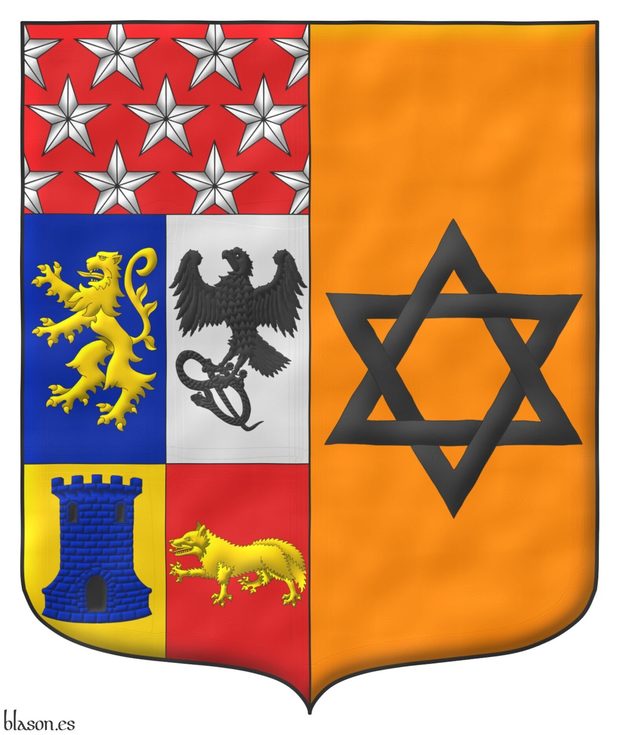
|
Las anteriores son dos formas de visualizar los blasones estructurados en paralelo, la primera mediante una imagen y la segunda mediante una combinación de dos textos y una imagen.
Blazon keywords: Party per pale, Quarterly, Azure, One, Lion, Rampant, Or, Argent, Falcon, Rising, Grasping, Claw, Serpent, Sable, Tower, Port and windows, Masoned, Gules, Fox, Passant, Chief, Semé, Mullet, Orange, Six, Base (lower 1/3), Voided and Interlaced.
Style keywords: Ogee, Outlined in sable, Illuminated and Watercolor.
Classification: Personal, Interpreted, Coat of arms and Structured and parallel blazons.
Bearer: Correa, Lorena.
Luis Gerardo Oyervides Ochoa, structured and parallel blazons
The coat of arms of Luis Gerardo Oyervides Ochoa, Mexico, designed and emblazoned by me, with the blazon written in English and Castilian in a structured way to observe the parallelism between both forms.
| Sable, a kapok tree eradicated and fructed between in base two lozenges Argent. | Escudo de sable, una ceiba arrancada, frutada y acompañada en punta de dos losanjes todo de plata. |
 |
Blazon keywords: Sable, Argent, One, Two, Kapok tree, Tree, Eradicated, Fructed, Between, In base and Lozenge.
Style keywords: Outlined in sable, Illuminated, Semi-circular and Leather.
Classification: Personal, Created, Structured and parallel blazons, Boa and Coat of arms.
Bearer: Oyervides Ochoa, Luis Gerardo.
Malka Gittel Bas Reuven, structured and parallel blazons
Coat of arms of Her Excellency Ratu Muda Malka Bas Reuven emblazoned by me with a shape known as a vesica piscis, and with the blazon written in English and Castilian in a structured way to observe the parallelism between both forms. My experience is that if shield shapes are named after countries, this creates problems in an international context. For example, if the shield with a rounded base is called a «Spanish shield», sooner or later someone will point out that the same shape is also used in Portugal, Hungary, or Poland, making it not exclusively Spanish. For this reason, I avoid assigning shield shapes names based on countries or kingdoms and instead give them names that describe their formal characteristics, which is not always easy. For example, I call the «semi-circular shield» in English and «escudo de medio punto» in Castilian to the commonly referred as «Spanish», or the «ogee shield» one that ends in an inverted ogee arch, «conopial» in Castilian. Despite this, at some point, breaking my own rule, I used the term «Bantu» to refer to the almond-shaped shield, only to be quickly corrected and informed of its connection to other African kingdoms. My mistake was not using the name I had always given it: «mandorla» in Castilian and «vesica piscis» in English.
| Tierced pallwise inverted Azure, Gules, and Sable; overall a chevron between, in the dexter of the chief, a mullet of six points, in the sinister of the chief a pair of scales, and in base an open book Or. | Terciado en perla invertida de azur, gules y sable; brochante sobre el todo un cabrio acompañado, en la diestra del jefe, de una estrella de seis puntas, en la siniestra del jefe, de una balanza, y en la punta, de un libro abierto todo de oro. |
 |
Blazon keywords: Azure, Gules, Sable, Or, One, Six, Tierced pallwise inverted, Overall, Chevron, Between, Dexter, Chief, Mullet, Sinister, Pair of scales, In base, Open book and Book.
Style keywords: Outlined in sable, Illuminated, Vesica piscis and Leather.
Classification: Personal, Interpreted, Structured and parallel blazons, Boa and Coat of arms.
Bearer: Gittel Bas Reuven, Malka.
Marc Eschenlauer

Azure, two lions passant, guardant, winged, each holding in its paws an open book Argent, with the inscription «Pax Tibi Marce Evangelista Meus» Sable distributed on their four pages. Motto: «Evangelium Annutiata».
Escudo de azur, dos leopardos alados, teniendo cada uno en sus garras un libro abierto todo de plata, con la inscripción «Pax Tibi Marce Evangelista Meus» de sable distribuida en sus cuatro páginas. Lema: «Evangelium Annutiata».
Coat of arms designed by me, illuminated with lights and shadows, contoured in Sable, with an ogee outer contour and with a freehand finishing.
Blazon keywords: Azure, Argent, Sable, Two, One, Four, Leopard, Winged, Grasping, Paw, Closed book, Book, Inscribed, Page and Motto.
Style keywords: Outlined in sable, Illuminated, Ogee and Freehand.
Classification: Religious, Created, Boa and Coat of arms.
Bearer: Eschenlauer, Marc.
Marcio Vieira Nastri, collage

Tierced per fess: 1 Sable, seven mullets Argent arranged as the Plough of Ursa Major; 2 Azure; 3 Sanguine, a demi-sun issuant from base Or. Crest: Upon a wreath Or and Sanguine, a raven proper.
Coat of arms of Marcio Vieira Nastri emblazoned by me. The image combines a photograph of a drawing of a raven along with his coat of arms, both painted by me.
Blazon keywords: Sable, Azure, Sanguine, Argent, Or, Seven, One, Tierced per fess, Mullet, Plough of Ursa Major, Demi, Sun, Issuant from base, Crest, Upon (wreath), Wreath, Raven and Proper.
Style keywords: Outlined in sable, Illuminated and Ogee.
Classification: Personal, Interpreted, Boa, Hand-drawn, Collage and Photographic.
Bearer: Nastri, Marcio Vieira.
Massey de Sale

Cheshire, 1613 and Vale-Royal.
Argent, a chevron Sable, between three lozenges Sable.
Escudo de plata, un cabrio de sable, acompañado de tres losanges de sable, dos y uno.
Coat of arms interpreted as follows: the base of the personal shield is rounded; the field is illuminated in Argent; the chevron is illuminated in Sable; the 3 lozenges are enamelled in plain Sable and outlined in the same colour; and the whole has a leather finish.
It appears in [Goldstraw, M. S. J.; 2013b] blazoned as «Argent, a chevron between three lozenges Sable».
Blazon keywords: Without divisions, Argent, Sable, Chevron, Between, Lozenge and Ordered.
Style keywords: Rounded, Illuminated, Outlined in sable and Leather.
Classification: Interpreted, Personal and Cheshire County.
Bearer: Massey de Sale.
Menéndez Pidal de Navascués, F.; 1974

Faustino Menéndez Pidal de Navascués, «Book of Armory of the Kingdom of Navarra: Transcription and Study», published by La Gran Enciclopedia Vasca, 160 pages, ISBN 84-248-0119-9, Bilbao, 1974.
Transcription and study of the Navarrese manuscript armorial [Bosque, J. del; 1540], preserved in the General Archive of Navarra.
This book contains an introduction, the transcription of the armorial texts, its photographic reproduction, which also includes the Navarrese coats of arms of the Reyneck armorial and the coat of arms of the refectory of the Cathedral of Santa María la Real de Pamplona, an index of names, a heraldic table, and a set of appendices [Martínez de Aguirre, J.; 2007; page 351].
The coat of arms accompanying this bibliographic reference is that of Qasqante de Navarra following, precisely, the armorial of Juan del Bosque.
Bibliographical reference of century XX.
The author is Menéndez Pidal de Navascués, Faustino.
The following articles cite this bibliographic reference:
- Bosque, J. del; 1540
- Martinena Ruiz, J. J.; Menéndez Pidal de Navascués, F.; 2001
- Navarra, closed carbuncle
External resources:
Meoles de Meoles

Cheshire, 1613.
Argent, a bend Sable, between two lions' heads ereased Sable, langued Gules.
Escudo de plata, una banda de sable, acompañada de dos cabezas de león de sable, lampasadas de gules.
Coat of arms interpreted with: a rounded base; the field and the bend illuminated in Argent and Sable; the charges in plain Sable and Gules tinctures, outlined in Sable; and the whole in leather.
[Goldstraw, M. S. J.; 2013b] blazons it as «Argent, a bend between two lions' heads ereased Sable», this being the first coat of arms I interpreted from the County of Cheshire.
Use of the plural with the Saxon genitive
While in Castilian one uses the plural for the heads and the singular for the lion, that is, one writes «dos cabezas de león», in English one uses the plural for both the heads and the lions, that is, one writes «two lions' heads» and, therefore, the «s» of the Saxon genitive is omitted and only the apostrophe is written. This usage is general, for example:
- «there boars' heads» ~ «tres cabezas de jabalí»,
- «a pair of eagles' wings» ~ «dos medios vuelos»,
- «two ravens' wings» ~ «dos alas de cuervo»,
- «three hinds' heads» ~ «tres cabezas de cierva»,
- «four tritons' trumpet» ~ «cuatro trompetas de tritón»,
- «three wolfs' claws» ~ «tres garras de lobo»,
- «two greyhounds' heads» ~ «dos cabezas de galgo»,
- «two bears' forepaws» ~ «dos patas delanteras de oso»,
- «four dragons' heads» ~ «cuatro cabezas de dragante»,
- «two roe deers' attires» ~ « dos cuernas de corzo»,
- «three spears' heads» ~ «tres puntas de lanza»,
- «two unicorns' heads» ~ «dos cabezas de unicornio»,
- «two rams' horns» ~ «dos cuernos de carnero» o
- «three leopards' faces» ~ «tres cabezas de leopardo».
Except in cases where the term is used in English as if it were an adjective, for example «two Catherine wheels» ~ «dos ruedas de Santa Catalina», which are the wheels used to martyr her, or «three wagon wheels» ~ «tres ruedas de carro».
Blazon keywords: Without divisions, Argent, Sable, Gules, Bend, Head and Lion.
Style keywords: Rounded, Illuminated, Outlined in sable and Leather.
Classification: Interpreted, Personal and Cheshire County.
Bearer: Meoles de Meoles.
Michael W. Morgan, structured and parallel blazons
Coat of arms of Michael W. Morgan, UE, emblazoned by me, with the blazon written in English and Castilian in a structured way to observe the parallelism between both forms. He is the eldest son of Commander Stephen T. Morgan.
| Or, a griffin segreant Sable, on a chief invected Azure three naval crowns Or, the whole debruised by a label of three points Argent. | Escudo de oro, un grifo rampante de sable; en un jefe acanalado de azur, tres coronas navales de oro, brisado de un lambel de tres pendientes de plata. |
 |
Blazon keywords: Or, Sable, Gules, Azure, Argent, One, Three, Griffin, Segreant, Chief, Invected, Naval crown, Cadency and Label of three points.
Style keywords: Outlined in sable, Illuminated and Freehand.
Classification: Personal, Interpreted, Structured and parallel blazons, Boa and Coat of arms.
Bearer: Morgan, Michael W..
Monroy, municipality of

Quarterly: 1 and 4 Gules, a castle triple-towered Or, port and windows Azure, and masoned Sable; 2 and 3 vair ancient.
Escudo cuartelado: 1o y 4o de gules, un castillo de oro, aclarado de azur, mazonado de sable; 2o y 3o de veros antiguos.
Arms depicted by me, illuminated with lights and shadows, contoured in Sable, with an ogee outer contour and with a freehand finish.
Coat of arms of the municipality of Monroy, Caceres, emblazoned by me with vair ancient. I have painted it using vair ancient, as I wish to illustrate with this coat of arms a reflection on the Virgin of the Sagrario of Plasencia, Caceres, dating from the mid-13th century, and on the forty-four coats of arms made of gilded silver sheet that adorn it, featuring lions, castles, and rounded vair ~ vair ancient, these may be associated with the lords of Monroy, a lineage of considerable importance in the town of Plasencia during the Late Middle Ages, can be seen in The Virgin of the Sagrario of Plasencia and the Monroy vair.
Blazon keywords: Gules, Or, Azure, Sable, One, Quarterly, Castle, Triple-towered, Port and windows, Masoned and Vair ancient.
Style keywords: Outlined in sable, Illuminated, Ogee and Freehand.
Classification: Civic, Interpreted, Boa and Coat of arms.
Bearer: Monroy, municipality of.
Motto around the shield of Alejandra Espeja Amieva

Or, four bell towers issuant from base Gules, windows Or. Motto around the shield: «Linaje Lanzagorta Otxoa · Catalunya · Barcelona» Sable over a scroll Argent.
Coat of arms depicted by me, in plain tinctures, contoured in Sable, with a semi-circular outer contour and with a texturized finishing.
Coat of arms of Alejandra Espeja Amieva, familiarly known as Sandra. This shield, surrounded by an annular scroll Argent inscribed in sable, has been designed byhas been designed by Juan Lanzagorta Vallín and emblazoned by me.
Blazon keywords: Or, Gules, Sable, Argent, Four, One, Bell tower, Issuant from base, Port and windows, Within, Motto (identification) and Scroll.
Style keywords: Outlined in sable, Plain tincture and Semi-circular.
Classification: Personal, Interpreted, Boa and Coat of arms.
Bearer: Espeja Amieva, Alejandra.
Mottos around the shield of Teresa Otxoa Magaña

Azure, in chief a moon with human face Argent, in base a crescent chequey Sable and Argent; overall a she-wolf ululant, sejant on the crescent proper, armed and the udders Gules. Motto around the shield: «Linaje Lanzagorta Otxoa · Bizkaia · México» Sable over a scroll Argent.
Coat of arms painted by me, in flat tinctures, contoured in Sable, with an oval external shape and with a texturized finishing.
The coat of arms of Teresa Otxoa Magaña designed by her and her husband Juan Lanzagorta Vallín, and emblazoned by me.
Blazon keywords: Azure, Argent, Sable, Gules, One, Chief, Moon, With human face, Base, Crescent, Chequey, Overall, She-wolf, Ululant, Sejant, Proper, Armed, Udder, Within, Motto (identification) and Scroll.
Style keywords: Outlined in sable, Plain tincture and Oval.
Classification: Personal, Interpreted, Boa and Coat of arms.
Bearer: Otxoa Magaña, Teresa.
Nelson, Matthew

Party per pale Or and Gules, on a bend counterchanged three fleur de lis palewise counterchanged Argent and Sable between six martlets, 3 and 3 in pale, counterchanged Sable and Argent.
Escudo partido: 1o de oro, en la diestra de la punta tres marletas en palo de sable; 2o de gules, en la siniestra del jefe tres marletas en palo de plata; brochante sobre el todo una banda del uno al otro cargada de tres flores de lis puestas en palo, la primera de plata, la segunda partida de plata y sable y la tercera de sable.
Arms devised by me, illuminated with lights and shadows, contoured in Sable, with an ogee external shape and with a watercolor finishing.
Coat of arms of Matthew Nelson designed by him and me and emblazoned by me. Alternative blazon: «Party per pale: 1 Or, in the dexter of the base three martlets in pale Sable; 2 Gules, in the sinister of the chief three martlets in pale Argent; overall a bend counterchanged charged with three fleurs de lis palewise, the first Argent, the second per pale Argent and Sable, and the third Sable».
Design rationale
This design combines elements and tinctures from the arms of his lineages: Luttrell, Anglo-Irish, and Nelson from Ireland, along with personal details. The bend, martlets, Or, and Sable are from Luttrell. The fleurs de lis Argent, Sable, and per pale Argent and Sable are from Nelson. As personal elements, the layout includes the letter N from his surname, and the color Gules.
Blazon keywords: Or, Sable, Gules, Argent, One, Three, Party per pale, Dexter, Base, Martlet, In pale, Sinister, Chief, Overall, Bend, Counterchanged, Counterchanged (side-by-side), Charged, Fleur de lis and Palewise.
Style keywords: Outlined in sable, Illuminated, Ogee and Watercolor.
Classification: Personal, Created, Design rationale, Boa and Coat of arms.
Bearer: Nelson, Matthew.
Nisbet, A.; 1722

Alexander Nisbet, «System of Heraldry Speculative and Practical: With the True Art of Blazon», subtitle «according to the most approved heralds in Europe: illustrated with suitable examples of armoria figures, and achievements of the most considerable surnames and families in Scotland, together with historical and genealogical memorials relative thereto», printed by J. MackEuen, Edinburgh, 1722.
This is the very 1st edition of this book and I consult the edition [Nisbet, A.; 1816].
Bibliographical reference of century XVIII.
Author: Nisbet, Alexander.
The following articles cite this bibliographic reference:
External link:
Noblemen of Navarre

The King of Navarre, at the time of his new and solemn coronation, is raised and lifted up as King by the hands of twelve barons of the greatest and oldest houses of the said Kingdom, and these are the twelve Noblemen who are named on the other side, with their blazons and coats of arms.
Interpretation and composition of 13 coats of arms that I have created with a parchment-like finish.
A free interpretation, for example, without the central crown over the arms of Navarre, with a different title, written «Navarra» and not «Nabarra», etc., based on the principal plate of [Bosque, J. del; 1540; folio 1 of the numbering of 1613] and with texts taken from the transcription by [Martinena Ruiz, J. J.; 1982; pages 122 and 123].
«Ricohombre», written together, currently means «title that formerly belonged to the highest nobility of Spain», [Real Academia Española; 2001].
Its plural «ricoshombres» is the most commonly used form, but «ricohombres» is also correct and used; and in [Bosque, J. del; 1540] it is written separately, and «honbre» with an «n» before the «b», that is, «ricos honbres».
Blazon keywords: Without divisions, Party per bend, Azure, Gules, Or, Argent, Sable, Vert, Eagle, Chequey, Cross flory, Cross couped, Fess, Chief, Lion, Pale, Poplar leaf, Clay pot and Rampant.
Style keywords: Semi-circular and Old parchment.
Classification: Interpreted and Kingdom of Navarre.
Bearer: Noblemen of Navarre.
Noronha, House of
![Quarterly: 1 and 4 Argent, five escutcheons in cross Azure, each charged with five plates in saltire; a bordure Gules, charged with seven castles triple-towered Or, 3, 2, and 2 [for Portugal]; the whole debruised by a baston Sable; 2 and 3 party per chevron Argent and Gules, in chief two lions combatant Purpure, armed and langued Gules [for Leon], in base a castle triple-towered Or, port and windows Azure, masoned Sable [for Castile]; a bordure compony of eighteen sections Or and vair [for Álvarez de las Asturias].](../escudo_heraldico/_detalle.htm?img=NoronhaC.22.Escudo.Metal.Avr20.jpg&cla=Diestro "Noronha, House of")
Quarterly: 1 and 4 Argent, five escutcheons in cross Azure, each charged with five plates in saltire; a bordure Gules, charged with seven castles triple-towered Or, 3, 2, and 2 [for Portugal]; the whole debruised by a baston Sable; 2 and 3 party per chevron Argent and Gules, in chief two lions combatant Purpure, armed and langued Gules [for Leon], in base a castle triple-towered Or, port and windows Azure, masoned Sable [for Castile]; a bordure compony of eighteen sections Or and vair [for Álvarez de las Asturias].
Escudo cuartelado: 1o y 4o de plata, cinco escudetes en cruz de azur, cada uno cargado de cinco bezantes en sotuer de plata; una bordura de gules, cargada de siete castillos de oro, 3, 1 y 3; [de Portugal] brisado de un bastón de sable; 2o y 3o de plata, mantelado en punta de gules, en jefe, dos leones afrontados de púrpura, armados y lampasados de gules [de León], en punta un castillo de oro, aclarado de azur, mazonado de sable [de Castilla]; una bordura componada de dieciocho compones de oro y veros [de Álvarez de las Asturias].
Arms depicted by me, illuminated with lights and shadows, outlined in Sable, with an ogee external shape and with a metal beaten finish.
Coat of arms of the House of Noronha in Portugal, a lineage of dual royal origin. The House of Noronha originated with Alfonso Enríquez of Castile, Count of Noreña and Gijón, the natural son of King Henry II of Castile, founder of the Trastámara dynasty, and of Elvira Íñiguez. The lineage became linked to the Portuguese Royal House through the marriage of Alfonso Enríquez to Isabel of Portugal, the natural daughter of King Ferdinand I of Portugal, an alliance arranged in the context of the Treaty of Santarém of 1373, which brought an end to the Fernandine Wars, during which Ferdinand I of Portugal confronted the kings of the House of Trastámara over the throne of Castile following the murder of Peter I at the hands of his half-brother Henry. The House of Noronha became established in Portugal, and its arms quarter those of the Kingdom of Portugal, differenced by a brisure consisting of a baston Sable, and those of the House of Trastámara. This coat of arms has been emblazoned for Fernando Durán Cabral de Mello d’Alpoim by me as a preparatory work for his armorial bearings, his coat of arms has a inescutcheon with the arms of the House of Noronha.
Blazon keywords: Argent, Azure, Gules, Or, Sable, Purpure, One, Two, Five, Seven, Eighteen, Quarterly, Escutcheon, In cross, Charged, Plate, In saltire, Bordure, Castle, Triple-towered, Cadency, Baston, Party per chevron, In chief, Lion, Combatant, Armed, Langued, In base, Port and windows, Masoned, Compony and Vair.
Style keywords: Outlined in sable, Illuminated, Ogee and Metal beaten.
Classification: Civic, Interpreted, Boa and Coat of arms.
Bearer: Noronha, House of.
o-XI, heraldic document

Heraldic document, 2 pages.
The pages have a heraldic frame with the elements of his coat of arms.
The motto, which is the beginning of the Gospel of Saint John, can be seen in [Cnut Gospels; 1020; folio 111].
Blazon keywords: Quarterly, Sable, Or, One, Letter, Two, Wolf, Passant, In pale, Number, Gules, Argent, Azure, Crest and mantling, Helm, Mantling, Wreath, Crest, On, Charged, Disordered, Cross, Cross of Burgundy, Cross couped, Book, Open, Motto, Scroll and Fimbriated.
Classification: Created, Personal, Catalogue, Heraldic document and Frame.
Bearer: Salmerón Cabañas, Antonio.
Odysseus of Ithaca

Party per pale: 1 Vair; 2 Sable, a barn owl Argent, the eyes Sable, beaked and armed Or.
Escudo partido: 1o de veros; 2o de sable, una lechuza de plata, encendida de sable, picada y armada de oro.
Blazon keywords: Party per pale, Argent, Azure, Vair, Sable, Or, Barn owl, The eyes, Beaked and Armed.
Style keywords: Rounded, Illuminated, Outlined in sable and Parchment.
Classification: Created, Imaginary, Coat of arms and Greco-Roman antiquity.
Imaginary bearer: Odysseus of Ithaca.
Olivia Zangenberg in «The Register of Arms, Volume 1»

Or, on a pile issuant from base Vert between two maunches Gules a displayed scroll Argent with seal pendant proper, the whole debruised by a label of three points Sable. Crest: A crown of Noble surmounted by a crown of Baron. The whole surrounded by a cordelier bearing two tassels Or. Motto: «Aliter Cogita».
R0047: the coat of arms of Olivia Zangenberg, of United Kingdom, as registered by the Chief Herald of Arms of Malta and emblazoned by me for this register. These arms have been included in the book [Gauci, C. A.; Cassar, R. M.; 2025; page 189] as shown in the photograph of the image.
Blazon keywords: Or, Vert, Gules, Argent, Sable, One, Two, Pile issuant from base, Between, Maunch, Displayed scroll, Suspended, Proper, Debruised, Cadency, Label of three points, Crest, Crown of Noble, Crown, Crown of Baron, Cord, Tassel and Motto.
Style keywords: Outlined in sable, Illuminated and Pointed.
Classification: Personal, Interpreted, Boa, Collage, Photographic and Seal.
Bearer: Zangenberg, Olivia.
Oratorio de San Felipe Neri, 3 different shapes

Argent, in chief an ecclesiastical cap Sable, in base a heart enflamed gules.
Blazon keywords: Argent, In chief, One, Ecclesiastical cap, Sable, In base, Heart enflamed, Heart, Enflamed and Gules.
Style keywords: Outlined in sable, Illuminated, Watercolor, Ogee, Double pointed and Testa di cavallo.
Classification: Religious, Created and Coat of arms.
Bearer: Congregación del Oratorio de San Felipe Neri de Alcalá de Henares.
Ormazabal of the Basque Country, lineage

Or, a tower Gules, embattled, masoned and with a turret Sable.
Escudo de oro, una torre de gules, almenada, mazonada y donjonada de sable.
Coat of arms emblazoned by me, highlighted with lights and shadows, outlined in Sable, with a semi-circular outer contour and with a freehand finishing.
Ancient arms of the lineage Ormazabal of the Basque Country emblazoned by me.
Blazon keywords: Or, Gules, Sable, One, Tower, Embattled, Masoned and With a turret.
Style keywords: Outlined in sable, Illuminated, Semi-circular and Freehand.
Classification: Personal, Lineage, Interpreted, Boa and Coat of arms.
Bearer: Ormazabal of the Basque Country, lineage.
Oschoven of the Rhin

Argent, flanched Sable, in chief a mullet of six points Gules.
Escudo de plata, flanqueado curvo de sable, en jefe una estrella de seis rayos de gules
Coat of arms interpreted with: a semicircular (round) base; illuminated in the tinctures Argent, Gules, and Sable; all outlined in Sable; and finished with a raised-stroke effect.
[Avilés, J.; 1725a; pages 92 and figure 197] blazons it as «Argent, and a six-pointed star Gules in chief, flanched in oval Sable». When he illustrates it in [Avilés, J.; 1725a; figure 197], the space left between both flanches is only 1/5 of the base of the coat of arms; this is feasible because the only charge is a mullet in chief. If there were more charges, it would be necessary to leave more space, for example, 1/3 of the base of the shield.
«Oschoven au Rhein» in the book [Menestrier, C. F.; 1659; page 315], it is blazoned «d'argent flanqué arrondi de sable à vne molette de mesme en chef», so the mullet would be Sable, bacause «de mesme» is written, and with a hole in the middle, this hole does not exits in other sources.
In the book [Rietstap, J. B.; 1861], it is blazoned «Argent, flanched in round Sable, Argent charged in chief of a mullet Gules», and in French «d'argent, flanqué en rond de sable, l'argent chargé en chef d'une étoile de gueules».
Some time ago I used to blazon it in English as «Argent, in chief a mullet of six points Gules, between two flanches Sable».
Blazon keywords: Argent, Sable, Gules, Mullet, Chief and Flanched.
Style keywords: Semi-circular, Illuminated, Outlined in sable and Freehand.
Classification: Interpreted and Personal.
Bearer: Oschoven of the Rhin.
Pennick, N.; 2015
Nigel Pennick, «Pagan Magic of the Northern Tradition: Customs, Rites, and Ceremonies», edited by Simon and Schuster, publicado por Destiny Books, ISBN.13 9781620553909, ISBN.10 1620553902, alternative ISBN.13 9781620553893, 352 pages, New York, 21th of May of 2015
On page 119, Nigel Pennick wrote «According to Aristotelian precepts, each of the metals and tinctures», maybe he should have written heraldic term color, «possesses a spiritual virtue related to a particular planetary sphere. Or signifies and relates to the Sun; Argent, the Moon; Sable, Saturn; Azure, Jupiter; Gules, Mars; Vert, Venus; and Purpure, Mercury».
Bibliographical reference of century XXI.
The author is Pennick, Nigel.
External resource:
Pesquera de Ebro, plain tincture

Azure, on four bars wavy Argent a barbel bendwise Or and a three arch bridge Or, masoned Sable, throughout, supporting a elm couped Argent leaved Or, between, in dexter a tower Or, port and windows Azure, mazoned Sable, and in sinister three escutcheon Or, 2 and 1.
Coat of arms designed by me, in flat tinctures, outlined in Sable, with a semi-circular outer contour and with a texturized finish.
The coat of arms of Pesquera de Ebro, Burgos, Castile and Leon, designed and emblazoned by me.
Blazon keywords: Argent, Or, Azure, Sable, One, Three, On, Bar, Wavy, Barbel, Bendwise, Bridge, Masoned, Throughout, Upon, Elm, Tree, Couped (tree), Leaved, Tower, Port and windows, Escutcheon and Ordered.
Style keywords: Outlined in sable, Plain tincture and Semi-circular.
Classification: Civic, Created, Boa and Coat of arms.
Bearer: Pesquera de Ebro.
Peter Iacobucci

Argent, a suspended oil lamp of three lions' heads erased and winged Vert, two heads visible, enflamed proper; a bordure Gules, charged with eight crosses botonny Argent. Crest: A galero with two cords, one on each side, each with a tassel Sable. Motto «Lux Orbis».
Escudo de plata, pendiente del jefe una lampara de aceite de tres cabezas de león arrancadas y aladas de sinóple; una bordura de gules cargada de ocho cruces botonadas de plata. Timbrado de un galero con cordones y una borla a cada lado de sable. Lema «Lux Orbis»
Coat of arms depicted by me, illuminated with lights and shadows, contoured in Sable, with a pointed outer contour and with a iridescent finishing.
Blazon keywords: Argent, Vert, Gules, Sable, One, Three, Two, Eight, Suspended, Oil lamp, Lion, Head, Erased, Winged, Visible, Enflamed, Proper, Bordure, Charged, Cross botonny, Crest, Galero, Cord, Tassel and Motto.
Style keywords: Outlined in sable, Illuminated, Pointed and Iridescent.
Classification: Religious, Interpreted, Boa and Coat of arms.
Bearer: Iacobucci, Peter.
Peter II of Urgell

Count of Urgell, Viscount of Àger, Baron of Entença, Antillón, and Alcolea de Cinca (1340–1408).
Dimidiated: 1 Or, four pallets Gules; 2 chequey Or and Sable.
Escudo dimidiado: 1o de oro, cuatro palos de gules; 2o ajedrezado de oro y sable.
Arms interpreted with: the escutcheon in a pointed and rounded shape; the tinctures of the pales and the chequey rendered in flat inks Or, Gules, and Sable; and the whole finished with a highly hammered metal effect.
Peter II of Urgell (1340–1408), Count of Urgell, Viscount of Àger, and Baron of Entença, Antillón, and Alcolea de Cinca, was a prominent figure of 14th-century Catalan nobility and grandson of Alfonso IV of Aragon.
Blazon keywords: Dimidiated, Pale, Chequey, Or, Gules and Sable.
Style keywords: Ogee, Plain tincture and Hard metal.
Classification: Interpreted, Personal, Coat of arms and Kingdom of Aragon.
Bearer: Peter II of Urgell.
Philip of Castile, Infante

Quarterly: 1 and 4 Gules, a castle triple-towered Or, port and windows Azure, and masoned Sable; 2 and 3 Or, an eagle displayed Sable.
Escudo cuartelado: 1o y 4o de gules, un castillo de oro, aclarado de azur, mazonado de sable; 2o y 3o de oro, un águila de sable.
Arms painted by me, illuminated with lights and shadows, outlined in Sable, with an ogee external shape and with a freehand finish.
Coat of arms of the Infante Philip of Castile, 1231–1274, 7th offspring of the King Ferdinand III of Castile, 1199-1252, and the Queen Beatrice of Swabia, 1205–1235. This coat of arms has been emblazoned by me and can be consulted in [Messía de la Cerda y Pita, L.; 1990; page 146] with the field Or in the 2nd and 3rd quarters. He bears a quarterly shield combining the first quarter of his father’s arms, Castile, with his mother’s arms. Among all his siblings, he is the one who most closely combines the arms of both parents.
Blazon keywords: Gules, Or, Azure, Sable, One, Quarterly, Castle, Triple-towered, Port and windows, Masoned and Eagle.
Style keywords: Outlined in sable, Illuminated, Ogee and Freehand.
Classification: Personal, Kingdom of Castile and Leon, Interpreted, Boa and Coat of arms.
Bearer: Philip of Castile, Infante.
Pixiv

My heraldic Pixiv wall is Dr.A.Salmeron @antoniosheraldry and pixiv.me/antoniosheraldry.
Pixiv is a Japanese online community for artists. I post in Pixiv 2 or 3 coats of arms per week. They use a strict form to post with many mandatory input fields. This week, they have added a new mandatory field «AI-generated work: Yes / No», AI ~ Artificial Intelligence. In the image, I have highlighted this new field in red.

My animation of the coat of arms of Juan Lanzagorta reached position 33 in Pixiv’s daily Ugoira animation ranking. I am very happy about this, as it is not easy to achieve.

Categories: Technology, Social networks, Quarterly, Gules, One, Chevron, Argent, Between, Three, Fleur de lis, Or, Five, Mullet, In saltire, Four, Escutcheon, In cross, Azure, Charged, Nine, Bezant and plate, Two, Flank, Fesswise, Center, Overall, Carbuncle, Cord, In orle, Knotted, Purpure, Overall (all), Sable, Mount, Issuant from base, Vert, On, Tower, Port and windows, Masoned, Wolf, Supporting, Enté en point, Fess, Wavy, Crown of the Sovereign and Most Noble Order of the Pomegranate, Crown and Motto.
Ponce I of Urgell

Count of Urgell, Viscount of Àger, deceased in 1243.
Chequey Or and Sable.
Escudo ajedrezado de oro y sable.
Arms interpreted with: a shield shaped as a triangle with curved sides; the chequey pattern in flat metal Or and colour Sable; and a heavily beaten metal finish.
[Avilés, J.; 1780a; page 286] states that he will call «Chequey those ordinaries composed of these small squares, which alternate between metal and colour, or vice versa, just like the boards of those Games.» and he also writes regarding the usual number of panes that «it must have six ranks or rows of these squares, though it is not necessary to specify their number, or at least the shield must include more than fifteen panes; it is only required, to properly blazon it, to always observe the first square, which is in the chief dexter; so that, if this is Or, and the one that follows is Gules, it is said to be Chequey Or and Gules, and so with other colours and metals.»
Although Ponce initially proclaimed himself count of the county of Urgell without sufficient rights, the death of the legitimate heiress and his agreements and assistance to king James I of Aragon enabled him to legalise his title. During this process, the capital of the county ceased to be the municipality of Balaguer only to eventually become it once again.
Blazon keywords: Chequey, Or and Sable.
Style keywords: Triangular curved, Plain tincture and Hard metal.
Classification: Interpreted, Personal, Coat of arms and Kingdom of Aragon.
Bearer: Ponce I of Urgell.
Portugal differenced by a baston Sable
![Argent, five escutcheons in cross Azure, each charged with five plates in saltire; a bordure Gules, charged with seven castles triple-towered Or, 3, 2, and 2 [for Portugal]; the whole debruised by a baston Sable.](../escudo_heraldico/_detalle.htm?img=PortugalR.39.Conopial.Brisado.TrazoAlzado.jpg&cla=Siniestro "Portugal differenced by a baston Sable")
Argent, five escutcheons in cross Azure, each charged with five plates in saltire; a bordure Gules, charged with seven castles triple-towered Or, 3, 2, and 2 [for Portugal]; the whole debruised by a baston Sable.
Coat of arms emblazoned by me, illuminated with lights and shadows, outlined in Sable, with an ogee external shape and with a freehand finishing.
Coat of arms of the Kingdom of Portugal differenced by a baston Sable, as it appears in the arms of the House of Noronha. In the Arquivo Heráldico Genealógico of the Viscount Sanches de Baena this brisure is blazoned as «é por diferença um filete de negro sobreposto em banda», while in the Armaría Portuguesa it is described as «um filete negro em contrabanda». This latter term may be confusing, as «contrabanda» corresponds to the bend sinister, that is, the opposite diagonal. For the purpose of blazoning this coat of arms I use the heraldic term «baston» in English ~ «bastón» in Spanish ~ «bande batonnée» in French ~ «bastone» in Italian, denoting a bend reduced to 1/4 of its normal width. It should be recalled that the diminished bend properly speaking is the «bendlet», whose width ranges between 1/2 and 1/3 of that of the bend; the baston, being thinner, is therefore more suitable and proportionate for this shield. This coat of arms has been emblazoned for Fernando Durán Cabral de Mello d’Alpoim by me as a preparatory work for his armorial bearings. In that coat of arms, the inescutcheon of the House of Noronha bears this differenced Portugal arms in the 1st and 4th quarters.
Blazon keywords: Argent, Azure, Gules, Or, Sable, One, Five, Seven, Escutcheon, In cross, Charged, Plate, In saltire, Bordure, Castle, Triple-towered, Cadency and Baston.
Style keywords: Outlined in sable, Illuminated, Ogee and Freehand.
Classification: Civic, Interpreted, Boa and Coat of arms.
Bearer: Portugal.
Qasqante of Navarre

Of the twelve lineages of Noblemen, the tenth is that of Qasqante; they bear as arms a shield Or and, on the shield, an eagle Sable, which is black, as it is now painted.
Or, an Eagle displayed Sable.
Escudo de oro, un águila de sable.
Coat of arms interpreted with: a semicircular (round) base; the field in flat Or; the eagle outlined in the colour of the field and illuminated in Sable; and finished in highly-hammered metal.
Based on the tenth coat of arms of the Navarrese «ricoshombres» from [Bosque, J. del; 1540; folio 1 of the numbering of 1613] and the text is from the transcription made by [Martinena Ruiz, J. J.; 1982; pages 122 and 123].
Under the title «Surname of Cascante» it can also be consulted in [Vega, P. J. de; 1702; folio 10 of the manuscript].
Blazon keywords: Without divisions, Or, Eagle and Sable.
Style keywords: Semi-circular, Illuminated, Outlined in the field tincture and Hard metal.
Classification: Interpreted, Personal and Kingdom of Navarre.
Bearer: Qasqante of Navarre.
Rage from Discord, first version

Barry of ten Argent and Azure, overall a double-headed eagle displayed Sable, nimbed, beaked, and membered Or, grasping in each claw an elephant's tusk proper, and charged on its breast with a double vajra Argent.
Escudo fajado de diez piezas de plata y azur, brochante sobre el todo un águila bicéfala de Sable, nimbada, picada y membrada de oro, teniendo en cada garra un colmillo de elefante al natural y su pecho cargado de una vajra doble.
Coat of arms interpreted and emblazoned by me with different shapes and finishings.


Blazon keywords: Without divisions, Barry, Ten, Argent, Azure, Overall, One, Eagle, Double-headed, Sable, Nimbed, Beaked, Membered, Or, Grasping, Claw, Tusk, Elephant, Proper, Chest, Charged and Double vajra.
Style keywords: Outlined in sable, Illuminated, Freehand, Rough, Rounded, Ogee and Pointed.
Classification: Interpreted and Coat of arms.
Bearer: Rage from Discord.
cross «paté»

Argent, a cross patty Gules, cantoned of four mullets of eight points Azure; on a chief Sable, an elephant passant Or.
Escudo de plata, una estrecha patada de gules, cantonada de cuatro estrellas de ocho puntas de azur; en un jefe de sable, un elefante pasante de oro.
Coat of arms of the Registro Internacional de Armas Gentilicias interpreted as follows: with a pointed base; the field in plain Argent metal; the chief illuminated in Sable; the elephant illuminated in Or and outlined of the field; the narrow patty cross illuminated in Gules and outlined in Sable; the eight-pointed stars illuminated in Azure and outlined of the field; and the whole with a lightly beaten metal finish.
At the following RIAG address escueladeheraldica.es/armorial-riag-pagina-1 the blazon of this coat of arms can be found written as «De plata, crus estrecha paté de gules, cantonada de cuatro estrellas de ocho puntas de azur; jefe de sable, con un elefante de oro pasante».
The most common star is the five-pointed one, therefore, when the number of points is not stated five are assumed, so, for example, [Avilés, J.; 1780a; página 27, ilustración 6] on Guillaume in France writes «trae de plata, y una Faxa de azur, cargada de una Estrella de oro, y acompañada de tres mirletas de sable» and in his illustration number 6 the star has 5 points. But when the number is other than 5, it must be specified, for example, [Avilés, J.; 1780a; página 92, ilustración 197] on Oschoven on the Rhine writes «trae de plata, y una Estrella de seis rayos de gules en Gefe, flanqueado en óvalo de sable» and it is for this reason that in the blazon included in this article, in addition to specifying the number 8, the term «rayos» has been used instead of its synonym «puntas».
Blazon keywords: Argent, Diminished cross, Patty, Gules, Cantoned, Mullet, Eight, Azure, Chief, Sable, Elephant, Passant, Or and Motto.
Style keywords: Pointed, Illuminated, Outlined in sable, Outlined in the field tincture and Soft metal.
Classification: Socioeconomic.
Bearer: Registro Internacional de Armas Gentilicias.
Richard Allen Stowe, structured and parallel blazons

Iridescent finishing.
This is an example of my approach to writing structured and parallel blazons in English and Castilian. I use the heraldic term «leopard», instead «lion guardant», because I seek the maximum parallelism between English and Castilian, and in Castilian we also use the heraldic term «leopard».
Blazon keywords: Vert, One, Pall, Raguly, Or, Three, Head, Leopard, Crest and mantling, Wreath, Above, Crown, Between, Two, Wing, Sable and Motto.
Style keywords: Illuminated, Iridescent (nacar), Pointed and Outlined in sable.
Classification: Structured and parallel blazons, Coat of arms, Interpreted and Personal.
Bearer: Stowe, Richard Allen.
Robert de Malet

Roberto de Malet ~ Robert de Malet
Argent, three buckles Sable.
Escudo de plata, tres hebillas de sable.
Included in [Vincent, MS; 1285; number 595] also known as [St. George's Roll; 1285; number 595].
Blazon keywords: Without divisions, Argent, Three, Buckle, Sable and Ordered.
Style keywords: Triangular curved, Illuminated and Freehand.
Classification: Interpreted and Personal.
Bearer: Roberto de Malet.
Romanet, Catherine de

Azure, on a pale Argent, between two lions combatant Or, armed and langued Gules, three chevronels Sable.
Escudo de azur, un palo de plata, cargado de tres tenazas de sable, acostado de dos leones afrontados de oro, armados y lampasados de gules.
Arms depicted by me, illuminated with lights and shadows, contoured in Sable, with a pointed outer contour and with a leather finishing.
The coat of arms of Catherine de Romanet emblazoned by me. Blazon in French: «D'azur, au pal d'argent chargé de trois chevrons de sable et accosté de deux lions affrontés d'or, armés et lampassés de gueules». Alternative blazon: «Azure, a pale Argent, charged with three chevronels Sable, between two lions combatant Or, armed and langued Gules».
Blazon keywords: Azure, Argent, Sable, Or, Gules, One, Three, Two, Pale, Charged, Chevronel, Between, Lion, Combatant, Armed and Langued.
Style keywords: Outlined in sable, Illuminated, Pointed and Leather.
Classification: Personal, Interpreted, Boa and Coat of arms.
Bearer: Romanet, Catherine de.
Royal Abahinda Clan, royal spears

Party per fess, fimbriated Gules: 1st Azure, two royal drums in fess Argent, stringed Or, each charged with a bar Sable; 2nd Vert, a monkey statant Argent; overall a fess tierced per fess Azure, Gules, and Vert, fimbriated Argent; overall an inescutcheon Gules, fimbriated Argent. Supporters: Two royal spears in saltire, the dexter per pale Argent and Sable, the sinister per pale Sable and Argent, both shafted Argent.
Coat of arms painted by me, highlighted with lights and shadows, outlined in Sable, with a vesica piscis external shape and with a leather finish.
Blazon keywords: Gules, Azure, Argent, Or, Sable, Vert, One, Two, Party per fess, Fimbriated, Drum, In fess, Stringed, Charged, Monkey, Statant, Overall (line of division), Fess, Tierced per fess, Overall, Inescutcheon, Supporter (thing), Supporter, Spear, In saltire, Dexter, Party per pale, Sinister and Shafted.
Style keywords: Outlined in sable, Illuminated, Vesica piscis and Leather.
Classification: Civic, Interpreted, Boa and Coat of arms.
Bearer: Abahinda Clan, Royal.
Rubén González Lara, page of armorial

Ermine, a lion rampant double queued Or, armed and langued Gules; a chief Gules, three castles triple-towered Or, port and windows Azure, masoned Sable. Crest: A crown of the Sovereign and Most Noble Order of the Pomegranate. The shield is surrounded by the Grand Collar of the Sovereign and Most Noble Order of the Pomegranate.
This is his coat of arms of emblazoned by me for the Roll of Arms of the Sovereign and Most Noble Order of the Pomegranate.
Blazon keywords: Without divisions, Ermine, One, Lion, Rampant, Tail, Double queued, Or, Armed, Langued, Gules, Chief, Three, Castle, Port and windows, Azure, Masoned, Sable, Crest and mantling, Crown, Pomegranate, Surrounded and Grand collar.
Style keywords: Pointed, Outlined in sable, Illuminated and Leather.
Classification: Personal, Interpreted, Coat of arms, Armorial roll and Castilian language.
Bearer: González Lara, Rubén.
Rudolph Andries Ulrich Juchter van Bergen Quast, blazon and blason

Gules, three Leopards faces Or, the whole within a Border Or with two Bars Gules. Crest: A crest coronet proper. Mantle: Gules doubled Erminois.
Escudo de gules, tres cabezas de leopardo de oro; una bordura de oro con dos burelas de gules. Timbrado de una corona de príncipe abierta y manto de gules y forro armiñado de oro y sable.
Watercolor finishing
Blazon keywords: Gules, Three, Head, Leopard, Or, Ordered, Bordure, Two, Bar, Crest and mantling, Crown of Prince, Crown, Open, Mantle, Erminois and Sable.
Style keywords: Watercolor, Pointed, Illuminated and Outlined in sable.
Classification: Coat of arms, Interpreted and Personal.
Bearer: Juchter van Bergen Quast, Rudolph Andries Ulrich.
Sable, three Towers Or, two and one

Sable, three Towers Or, two and one
The classic heraldic layout for three charges on a coat of arms is two in chief and on in base. The layout one in chief and two at base are considered disordered in many heraldic traditions.
The blazon of this coat of arms, «Sable, three Towers Or, two and one», is disordered, and the entropy refers to disorder, and more entropy means more disorder. Then this imaginary coat of arms is full of entropy, and it could belong to the entropy.
Categories: Riddle solution, Imaginary, Sable, Three, Tower, Or, Two, One and Disordered.
Sánchez Juárez, María de Jesús

Party per pale, Vert and Gules, overall a saltire Argent charged with an eagle displayed, facing sinister Sable, grasping in its sinister claw a prickly pear cactus (Opuntia ficus-indica) couped Vert, fructed Gules, leaved Or, and in its dexter claw and beak a serpent Vert, langued Gules, the fangs Or.
Escudo de partido de sinople y gules, brochante sobre el todo un sotuer de plata cargado de un águila alterada de sable, teniendo en su garra siniestra una chumbera nurida de sinople, frutada de gules, hojada de oro y en su garra diestra y cebada de una sierpe de sinople, lampasada de gules, fierezada de oro.
Arms depicted by me, in flat tinctures, outlined in Sable, with a semi-circular outer contour and with a freehand finishing.
This is the coat of arms of María de Jesús Sánchez Juárez, also known as «Aunt Susan», great-granddaughter of Benito Juárez, President of Mexico. This coat of arms has been designed by her nephew Juan Lanzagorta Vallín and has been painted by me. The artistic conception of the ensemble draws inspiration from a work of Mexican muralist Víctor Cauduro Rojas, providing a pictorial reference for this heraldic interpretation.
Blazon keywords: Vert, Gules, Argent, Sable, Party per pale, Overall, Saltire, Charged, Eagle, Displayed, Facing sinister, Grasping, Sinister, Claw, Prickly pear cactus, Couped, Fructed, Leaved, Dexter, Beak, Serpent, Langued and The fangs.
Style keywords: Outlined in sable, Plain tincture, Semi-circular and Freehand.
Classification: Personal, Interpreted, Boa and Coat of arms.
Bearer: Sánchez Juárez, María de Jesús.
Sancho IV of Castile

Known as the Brave, king of Castile and León from 1284 to 1295.
Quarterly: 1 and 4 Gules, a castle triple towered Or, port and windows Azure, masoned Sable; 2 and 3 Argent, a lion rampant Purpure, armed and langued Gules, crowned Or.
Escudo cuartelado: 1o y 4o de gules, un castillo de oro, aclarado de azur, mazonado de sable; 2o y 3o de plata, un león rampante de púrpura, armado y lampasado de gules, coronado de oro.
Pre-existing arms interpreted by me as described below: the shield of arms has a rounded (semicircular) base; the field, the two castles and the two lions are illuminated; and the whole has a parchment-like finish.
Blazon keywords: Quarterly, Gules, Or, Azure, Sable, One, Castle, Port and windows, Masoned, Argent, Purpure, Lion, Rampant, Armed, Langued and Crowned.
Style keywords: Rounded, Illuminated and Parchment.
Classification: Interpreted, Personal, Coat of arms and Kingdom of Castile and Leon.
Bearer: Sancho IV of Castile.
Sancho of Castile, Infante

Party per pale: 1 Gules, a castle triple-towered Or, port and windows Azure, and masoned Sable; 2 Argent, a lion rampant Purpure, armed and langued Gules.
Escudo partido: 1o de gules, un castillo de oro, aclarado de azur, mazonado de sable; 2o de plata, un león rampante de púrpura, armado y lampasado de gules.
Arms emblazoned by me, highlighted with lights and shadows, contoured in Sable, with an ogee outer contour and with a freehand finish.
Coat of arms of the Infante Sancho of Castile, 1233–1261, 8th offspring of the King Ferdinand III of Castile, 1199-1252, and the Queen Beatrice of Swabia, 1205–1235. Unlike his siblings, he does not use a quarterly shield but rather impaled arms of Castile and Leon.
Blazon keywords: Gules, Or, Azure, Sable, Argent, Purpure, One, Party per pale, Castle, Triple-towered, Port and windows, Masoned, Lion, Rampant, Armed and Langued.
Style keywords: Outlined in sable, Illuminated, Ogee and Freehand.
Classification: Personal, Kingdom of Castile and Leon, Interpreted, Boa and Coat of arms.
Bearer: Sancho of Castile, Infante.
Sea of the Mediterranean, plain tincture

Party per fess: 1 Sable, three mullets of eight points Argent, 1 and 2; 2 Azure, a ship in full sail Or.
Coat of arms designed by me, in plain tinctures, contoured in Sable, with a semi-circular external shape and with a texturized finish.
Coat of arms of the Sea of the Mediterrean designed and emblazoned by me as imaginary heraldry. This coat of arms is one of my very first heraldic designs.
Blazon keywords: Sable, Argent, Azure, Or, Three, Eight, One, Party per fess, Mullet, Disordered, Ship and Full sail.
Style keywords: Outlined in sable, Plain tincture and Semi-circular.
Classification: Imaginary, Created, Boa and Coat of arms.
Imaginary bearer: Mediterranean, Sea of the.
Sealed arms of Darryn Carlo and Roberto Luchoro and Darryn Carlo

Vert, on a fess Argent, between in chief a castle triple-towered Or, port and windows Gules, masoned Sable, between four mullets Argent, 2 and 2, and in base a Merino ram's head caboshed Or, between three mullets Argent, 2 and 1, two wolves passant Sable. Motto: «Amor Non Timet» Sable, with initial letters Gules, over a scroll Argent.
Blazon keywords: Vert, Argent, Or, Gules, Sable, One, Two, Seven, Fess, Between, In chief, Castle, Triple-towered, Port and windows, Masoned, Mullet, In base, Merino ram, Head, Caboshed, Wolf, Passant and Motto.
Style keywords: Outlined in sable, Illuminated, Semi-circular and Sealed.
Classification: Personal, Created, Boa, Sealed arms and Heraldic document.
Bearer: Luchoro and Darryn Carlo, Roberto.
Sealed arms of the Barrio del Artista of Mon'Tarena

Party per pale Azure and Argent, a hummingbird volant bendwise counterchanged. Motto: «Barrio del Artista» Sable with initial letters Gules over a scroll Argent.
The coat of arms of the Barrio del Artista of Mon'Tarena, Queretaro, Mexico, designed by Joaquin Haces Perdomo and me, and emblazoned, dated, signed and sealed by me.
Blazon keywords: Argent, Azure, Sable, Gules, One, Party per pale, Hummingbird, Volant, Bendwise, Counterchanged, Motto and Scroll.
Style keywords: Outlined in sable, Illuminated and Chasuble.
Classification: Civic, Created, Boa, Sealed arms and Heraldic document.
Bearer: Barrio del Artista of Mon'Tarena.
Seth Rawson, plain tincture

Party per fess Azure and Sable, overall a four-towered castle Or, port and windows Sable, in chief two pairs of gouttes Or.
Coat of arms depicted by me, highlighted with lights and shadows, contoured in Sable, with an ogee triple-pointed external shape and with a texturized finishing.
Coat of arms for Seth Rawson emblazoned by me. This coat of arms is based on the ancient arms of the lineage Rawson, with the addition in chief of two pairs of gouttes Or for difference.
Blazon keywords: Azure, Sable, Or, One, Two, Party per fess, Overall, Four-towered, Castle, Port and windows, In chief, Pair and Goutte.
Style keywords: Outlined in sable, Illuminated, Ogee Triple-Pointed and Plain tincture.
Classification: Personal, Interpreted, Boa and Coat of arms.
Bearer: Rawson, Seth.
Shakespeare, W.; 1608

William Shakespeare, «Coriolanus», Tragedy in 5 acts and 29 scenes, written in verse, dated to either 1608 or 1609, depending on the sources.
It is one of the last works written by William Shakespeare, a tragedy based on the life of Caius Marcius Coriolanus, a legendary Roman general from the 5th century B.C. Some authors consider General Coriolanus to be a historical figure, while others do not.
Initially known only as Caius Marcius, during the war against the Volsci he becomes a hero by entering the city of Corioli with a few soldiers, and from then on, he is called Caius Marcius Coriolanus.
Act 3, Scene 2, Volumnia, mother of Coriolanus
I prithee now, my son,
Go to them, with this bonnet in thy hand;
And thus far having stretch'd it (here be with them)
Thy knee bussing the stones (for in such business
Action is eloquence, and the eyes of the ignorant
More learned than the ears) waving thy head,
Which often, thus, correcting thy stout heart,
Now humble as the ripest mulberry
That will not hold the handling: or say to them,
Thou art their soldier, and being bred in broils
Hast not the soft way which, thou dost confess,
Were fit for thee to use as they to claim,
In asking their good loves, but thou wilt frame
Thyself, forsooth, hereafter theirs, so far
As thou hast power and person.
Bibliographical reference of century XVII.
The author is Shakespeare, William.
External resource:
Sneddon, Jon

Argent, three lozenges Sable; on a chief wavy Azure, three snowflakes Argent.
Escudo de plata, tres losanjes de sable; en un jefe ondeado de azur, tres copos de nieve de plata.
Arms depicted by me, illuminated with lights and shadows, contoured in Sable, with a semi-circular external shape and with a freehand finish.
Coat of arms of Jon Sneddon emblazoned by me.
Blazon keywords: Argent, Sable, Azure, Three, Lozenge, Chief, Charged, Wavy, Snowflake and Ordered.
Style keywords: Outlined in sable, Illuminated, Semi-circular and Freehand.
Classification: Personal, Interpreted, Boa and Coat of arms.
Bearer: Sneddon, Jon.
Standard of Kimberly Louise Severson

It has been painted by me, highlighted with lights and shadows, outlined in Sable, with a pointed external shape and with a watercolor finish.
This is the heraldic standard of Kimberly Louise Severson emblazoned by me. Structure: Coat of arms; Badge; Crest; Badge.
Blazon keywords: Azure, Argent, Sable, Or, Vert, One, Two, Gyronny, Hurt, Celtic Trinity knot, Knot, Bordure, Crest, Mountain bluebird, Volant, Proper, Lion, Footprint, Supporter, Easter lily, Flower and Lily.
Style keywords: Outlined in sable, Illuminated, Pointed and Watercolor.
Classification: Personal, Interpreted, Boa, Standard, Flag and Badge.
Bearer: Severson, Kimberly Louise.
Stephan Urs Breu with supports, terraze, and motto

Party per fess: 1 Argent, a rose Gules, barbed and seeded proper; 2 Gules, two swords in saltire Argent, hilted Or. Supporters: Two bears Sable, the eyes, pizzled, langued, armed and gorged Gules, terraced Vert. Motto: «Ingenuus et fortis» Sable over a scroll Argent doubled Gules.
Blazon keywords: Party per fess, Argent, One, Rose, Gules, Leaved, Seeded, Two, Sword, In saltire, Hilted, Or, Proper, Terrace in base, Supporter (animal), Supporter, Bear, Sable, The eyes, Pizzled, Langued, Armed, Collared, Motto and Scroll.
Style keywords: Semi-circular, Outlined in sable, Illuminated and Leather.
Classification: Personal, Interpreted, Coat of arms and Latin language.
Bearer: Breu, Stephan Urs.
Subiça of Navarre

Of the twelve lineages of Noblemen, the seventh is Subiça, and bears as arms a shield Or, with a chief Sable at the upper part of the shield, in the same manner as painted in this one.
Or; a chief Sable.
Escudo de oro; el jefe de sable.
Coat of arms interpreted with: a semicircular (round) base; the field in flat Or metal; the chief in flat Sable; and the whole finished in highly-hammered metal.
Coat of arms based on the seventh of the Navarrese «ricoshombres» from [Bosque, J. del; 1540; folio 1 of the numbering of 1613]. The text heading it is taken from the transcription made by [Martinena Ruiz, J. J.; 1982; pages 122 and 123].
Under the title «Surname of Cubiza» these armorial bearings can be consulted in [Vega, P. J. de; 1702; folio 7 of the manuscript].
Blazon keywords: Without divisions, Or, Chief and Sable.
Style keywords: Semi-circular, Plain tincture and Hard metal.
Classification: Interpreted, Personal and Kingdom of Navarre.
Bearer: Subiça of Navarre.
Tatton de Wythenshawe, crescents

Cheshire, 1613.
Quarterly: 1 and 4 Argent, a crescent Sable; 2 and 3 Gules, a crescent Argent.
Cuartelado: 1 y 4 de plata, un creciente de sable; 2 y 3 de gules, un creciente de plata.
Coat of arms interpreted with: a rounded base; the field illuminated in Argent and Gules; the 4 crescents, outlined in Sable, in plain Argent and Sable tinctures; and the whole in raised-stroke style.
Regarding the moon, [Avilés, J.; 1780a; página 306] tells us that «según el error popular figuran con cara humana algunos, se ve muy poco usada en las Armerías de España, y lo mismo en las de Francia; y porque se encuentra así en muchos Escudos de Alemanes.». On the crescent he adds that «es una figura en forma de Luna, llamada por esto de muchos así, ó por su diminución Luneta».
Blazon keywords: Quarterly, Argent, Gules, Crescent and Sable.
Style keywords: Rounded, Illuminated, Outlined in sable and Freehand.
Classification: Interpreted, Personal and Cheshire County.
Bearer: Tatton de Wythenshawe.
Templar and Humanitarian Order of the Kingdom of Spain in Twelve Lineages

My interpretation of the arms of the Templar and Humanitarian Order of the Kingdom of Spain with the help of Antonio José Gómez Morillo, on the blog Twelve Lineages of Soria in an article entitled: Beautiful rendering of the Arms of the T.H.O.K.S., created by Mr. Antonio Salmerón Cabañas.
Categories: Link, Watercolor, Freehand, Semi-circular, Closed royal crown, Crown, Supporter (human form), Supporter, Mantle, Sable, Gules, Argent, Or, Ermine, Cross of Saint James, Cross couped, Escallop, Flag and Party per pale.
Root: Twelve Lineages of Soria.
Teresa of Entenza

Countess of Urgell, Viscountess of Ager, Lady of Alcolea de Cinca, died in 1327.
Dimidiated: 1 Or, four pallets Gules; 2 chequey Or and Sable.
Escudo dimidiado: 1o de oro, cuatro palos de gules; 2o ajedrezado de oro y sable.
Arms interpreted with: a round-bottom shield; all tinctures in flat Or, Gules, and Sable; and a heavily beaten metal finish.
A dimidiated coat of arms is the result of combining two shields of arms by taking the dexter half of the first and the sinister half of the second.
Dimidiation was used in the 13th and 14th centuries to combine, for instance, the arms of two families.
Its blazoning method does not consist of describing what appears in each of the resulting quarters, but rather, by stating from the beginning that it is dimidiated, describing the original coats of arms. Thus, in this particular case of the arms of Teresa of Entenza, it is not stated that there are only two pallets in the first quarter, but that it is dimidiated and has four pallets, so the reader must know that from the four pallets, only the first two are visible due to the dimidiation.
This method of dimidiating the arms of predecessors results in very beautiful and original designs, but depending on the charges and figures involved, in other cases the result may be unrecognisable or even absurd.
Blazon keywords: Dimidiated, Pale, Chequey, Or, Gules and Sable.
Style keywords: Semi-circular, Plain tincture and Hard metal.
Classification: Interpreted, Personal, Coat of arms and Kingdom of Aragon.
Bearer: Teresa of Entenza.
Testaferrata Moroni, Viani Martin
![Quarterly: 1 and 4 Argent, a bull salient, guardant Gules, on a chief Azure, three mullets of six points Or [for Testaferrata, baronial line]. 2 Argent, a mulberry tree proper on a terrace in base Vert [for Moroni]. 3 quarterly: 1 and 4 Argent, a bull salient, guardant Gules, on a chief Or, a demi-eagle displayed Sable, beaked and langued Gules [for Testaferrata, line of the Knights of the Holy Roman Empire]; 2 quarterly: i and iv Gules, a castle of three towers Or, ii and iii Azure, a griffin segreant Argent [for Castelletti]; 3 Or, a head affronty, couped and vulned Proper, crined Sable between two arms embowed proper, vambraced Sable, grasping it by the hair, in chief three mullets of six points Gules [for Viani]. All within a bordure Gules for difference.](../escudo_heraldico/_detalle.htm?img=G0115.21.CoA.FreeHand.jpg&cla=Diestro "Testaferrata Moroni, Viani Martin")
Quarterly: 1 and 4 Argent, a bull salient, guardant Gules, on a chief Azure, three mullets of six points Or [for Testaferrata, baronial line]. 2 Argent, a mulberry tree proper on a terrace in base Vert [for Moroni]. 3 quarterly: 1 and 4 Argent, a bull salient, guardant Gules, on a chief Or, a demi-eagle displayed Sable, beaked and langued Gules [for Testaferrata, line of the Knights of the Holy Roman Empire]; 2 quarterly: i and iv Gules, a castle of three towers Or, ii and iii Azure, a griffin segreant Argent [for Castelletti]; 3 Or, a head affronty, couped and vulned Proper, crined Sable between two arms embowed proper, vambraced Sable, grasping it by the hair, in chief three mullets of six points Gules [for Viani]. All within a bordure Gules for difference.
Escudo cuartelado: 1o y 4o de plata, un toro saltante, guardante de gules, en un jefe de azur, tres estrellas de seis punta de oro [de Testaferrata, línea baronial]. 2o de plata, una morera al natural, terrazada de sinople [de Moroni]. 3o cuartelado: 1o y 4o de plata, un toro saltante, guardante de gules, en un jefe de oro, un águila saliente de sable, picada y lampasada de gules [de Testaferrata, línea de los caballeros del Sacro Imperio Romano]; 2o cuartelado: i y iv de gules, un castillo de tres torres de oro, ii y iii de azur, un grifo rampante de plata [de Castelletti]; 3o de oro, una cabeza de frente, cortada y ensangrentada al natural, cabellada de sable, acompañada de dos brazos curvados al natural, armados de sable, teniéndola por los cabellos, en jefe tres estrellas de seis punta de gules [de Viani]. El todo brisado de una bordura de gules.
Coat of arms depicted by me, highlighted with lights and shadows, contoured in Sable, with an ogee external shape and with a freehand finishing.
G0115: the coat of arms of Dr Martin Testaferrata Moroni Viani, of Malta, as granted by the Chief Herald of Arms of Malta and emblazoned by me for this grant.
Blazon keywords: Argent, Gules, Azure, Or, Sable, Vert, One, Two, Three, Quarterly, Bull, Salient, Guardant, Chief, Mullet, Mulberry tree, Proper, Terrace in base, Demi, Eagle, Beaked, Langued, Castle, Tower, Griffin, Segreant, Head, Affronty, Couped, Vulned, Crined, Between, Arm vambraced, Embowed, Grasping, In chief, Bordure and Cadency.
Style keywords: Outlined in sable, Illuminated, Ogee and Freehand.
Classification: Personal, Interpreted, Boa and Coat of arms.
Bearer: Testaferrata Moroni, Viani Martin.
The American College of Heraldry

It was founded in New Orleans, state of Louisiana, in the year 1972 and, subsequently, was legally structured as a non-profit association in the state of Alabama.
The aim of the «College» is to contribute to the orderly development of the American heraldic tradition, whose origins go back to and are the same as those of the United States of America, and to meet the heraldic needs of its citizens.
The American College of Heraldry is governed by its Board of Directors, which elects both the directors of the «College» and its Advisory Council.
There are different ways of belonging to The American College of Heraldry, from members distinguished by their recognised prestige in the field of heraldry or by their contribution to heraldry from academic institutions to other persons interested in heraldry and, even, young associate members who are minors.
The address of its website is AmericanCollegeOfHeraldry.org, where the blazon of its arms is written as «Sable, a lion rampant, crowned with an ancient coronet, holding in the dexter paw a baton fleury Or, armed and langued Gules».
Categories: Institution, Interpreted, Socioeconomic, Illuminated, Outlined in sable, Shaded, Parchment, Semi-circular, Coat of arms, Without divisions, Sable, Lion, Or, Rampant, Armed, Langued, Gules, Crown, Open royal crown, Crowned, Dexter, Grasping, Scepter and Flory.
The Heraldry Society, my arms

Quarterly: 1 Sable, an «o» Or; 2 and 3 Or, two Wolves passant, in pale Sable; 4 Sable, an «XI» Or. Crest: Upon a helm, with a wreath Or and Sable, a cross of Burgundy Gules, charged with three open books Argent, 1 and 2, leathered Sable, inner Gules, garnished Or, charged with twelve numbers «100 100 111 110 011 000 011 001 001 001 011 11» Azure, two in each page. Mantling: Sable doubled Or. Motto: «In principio erat Verbum» Argent over a scroll Azure, fimbriated Or.
Escudo cuartelado: 1o de sable, una «o» de oro; 2o y 3o de oro, dos lobos pasantes, en palo de sable; 4o de sable, un «XI» romano de oro. Timbrado de un yelmo, adornado de dos lambrequines de sable doblados oro, un burelete de oro y sable, cimado de una cruz de Borgoña de gules, cargada de tres libros abiertos de plata, 1 y 2, de tapas de sable, guardas de gules, filos de oro, cargados de doce números «100 100 111 110 011 000 011 001 001 001 011 11» de azur, dos en cada hoja. Lema: «In principio erat Verbum» de plata sobre una filacteria de azur, perfilada de oro.
Image of one of the web pages of the members belonging to The Heraldry Society where their coats of arms are shown, in this case mine with its blazon written in English, which can be consulted at TheHeraldrySociety.com/membersarms/antoniosalmeron.htm
New website design


Categories: Technology, Socioeconomic, Created, Personal, Semi-circular, Illuminated, Outlined in the field tincture, Freehand, Quarterly, Or, Sable, One, Letter, Two, Wolf, Passant, In pale, Number, Gules, Argent, Azure, Crest and mantling, Helm, Mantling, Wreath, Crest, On, Charged, Disordered, Cross, Cross of Burgundy, Cross couped, Book, Open, Motto, Scroll and Fimbriated.
Root: The Heraldry Society.
The Heraldry Society; 2013

The Heraldry Society, «Education Pack, A brief explanation of Heraldry for teachers together with explanatory sheets and templates for students», Baldock, Hertfordshire, 2013.
This bibliographical reference is illustrated with the quartered coat of arms of The Heraldry Society.
Bibliographical reference of century XXI.
The author is The Heraldry Society.
Here are the articles quoting this reference:
- Balaguer, municipality of
- Chequey, chequy or checky
- Drawing the arcs of a pointed coat of arms
- Geoffrey Plantagenet
- Savoy, Duchy of
- The American College of Heraldry, coat of arms
- The Heraldry Society
- The Heraldry Society, shield
External link:
Internal resources: TheHeraldrySociety2013.EducationPack.pdf.
The International Heraldry Society, coat of arms

Vert, an inescutcheon Argent; overall a compass rose Sable and Or. Motto: «De jure».
Escudo de sinople, un escusón de plata; brochante sobre el todo, una rosa de los vientos de sable y oro. Lema: «De jure».
I have interpreted this coat of arms with: a Spanish base, that is, semicircular (round); the field and the inescutcheon in plain green and Argent; the compass rose illuminated in Sable and Or and outlined in Sable; and the whole with a parchment finish.
Blazon keywords: Without divisions, Vert, Inescutcheon, Argent, Surmounted, Overall (deprecated), Compass rose, Sable, Or and Motto.
Style keywords: Illuminated, Outlined in the field tincture, Parchment and Semi-circular.
Classification: Interpreted, Socioeconomic and Coat of arms.
Bearer: The International Heraldry Society.
Thomas Roscelyn

Tomás Roscelyn Thomas ~ Roscelyn ~ Thomas Rocelin.
Gules, three buckles Argent.
Escudo de gules, tres hebillas de plata.
Included in [Vincent, MS; 1285; number 595] also known as [St. George's Roll; 1285; number 595].
Blazon keywords: Without divisions, Argent, Three, Buckle, Sable and Ordered.
Style keywords: Triangular curved, Illuminated, Outlined in sable and Freehand.
Classification: Interpreted and Personal.
Bearer: Tomás Roscelyn.
Trastámara, House of
![Party per chevron Argent and Gules, in chief two lions combatant Purpure, armed and langued Gules [for Leon], in base a castle triple-towered Or, port and windows Azure, masoned Sable [for Castile]; a bordure compony of eighteen sections Or and vair [for Álvarez de las Asturias].](../escudo_heraldico/_detalle.htm?img=TrastamaraC.22.Conopial.Metal.Avr20.jpg&cla=Diestro "Trastámara, House of")
Party per chevron Argent and Gules, in chief two lions combatant Purpure, armed and langued Gules [for Leon], in base a castle triple-towered Or, port and windows Azure, masoned Sable [for Castile]; a bordure compony of eighteen sections Or and vair [for Álvarez de las Asturias].
Escudo de plata, mantelado en punta de gules, en jefe, dos leones afrontados de púrpura, armados y lampasados de gules [de León], en punta un castillo de oro, aclarado de azur, mazonado de sable [de Castilla]; una bordura componada de dieciocho compones de oro y veros [de Álvarez de las Asturias].
Coat of arms emblazoned by me, illuminated with lights and shadows, outlined in Sable, with an ogee outer contour and with a metal beaten finish.
Coat of arms of the House of Trastámara, founded by Enrique of Trastámara, later King Henry II of Castile, son of Alfonso XI and his mistress Leonor de Guzmán. Adopted at birth by Rodrigo Álvarez de las Asturias, he inherited the lordship of the County of Noreña the following year upon his adoptive father’s death. Later, his father the king granted him the County of Trastámara, among other lordships, giving rise to the House and the Trastámara dynasty, which began when Henry II ascended the throne after killing his half-brother Peter I in 1369. The Trastámara dynasty ruled in Castile, Aragon, Navarre, and Naples, and came to an end with our Queen Joanna of Castile, daughter of Isabella I of Castile and Ferdinand II of Aragon, both members of the House of Trastámara. This coat of arms has been created for Fernando Durán Cabral de Mello d’Alpoim as a preparatory work for his armorial bearings. In that coat of arms, the House of Noronha inescutcheon bears the arms of Trastámara in the 2nd and 3rd quarters.
Blazon keywords: Argent, Gules, Purpure, Or, Azure, Sable, One, Two, Eighteen, Party per chevron, In chief, Lion, Combatant, Armed, Langued, In base, Castle, Triple-towered, Port and windows, Masoned, Bordure and Compony.
Style keywords: Outlined in sable, Illuminated, Ogee and Metal beaten.
Classification: Personal, Interpreted, Boa and Coat of arms.
Bearer: Trastámara, House of.
Triana, Hacienda de

Party per pale: 1 Argent, a tree issuant from base Murrey; 2 Murrey; two annulets interlaced, in pale Or; in a chief Sable, three arches Argent.
Escudo partido: 1o de plata, un árbol moviente de la punta de morado; 2o de morado, dos anilletes entrelazos, en palo de oro; en un jefe de sable, tres arcos de plata.
Coat of arms depicted by me, highlighted with lights and shadows, with a chasuble outer contour and with a watercolor finish.
The coat of arms of the Hacienda de Triana, Val’Quirico, Tlaxcala, Mexico, designed by Joaquin Haces Perdomo and me and emblazoned by me.
Blazon keywords: Sable, Argent, Murrey, Or, One, Two, Three, Party per pale, Tree, Issuant, Base, Annulet, Interlaced, In pale, Chief and Arch.
Style keywords: Illuminated, Chasuble and Watercolor.
Classification: Socioeconomic, Interpreted, Boa and Coat of arms.
Bearer: Triana, Hacienda de.
Twist, Michael

Party per fess Argent and Or, in chief twenty one fleurs de lis Sable, 8, 7, and 6, in base, a stag passant Gules attired proper, holding in its mouth a sprig Vert, gorged with a wreath Argent and Or.
Escudo cortado de plata y oro, en jefe veintiuna flores de lis de sable, 8, 7 y 6, en punta un ciervo pasante de gules, ramado al natural, teniendo en su boca una ramita de sinople, colletado de un burelete de plata y oro.
Coat of arms depicted by me, highlighted with lights and shadows, contoured in Sable, with a pointed outer contour and with a freehand finish.
G0130, Chief Herald of Arms of Malta's grant of the coat of arms of Michael Twist, Malta. This coat of arms has been emblazoned by me.
Blazon keywords: Argent, Sable, Or, Gules, Vert, Twenty-one, One, Party per fess, In chief, Fleur de lis, Stag, Passant, Attired, Grasping, Sprig, Gorged and Wreath.
Style keywords: Outlined in sable, Illuminated, Pointed and Freehand.
Classification: Personal, Interpreted, Boa and Coat of arms.
Bearer: Twist, Michael.
My heraldic channel @ntoniosalmeron at Twitter is twitter.com/ntoniosalmeron.

Categories: Technology, Social networks, Castle, Or, Port and windows, Azure, Masoned and Sable.
Urgell, County of

Chequey Or and Sable.
Escudo ajedrezado de oro y sable.
Arms interpreted with: a round-topped shield shape; the chequey pattern in flat metal Or and colour Sable; and a heavily beaten metal finish.
[Avilés, J.; 1780a; page 33] writes about the application of the chequey pattern to shields, ordinaries and charges: «chequey is said of the shield, the principal ordinaries, and even some animals, such as eagles, lions, and other charges, when they are composed of alternating square pieces in the fashion of a chessboard.» On the minimum number of panes he generally specifies that «for a shield to be called chequey, it must have at least twenty chessboard panes; because if it has only nine, it is called equipoll; and if it has fifteen, it is said to be of fifteen panes of chequey» and for its application to ordinaries that «other ordinaries, such as bends, fesses, etc., must have at least two rows of chequey to be considered chequey, otherwise they would be called compony.»
Blazon keywords: Chequey, Or and Sable.
Style keywords: Semi-circular, Plain tincture and Hard metal.
Classification: Interpreted, Civic, Coat of arms and Kingdom of Aragon.
Bearer: Urgell, County of.
Urroz of Navarre

De los doce linajes de Ricos Hombres el quinto es la buena villa de Urroz, la torre blanca; y goza en armas un escudo partido por medio, de lo alto ata baxo, a manera de banda, desta forma e deuisas que en este escudo está de presente pintado.
Party per bend: 1 Gules; 2 Argent.
Escudo tronchado: 1o de gules; 2o de plata.
Coat of arms with poco margen for the interpretación con: la base of semicircular (round); el field of tintas planas of Gules and Argent; y con a finish of metal muy batido.
Coat of arms basado in the 5o of los «ricoshombres» of Navarra de [Bosque, J. del; 1540; folio 1o of the numeración of 1613]. El texto previo a su blasón está extraído of the transcripción realizada por [Martinena Ruiz, J. J.; 1982; páginas 122 and 123].
Bajo the título «Apellido of Vrroz» también puede consultarse en [Vega, P. J. de; 1702; folio 4B of the manuscrito], estando the 4 in the esquina superior izquierda and the B in the base of the coat of arms. Este folio tendría that estar numerado with a 5.
Blazon keywords: Party per bend, Gules and Sable.
Style keywords: Semi-circular, Plain tincture and Hard metal.
Classification: Interpreted, Personal and Kingdom of Navarre.
Bearer: Urroz of Navarre.
Val'Quirico, the equestrian club's facilities, 2

Party per pale: 1 Azure, an angel Argent, crowned, crined and vested Or holding an open book Argent; 2 Or, three horses' heads couped, in pale Sable. Crest: Upon a wreath Or and Azur, an owl's head couped at the shoulders Or, beaked Argent.
Blazon keywords: Party per pale, Azure, One, Angel, Argent, Crowned, Crown, Crined, Vested, Or, Charged, Book, Open, Three, Head, Horse, Sable, Couped, In pale, Crest and mantling, Wreath, Owl, Nascent and Beaked.
Style keywords: Watercolor, Illuminated, Rounded, Outlined in the field tincture and Outlined in sable.
Classification: Photographic, Created and Socioeconomic.
Bearer: Club Ecuestre Val'Quirico.
Valero de Bernabé, L.; 2009a

Luis Valero de Bernabé y Martín de Eugenio, «Los Castillos en la Heráldica Española», 2009.
I received this article directly from the author, to whom I am grateful for his kind submission. I consider it a preliminary and preparatory work for the article [Valero de Bernabé, L.; 2009b; pages 32-34] published later.
Bibliographical reference of century XXI.
Classification: Castilian language.
The author is Valero de Bernabé y Martín de Eugenio, Luis.
The following articles cite this bibliographic reference:
Internal resources: ValeroBernabeL2009.ElCastilloEnLaHeraldicaEspañola.pdf.
Vega, P. J. de; 1702

Pedro José de Vega, «Compendio de la Maior Parte Ð los Blassones, Armas, e Ynsignias Ð las Ylustres Casas, Familias, y Apellidos del Reyno Ð Navarra i Parte Ð la Provincia de Gvipvzcoa, Segvn las Vsan y Traen los Svccesores Ðellas» ~ «Compendium of the Greater Part of the Blazons, Arms, and Insignias of the Illustrious Houses, Families, and Surnames of the Kingdom of Navarre and Part of the Province of Guipuzcoa, As Used and Carried by Their Successors», manuscript in 2 volumes, Volume I, catalog number MSS/7835 V.1, and Volume II, catalog number MSS/7836 V.2, in the National Library of Spain, 1702.
As stated on the title page, the Field Master «Pedro Ioseph Ð Vega» was a native of the Kingdom of Navarre, deputy of the Kingdom of Navarre from 1688 to 1691, governor of the provinces of Cotabamba and Parinacochas in Peru, written as «governador», and gentleman of the «Voca de su Majestad» (His Majesty's Voice).
Bibliographical reference of century XVIII.
The author is Vega, Pedro José de.
Bibliographic reference mentioned in the following articles:
- Almorrabides of Navarre
- Aybar of Navarre
- Baztanes of Navarre
- Guebara of Navarre
- Lete of Navarre
- Mauleón of Navarre
- Monteagudo of Navarra
- Navarra, emerald overall
- Qasqante of Navarre
- Rada of Navarre
- Subiça of Navarre
- Urroz of Navarre
- Vidaurre of Navarre
External resource:
Vidriales, C. M.

Interpreted coat of arms: with a semi-circular shape; illuminated with metals argent and or and colors sable and azure; outlined with sable; and a freehand finish.
Blazon keywords: Party per pale, Argent, Cross, Sable, Bordure, Motto, Or, Thirteen, Hurt, Hurt, torteau, pellet, pomme and golpe, Azure, Three, In pale, Four, Five, Chief, Fleur de lis, Label and Suspended.
Style keywords: Freehand, Semi-circular, Illuminated and Outlined in sable.
Classification: Coat of arms, Interpreted and Personal.
Bearer: Vidriales, C. M..
Vidriales, M. P.

Interpreted coat of arms: with a semi-circular shape; illuminated with metals argent and or and colors sable and azure; outlined with sable; and a freehand finish.
Blazon keywords: Party per pale, Argent, Cross, Sable, Bordure, Motto, Or, Thirteen, Hurt, Hurt, torteau, pellet, pomme and golpe, Azure, Three, In pale, Four, Five, Chief, Fleur de lis, Cantoned and Martlet.
Style keywords: Freehand, Semi-circular, Illuminated and Outlined in sable.
Classification: Coat of arms, Interpreted and Personal.
Bearer: Vidriales, M. P..
Walker, Peter Edward

Baron Walker of Worcester
Party per pale Sable and Or semé of portcullises and three turreted towers all counterchanged.
Escudo partido de sable y oro sembrado del uno al otro de rastrillos y torres tridonjonadas.
Illuminated with lights and shadows and with a metallic finish.
Coat of arms of Peter Edward Walker, Baron Walker of Worcester, emblazoned by me in 4 steps, notice that it is a double semé.

Blazon keywords: Party per pale, Sable, Or, Semé, Counterchanged, Portcullis, Tower, With a turret, Three and Turret.
Style keywords: Soft metal, Outlined in sable, Illuminated and Pointed.
Classification: Interpreted and Schema.
Bearer: Walker, Peter Edward.
Wilkins, Tim

Party per bend sinister Or and Gules, a clenched gauntlet Sable.
Escudo tajado de oro y gules; brochante sobre la partición un guantelete de sable, puesto en palo.
Coat of arms emblazoned by me with a pointed shape, illuminated, and with a rough finishing.
Blazon keywords: Party per bend sinister, Or, Gules, Surmounted, Gauntlet, Sable and Palewise.
Style keywords: Pointed, Outlined in sable, Illuminated and Rough.
Classification: Personal, Interpreted and Coat of arms.
Bearer: Wilkins, Tim.
William Shakespeare, lanza de torneo

Or, on a bend Sable, a spear of the first, steeled Argent.
Escudo de oro, una banda de sable, cargada de una lanza de plata, fustada oro.
Coat of arms interpreted by me with: a semicircular (round) base; the field and bend illuminated in Or and Sable; the lance is a tournament one, similar to other Shakespeare coats of arms, which I have illuminated in Argent and Or and outlined from the field; and finished with a lightly hammered metal effect.
In this version of his blazon in English I have written «steeled Argent», which is how some authors write it, while in another article I have specified it as «headed Argent».
In the figure that is charged upon the bend of this interpretation of the shield, I recreate a tournament lance, which is the type usually used to represent the arms of William Shakespeare. Note that the blazon of his shield only indicates «a Spear» ~ «una lanza», so it could equally be the type of lance used by infantry or light cavalry. However, English tradition usually employs, for William Shakespeare, a tournament lance, both for the one charged on the bend and for the one held by the falcon on his crest.
Blazon keywords: Without divisions, Or, Sable, Argent, Bend, Bendwise, Spear and Charged.
Style keywords: Soft metal, Outlined in the field tincture and Illuminated.
Classification: Interpreted, Personal, Coat of arms, Canting and Literature.
Bearer: Shakespeare, William.
Wright, Charles F. M.

Sable, on a chevron Argent three spears' heads Gules, in chief two unicorns' heads erased Argent, horned and crined Or, langued Gules, in base on a pile of the last issuant from the chevron a unicorn head erased Sable, langued Gules.
Escudo de sable, un cabrio de plata con tres puntas de lanza de gules; en jefe, dos cabezas de unicornio arrancadas de plata, cabelladas y acornadas de oro, lampasadas de gules; en punta, una pila de oro, saliente del cabrio, cargada de una cabeza de unicornio de sable, lampasada de gules.
Illuminated and a watercolor finishing.
Note that it is a pile bacause it does not touch the border of the shield.
Blazon keywords: Sable, Chevron, Argent, Three, Spear's head, Gules, In chief, Two, Head, Unicorn, Erased, Crined, Horned, Or, Langued, In base, One and Pile.
Style keywords: Outlined in sable, Pointed, Illuminated and Watercolor.
Classification: Personal, Interpreted and Coat of arms.
Bearer: Wright, Charles F. M..
Yaroslav Pototsky

Azure, a chevron in base ensigned by a pelican in her piety Argent, vulned Gules, in base a mullet of eight points Argent. Motto: «Finis amoris ut duo unum fiant» Sable over a scroll Argent doubled Azure.
Escudo de azur, un cabrio en punta sosteniendo un pelícano en su piedad, desplegado de plata, ensangrentado de gules, en punta una estrella de ocho puntas de plata. Lema: «Finis amoris ut duo unum fiant» de sable sobre una filacteria de plata doblada de azur.
Arms interpreted by me, illuminated with lights and shadows, contoured in Sable, with a pointed outer contour and with a parchment finish.
Coat of arms of Yaroslav Pototsky emblazoned by me under his directions. In some heraldic traditions, as in this case, it is the pelican that feeds its young with the blood from its chest; in other traditions, it is the heron. In all, it is a mystical symbol of supreme sacrifice.
Blazon keywords: Azure, Argent, Gules, Sable, One, Chevron, In base, Pelican in her piety, Pelican, Vulned, Mullet, Motto and Doubled.
Style keywords: Outlined in sable, Illuminated, Pointed and Parchment.
Classification: Personal, Interpreted, Boa and Coat of arms.
Bearer: Pototsky, Yaroslav.
Zúñiga y Guzmán, Álvaro de

Justice and High Sheriff of Castile, first knight of the realm, warden of the fortress of Burgos, administrator of the mastership of the Order of Alcántara, nobleman of Castile, 1410–1488.
Argent, a bend Sable; overall a chain orlewise Or.
Escudo de plata, una banda de sable; brochante sobre el todo una cadena puesta en orla de oro.
Coat of arms of Álvaro de Zúñiga y Guzmán, which I have interpreted as follows: the shield has a semicircular (round) base; the field and the bend are illuminated in flat tinctures Argent and Sable; the chain is illuminated in Or; and the whole is rendered with a raised-stroke effect.
For the crafting of the chain in this coat of arms, which has a total of 16 links, of which 8 are long and 8 are round, I have followed the two coats of arms of Álvaro de Zúñiga y Guzmán that appear in what was his copy of [Alfonso X of Castile; 1265; page 6 of the later pencil numbering].
Blazon keywords: Without divisions, Argent, Sable, Or, One, Bend, Chain, Orlewise and Overall.
Style keywords: Freehand and Illuminated.
Classification: Interpreted, Personal and Coat of arms.
Bearer: Zúñiga y Guzmán, Álvaro de.
-
Language
-
Categories of heraldry
-
Divisions of the field
- Without divisions
- Party per pale
- Party per fess
- Party per bend
- Party per bend sinister
- Tierce
- Tierce sinister
- Tierced per pale
- Tierced per fess
- Tierced per bend
- Tierced pallwise inverted
- Quarterly
- Quarterly per saltire
- Gyronny
- Party per fess, the chief per pale
- Party per pale, the sinister per fess
- Party per fess, the base per pale
- Party per pale, the dexter per fess
- Chapé
- Chaussé
- Embrassé
- Contre-embrassé
- Chapé ployé
- Party per chevron
- Enté
- Enté en point
- Flanched
-
Metals
-
Colours
-
Furs
-
Other tinctures
-
Ordinaries and sub-ordinaries
-
Diminutives of the ordinaries
-
Geometric charges
-
Composite ordinaries
-
Inanimate charges from Nature
Atom, Cloud, Crescent, Decrescent, Diamond, Emerald, Estoile, Goutte, Increscent, Lightning flash, Moon, Mount, Mullet, Mullet of four points, Orbital, Plough of Ursa Major, Rainbow, Ray of the sun, River, Sea, Snowflake, Sun, Sun in splendour, Sun of May, Terrestrial globe, Trimount, Water and Wave.
-
Vegetal charges from Nature
Acorn, Apple, Apple tree, Ash, Bluebonnet, Bunch, Camellia, Chrysanthemum, Cinquefoil, Cornflower, Dogwood flower, Double rose, Easter lily, Eguzki-lore, Elm, Fleur de lis, Flower, Gourd, Grape, Holm oak, Hop cone, Indian paintbrush, Kapok tree, Laurel, Lily, Linden, Lotus flower, Madonna lily, Madrone tree, Mexican cedar tree, Mulberry tree, Oak, Olive tree, Palm tree, Plantain plant, Pomegranate, Poplar leaf, Prickly pear cactus, Rose, Scots pine, Shamrock, Sunflower, Thistle, Tree, Tulip, Vine and Wheat.
-
Animal charges from Nature
Badger, Bald eagle, Barbel, Barn owl, Bear, Beaver, Bee, Beetle, Bighorn sheep, Binson, Black grouse, Blackbird, Boar, Brach hound, Bull, Cat, Cow, Doe, Dog, Dolphin, Dove, Eagle, Elephant, Falcon, Female figure, Fish, Flame, Fly, Fox, Frog, Gazelle, Goat, Goldfinch, Goose, Heron, Horse, Hummingbird, Jaguar, Lark, Leopard, Lion, Lion passant, Lion rampant guardant, Lioness, Lynx, Male figure, Martlet, Merino ram, Monkey, Mountain bluebird, Owl, Panther, Parrot, Peacock, Pelican, Pelican in her piety, Pronghorn, Puffin, Quetzal, Raven, Roe deer, Rooster, Salamander, Savage, Seagull, Serpent, She-wolf, Stag, Starling, Swan, Talbot, Turtle, Tyger, Vulture, Warren hound and Wolf.
-
Parts of natural charges
Arm, Beak, Branch, Caboshed, Chest, Claw, Covert, Dorsal fin, Eagle claw, Ear of wheat, Ermine spot, Escallop, Feather, Foot (palmiped), Footprint, Foreleg, Forepaw, Hand, Head, Heart, Hoof, Leaf, Neck, Ostrich feather, Palm frond, Paw, Roe deer' attire, Shoulder, Sprig, Stag's attire, Stag's massacre, Stem, Swallow-tail, Tail, Tail addorsed, Tail fin, Talon, Tibia, Tooth, Trunk, Trunk (elephant), Two hands clasped, Two wings in vol, Udder, Wing and Wrist.
-
Artificial charges
Ace of spades, Adze, Anchor, Anvil, Arch, Archer, Arm vambraced, Armillary sphere, Arrow, Axe, Baton of Herald, Bell, Bell tower, Beret, Bonfire, Book, Bookmark, Bow, Branding iron, Bridge, Broken, Buckle, Cannon, Cannon dismounted, Cannon port, Canopy roof, Caravel, Carbuncle, Castle, Cauldron, Celtic Trinity knot, Celtic trefoil knot, Censer, Chain, Chess rooks, Chi-Rho symbol, Church, Clarion, Clay pot, Closed book, Club, Column, Comb, Comedy mask, Compass rose, Conductor's baton, Cord, Covered cup, Crossbow, Crossed staff, Crozier, Crucible, Cuffed, Cup, Cutlass, Cyclamor, Dagger, Displayed scroll, Double vajra, Drum, Ecclesiastical cap, Fanon, Federschwert, Flagpole, Fleam, Four crescents joined millsailwise, Full plate armor, Galician granary, Garb, Gauntlet, Geometric solid, Grenade, Halberd, Hammer, Harp, Host, Hourglass, Incense burner, Key, Key ward, Knight, Knot, Lantern, Letter, Line, Loincloth, Maunch, Menorah, Metal mortar, Millrind, Millstone, Millwheel, Minaret, Monstrance, Mortar, Mullet of six points pierced, Nail, Non-classic artifact, Norman ship, Number, Oar, Oil lamp, Open book, Page, Paintbrush, Pair of pliers, Pair of scales, Pestle, Piano, Pilgrim's staff, Plough share, Polish winged hussar, Port, Portcullis, Potent, Quill, Ribbon, Rolled scroll, Rosette of acanthus leaves, Sabre, Sackbut, Sail, Scepter, Scroll, Scythe, Sheaf of tobacco, Ship, Skirt, Spear, Spear's head, Stairway, Star of David, Step, Sword, Symbol, Tetrahedron, Torch, Tower, Tragedy mask, Trident, Trumpet, Turret, Two-handed sword, Two-man cross-cut saw, Wagon-wheel, Wall between two towers, Wall couped, Water-bouget, Wheel, Winnowing fan and With a turret.
-
Immaterial charges
Angel, Archangel, Basilisk, Dragon, Dragon's head, Garuda, Golden fleece, Griffin, Heart enflamed, Justice, Mermaid, Our Lady of Mercy, Ouroboros, Paschal lamb, Pegasus, Phoenix, Sacred Heart of Jesus, Saint George, Sea-griffin, Sea-lion, Trinity, Triton, Unicorn, Winged hand and Wyvern.
-
External elements
-
Heraldic creations
-
References
-
Formats
-
Keywords on this page
Port and windows, Between, Watercolor, Proper, Pointed, Armed, Azure, Boa, Bordure, Overall, Wreath, Charged, Castle, Crest, Ogee, Crown, Created, Quarterly, Outlined in sable, Two, In base, Coat of arms, Mullet, Personal, Gules, Illuminated, Interpreted, Chief, Langued, Motto, Lion, Masoned, Semi-circular, Or, Party per pale, Leather, Argent, Without divisions, Civic, Purpure, Rampant, Sable, Vert, Plain tincture, Freehand, Three, One, Helm and Eagle.